
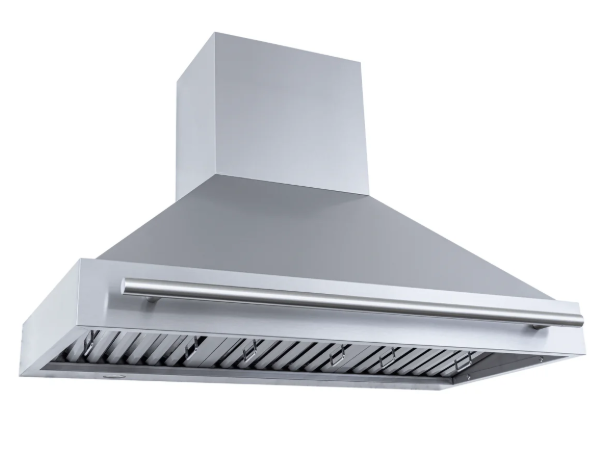
A well-ventilated kitchen is essential for maintaining comfort, cleaner air, and a more enjoyable cooking environment. When households cook frequently with high heat, smoke, steam, and grease can build up quickly, which is why professional range hoods are often considered a practical solution for stronger ventilation and wider coverage.
Understanding Professional-Style Ventilation
Range hoods are designed to remove smoke, airborne grease, heat, and odors from the cooking area, helping keep the kitchen cleaner and more comfortable during meal preparation. Professional-style models are generally built for more demanding cooking conditions and often include stronger airflow, stainless steel construction, LED lighting, and baffle filters that are easier to maintain than many basic alternatives.
These heavier-duty systems are especially useful in homes where cooking involves frying, searing, grilling, or using multiple burners at once. The goal is not only to clear smoke faster but also to reduce the amount of grease and moisture that settles on surrounding cabinets, walls, and ceilings over time.
Key Features That Matter
One of the most important differences in professional range hoods is airflow power. The referenced collection states that each model delivers over 900 CFM of airflow, with multiple models offering 1000, 1100, 1200, 1800, or even 2000 CFM, which can support kitchens that handle frequent high-heat cooking.
Construction quality also matters. The collection emphasizes stainless steel bodies, bright LED lighting, dishwasher-safe baffle filters, and balanced motors designed to reduce vibration and noise, all of which contribute to a more durable and practical ventilation setup for daily use.
Another valuable factor is flexibility in design. The same collection includes wall-mounted, island, and under-cabinet options in sizes such as 30, 36, 42, 48, 54, and 60 inches, allowing homeowners to match ventilation more closely to both the cooktop width and the kitchen layout.
Why Size and Coverage Are Important
Choosing the correct hood size is just as important as choosing airflow. A wider canopy generally improves the hood’s ability to capture rising smoke and grease before those particles spread into the rest of the kitchen, especially when cooking across several burners.
Depth is another factor that affects capture performance. Search results discussing larger pro-style hoods note that deeper hoods can cover more of the cooking surface and that stronger cooking setups often need both higher CFM and better capture area rather than just a powerful blower alone.
For homeowners using larger ranges or rangetops, professional range hoods with broader widths can help improve full-surface ventilation. This is especially relevant in kitchens designed around wider appliances, where undersized ventilation may leave outer burners less effectively covered during heavy cooking sessions.
Ducted and Ductless Options
Ventilation systems are commonly available in either ducted or ductless configurations. Ducted systems move smoke, heat, and odors outdoors, while ductless systems filter the air and circulate it back into the kitchen after treatment.
The referenced collection includes both ducted and ductless-compatible options, which can be helpful for homes with different installation limits. This flexibility matters because some kitchens are able to support outside venting, while others must rely on recirculation due to building structure or remodel constraints.
Maintenance and Everyday Use
Routine cleaning plays a major role in keeping kitchen ventilation effective. Stainless steel baffle filters are designed to trap grease while allowing strong airflow, and dishwasher-safe filters can make regular maintenance easier for households that cook often.
Noise level also influences long-term satisfaction. The collection highlights balanced motors and insulated construction meant to reduce vibration and support quieter operation even at higher fan speeds, which is especially useful in open kitchens where cooking and conversation happen in the same space.
In practical terms, professional range hoods are most beneficial when they match the cooking habits of the household. A powerful hood that fits the range properly, is cleaned consistently, and suits the kitchen layout will usually perform better than a model chosen only for appearance or raw airflow numbers.
Conclusion
Choosing the right ventilation system involves more than appearance, because airflow strength, hood size, filter design, and installation type all affect how well a kitchen handles smoke, grease, and heat. For larger cooktops or more demanding cooking routines, a 48 range hood can be a smart choice because it offers broader coverage and supports the stronger ventilation capacity often needed in high-use kitchens.
Comments
Log in or sign up to join the conversation.