
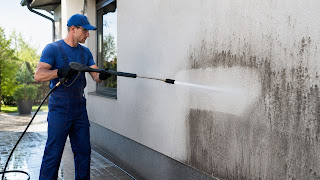
The debate between pressure washing & traditional cleaning methods comes down to one practical question - what are you trying to clean & how deeply does it need to be done? Scrubbing, mopping & chemical soaking have their place, but they have clear limitations when dealing with large exterior surfaces, embedded grime & biological growth. Pressure washing does not replace every traditional method, but on the right surfaces, it outperforms them in speed, consistency & long-term results.
Where Traditional Cleaning Falls Short
Manual scrubbing is labour-intensive & struggles with porous surfaces like concrete & brick where dirt sits below the surface layer. Chemical soaking alone can lift biological matter but leaves residue behind without a mechanical rinse. For large surface areas - commercial car parks, building exteriors, warehouse floors or long stretches of pathway - traditional methods are simply not scalable. The time & labour cost to achieve an equivalent result makes them impractical for most commercial & industrial applications.
What Pressure Washing Does Better
High-pressure water penetrates the pores of hard surfaces & flushes out compacted dirt, oil stains, mould, algae & mineral deposits that surface-level cleaning cannot reach. It works faster across large areas, requires fewer chemical inputs when used correctly & produces a more uniform result. On surfaces like concrete, clay pavers & brick, the difference between a pressure-washed finish as well as a hand-scrubbed one is visible immediately.
For urban environments with heavy pollution, traffic grime & biological growth accelerated by humidity, pressure washing in Brisbane has become a routine part of building & property maintenance rather than an occasional deep clean.
When Traditional Methods Still Win
Indoor surfaces, delicate materials & spaces where water control is difficult still favour traditional cleaning. Timber furniture, fabric surfaces, electronics-adjacent areas & food preparation zones require controlled chemical application & careful wiping rather than high-pressure water. Pressure washing in these contexts creates more problems than it solves.
The Hybrid Approach Most Professionals Now Use
Experienced operators rarely rely on one method exclusively. Pressure washing in Brisbane carried out by professional contractors typically combines high-pressure rinsing with pre-treatment chemicals, surface-appropriate pressure calibration & post-clean inspection. This hybrid approach addresses what pressure alone cannot - chemical contamination, rust staining as well as biological growth that needs to be killed rather than just removed.
Author Resource:-
David Alexander is an independent content writer specializing in property maintenance and cleaning service industries. With a strong focus on topics such as body corporate cleaning, house washing, industrial cleaning and strata property maintenance in Brisbane, David creates clear, informative and engaging content tailored for both businesses and homeowners. You can find his thoughts at professional cleaning blog.
Comments
Log in or sign up to join the conversation.