

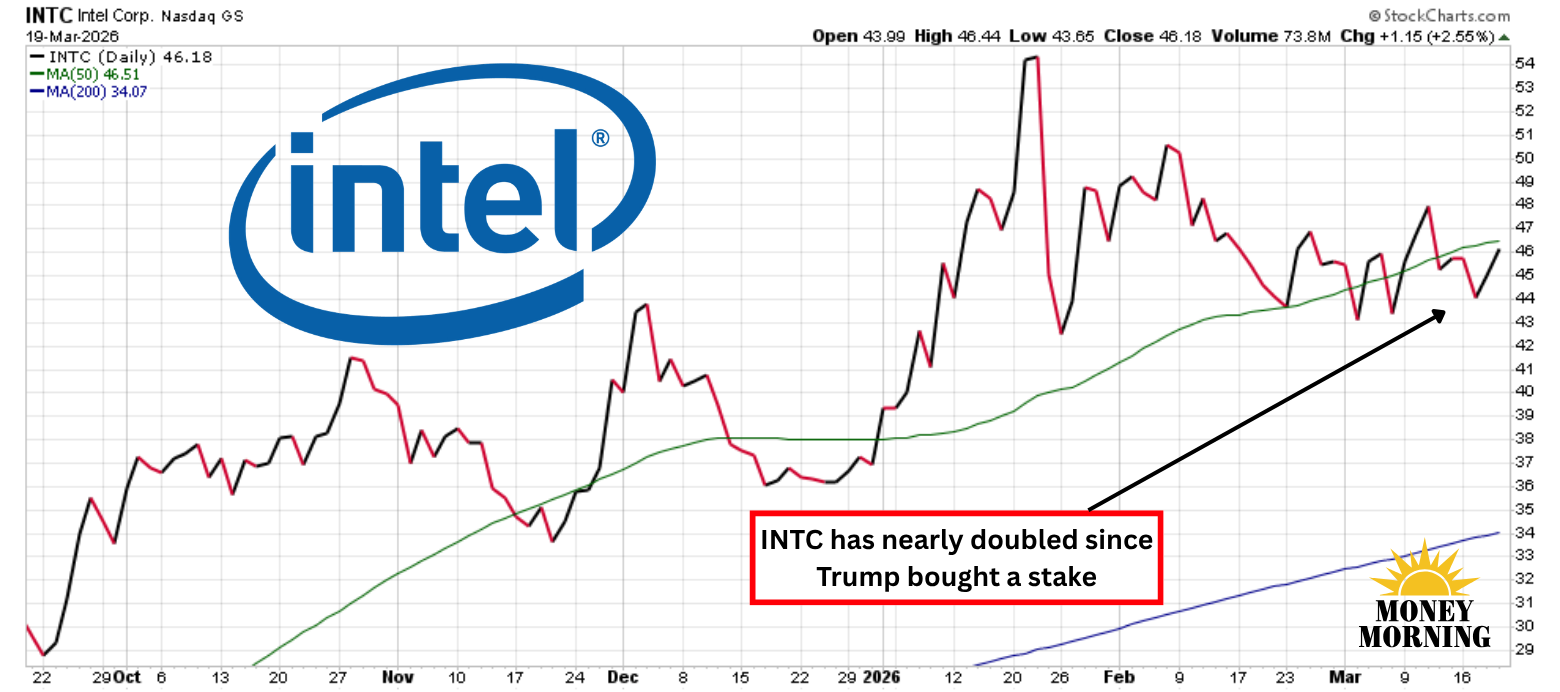
In an unprecedented strategy to fortify America's self-reliance in semiconductors and critical minerals, the Trump administration deployed billions in taxpayer funds through direct equity purchases and funding commitments during 2025 and early 2026. The goal: reduce dependence on adversarial nations, especially China, for technologies essential to defense, electric vehicles, and advanced computing. These moves shifted from traditional grants or loans to outright ownership stakes, signaling a more hands-on approach to national security.
The targeted companies include investments in rare earth minerals, semiconductors, lithium, and copper and zinc projects. To measure their real-world impact today, returns for each stock were calculated from the market close the day before the respective investment announcement through Thursday's closing prices. This pre-announcement baseline captures investor sentiment just prior to the government's involvement.
Stock | Pre-Investment Date Close | March 19, 2026 Close | Cumulative Return |
|---|---|---|---|
MP Materials (MP) | $30.03 (July 9, 2025) | $53.10 | +76.8% |
Intel (INTC) (INTC) | $23.50 (Aug. 21, 2025) | $46.18 | +96.5% |
Lithium Americas (LAC) (LAC) | $3.30 (Sept. 22, 2025) | $4.01 | +21.5% |
Trilogy Metals (TMQ) (TMQ) | $2.08 (Oct. 3, 2025) | $3.47 | +66.8% |
USA Rare Earth (USAR) (USAR) | $24.77 (Jan. 23, 2026) | $17.81 | -28.1% |
These results reveal a tale of divergence. Early momentum in rare earth and mining plays has moderated amid commodity cycles, project hurdles, and a risk-off environment created by the war in Iran and its impact on global oil supplies and prices, while broader market benchmarks have trailed many of these targeted holdings.
Yet one clear standout has emerged, turning federal backing into exceptional shareholder value.
Intel Dominates the Semiconductor Rally
Intel has delivered the strongest performance at +96.5%, nearly doubling the pre-investment price in under eight months. Several factors explain its edge. The massive equity conversion from CHIPS Act and defense grants provided not only capital but also strong validation, attracting follow-on investments from heavyweights such as Nvidia (NVDA) (NVDA), Microsoft (MSFT) (MSFT), and SoftBank (SFTBY). This capital fueled rapid progress on domestic foundries, positioning Intel at the heart of the AI and data-center boom that accelerated under reshoring policies and tariff protections.
The government acquired 433.3 million shares at $20.47 each on August 22, with the stock closing 2025 at $36.90 per share, an 80.3% gain from the purchase price. Year-to-date, Intel is up over 25% and is cumulatively 96.5% higher. In comparison, the S&P 500 has a return of just 3.7% from the time of the Intel purchase.
Unlike its mining counterparts – vulnerable to lithium price softness (LAC), permitting delays in remote projects (TMQ), or rare earth market swings and post-deal dilution (USAR and even MP) – Intel operates in a higher-margin, diversified semiconductor ecosystem with established scale. Its partnerships enable quick technology deployment in cutting-edge nodes, while government involvement reduced foreign reliance risks without the execution uncertainties plaguing junior.
Bottom Line
In short, Intel illustrates how strategic federal equity can catalyze established leaders in foundational tech, delivering outsized gains even as peers face sector-specific headwinds.
While past results do not guarantee future performance and regulatory or execution risks remain, the company's trajectory highlights the upside of aligning with Washington's supply-chain priorities. Intel remains a potential buy for long-term investors due to its forward price-to-earnings ratio of 48 and industry partnerships.



Comments
Log in or sign up to join the conversation.