
Source: Time
President Obama took the helm in 2009 amid the worst economy crisis of our lifetime. Banks had just received over $400 billion in TARP to help save them after wanton speculation and exposures to subprime mortgages, and bad real estate investments. The night he was formally announced as the new president the entire globe erupted with celebration. At the end of his second term Mr. Obama must now be his own cheerleader, proclaiming to the New York Times that he saved the U.S. economy:
To hear President Obama tell it, the U.S. economic recovery under his watch is a resounding success. He saved the banks, he saved the auto industry and he helped revive a moribund housing market.
“I actually compare our economic performance to how, historically, countries that have wrenching financial crises perform. By that measure, we probably managed this better than any large economy on Earth in modern history ... Anybody who says we are not absolutely better off today than we were just seven years ago, they’re not leveling with you,” said Obama, blaming Republicans in part for the failure of Americans to recognize how much the economy has improved. “They’re not telling the truth.”
Sure, U.S. GDP has grown steadily since the Financial Crisis of 2008/2009, but so has our debt; debt/GDP increased from 63% at the end of 2007 to 104% at the end of 2015. The rub is that most of the government spending has gone to support Wall Street, hedge funds and big business -- major donors of political campaigns -- at the expense of the labor class.
That wasn't the "hope and change" his supporters had envisioned during Mr. Obama's first campaign. According to the book, Shock Exchange: How Inner-City Kids From Brooklyn Predicted The Great Recession And The Pain Ahead, Mr. Obama's big idea to save the economy -- invest in infrastructure -- was not even his:
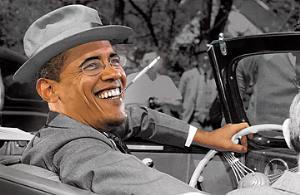
On November 23, 2008 the cover of the New York Times caught my eye ... The caption read, "Obama plays FDR in 2.5 million Jobs Plan; Pledges Building Blitz To Jump Start Economy." The key plan involved stimulating the economy while overhauling the country's infrastructure ... I chuckled at the article. Mr. Obama was trying to convince the world that the infrastructure idea had come to him through a seance with FDR ...
Ironically, FDR was known for Wall Street reform and breaking up the banks into commercial banks and investment banks ... For his efforts FDR was known as a traitor to his class -- the monied class -- by Wall Street sympathizers. Secondly, in giving the credit for his grand plan to FDR, an icon who the country revered, it struck me as an attempt to curry favor with white voters. "President Obama conveniently failed to mention the true source of his idea to invest in roads and bridges to spur the economy," I surmised.
While FDR was known for breaking up the banks the populace, including Senators Bernie Sanders Elizabeth Warren, have screamed for a return to Glass-Stegall. Not only has President Obama been oddly silent on the issue, bankers have not been jailed on his watch. The U.S. is the world's most-incarcerated country, yet bankers have not been brought to justice for securities crime committed amid the Financial Crisis. While FDR was considered a traitor to the monied class, income inequality has expanded during the Obama administration as a result of trillions in bailouts and quantitative easing enjoyed by the monied class.
With the benefit of hindsight, does anyone really believe Mr. Obama is a disciple of FDR? In my opinion, his claims of having saved the U.S. economy also ring of happy talk and wordsmithing.
Big Ticket Items Are A Mixed Bag
Big ticket items like housing starts and auto sales drive the economy. These two items' share of GDP is in the double-digits; by tracking them one can practically track GDP growth.
As Good As It Gets For Housing
Housing starts bottomed in 2009, yet have never reached the levels of 2006. Current starts have occurred amid record low interest rates which implies that it is as good as it gets for housing.
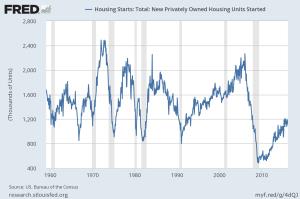
After all, rates can't fall from the floor and when they rise, it could dampen housing even further. Traditionally, demographics have driven housing. People between the ages of 26 - 30 tend to buy their first home. However, with millennials' buying power soaked up in student loans tied to the rising cost of college, they have little money to spend on housing. Until the cost of college is drastically reduced the outlook for housing is not pretty.
Auto Sales Driven To Growth In Credit
The bring spot for the U.S. economy has been auto sales. While overall rail shipments have been down, railroads have benefited from increasing shipments of auto-related equipment. U.S. manufacturing activity has been dismal, so the auto sales data almost defies logic. October 2015 auto sales achieved a seasonally annual adjusted rate of 18.1 million -- the most since July 2005.
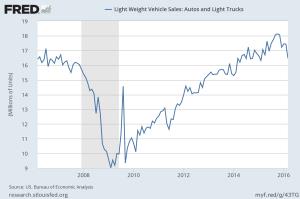
Americans bought more cars in 2015 than ever before. The catalysts have been attributed to pent up demand, low gas prices and easy credit. Last year auto loans hit $1 trillion for the first time ever. According to Fitch the rate of seriously delinquent car loans exceeded 5% -- the most since 1996. Not only does the boom in auto sales appear ethereal, subprime auto debt could help trigger the next economic contraction.
The Jobs Picture Is Dismal
Ultimately GDP growth triggers job growth. The unemployment rate is a lagging indicator; when businesses do well, hiring follows and vice versa. In March nonfarm payrolls grew by 215,000 which followed revised figures of 245,000 in the previous month. As importantly, average hourly earnings rose 2.3%. Over the past six years 14.4 million jobs have been created -- a figure the President touts as evidence that his economic policies have paid off.
The rub is that the labor participation rate was 63%, just up from 62.4% in September -- the lowest in nearly 40 years. Secondly, the lion's share of job growth has been in low-paying retail and service jobs. Those are the same occupations that tend to serve the wealthy -- those who have benefited most from Obama's policies -- and their leisure activities. High-paying manufacturing jobs appear to have eluded this so-called recovery; manufacturing lost 29,000 jobs in March -- the most since 2009. The data gives credence to the notion that the Obama administration has turned its back on the labor class. Furthermore, by tapping into labors' angst Donald Trump could become the next president.
In my opinion, the true output of the U.S. economy has been masked by record low interest rates. There has been only one rate hike in nearly a decade. There is even a school of thought that by keeping rates low and asset prices high, the Federal reserve is protecting the President. Until the Fed normalizes rates we may never know the true economic output of he economy. Such normalization may not occur until Mr. Obama leaves office, which makes his claims of having saved he economy ring hollow. While millions of Americans live paycheck to paycheck, in Mr. Obama's own words, hedge fund managers have become lottery winners during his regime. That will likely be his true legacy -- a loyalist to the monied class -- the complete opposite of FDR.



Comments
Log in or sign up to join the conversation.