

English spelling can sometimes be confusing, especially when two words look like they could both be correct. One common example is presentor vs presenter. Students may come across “presentor” while writing assignments, preparing presentations, or communicating online, while professionals may hesitate over the correct term when preparing reports, event materials, or workplace documents.
Although the two forms look similar, standard English uses presenter when referring to a person who gives a presentation, introduces information, or hosts a program. “Presentor” is generally considered a nonstandard spelling in modern English.
Understanding the difference can help students and professionals communicate more accurately and confidently.
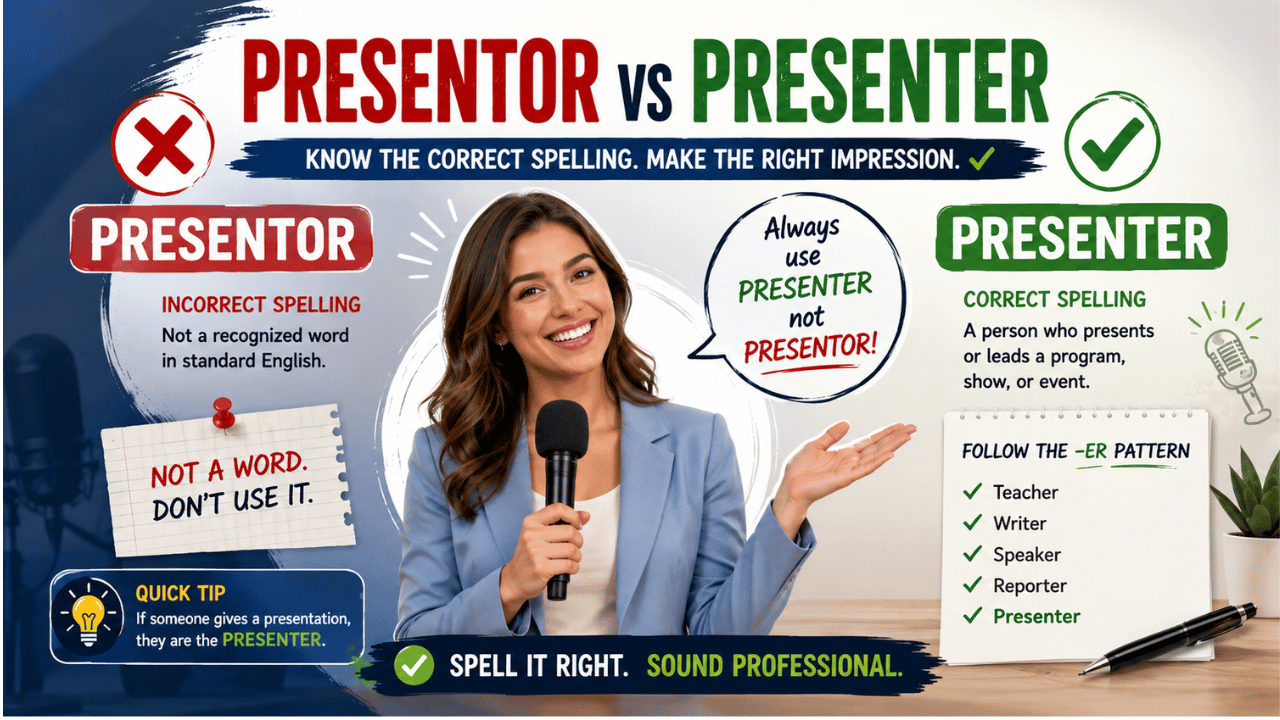
Presentor vs Presenter: Which Spelling Is Correct?
When choosing between presentor vs presenter, the standard English word is presenter.
A presenter is a person who presents something to an audience. This could be a student explaining a project, an employee presenting a business proposal, or a television personality hosting a program.
For example:
The presenter explained the research findings clearly.
Each student became a presenter during the final project.
The conference presenter answered questions from the audience.
She works as a television presenter.
“Presentor” may appear because English sometimes creates nouns by adding “-or” to verbs. However, that pattern does not mean every verb naturally takes the “-or” ending.
Why Do People Write “Presentor”?
The confusion usually comes from the way English forms nouns from verbs.
Words such as actor, creator, instructor, and administrator can make it seem reasonable to form “presentor” from the verb “present.” Someone may therefore assume that a person who presents should be called a “presentor.”
However, English word formation is not always completely predictable. Different words develop according to historical usage, pronunciation, and established language conventions.
In modern standard English, presenter is the accepted noun for someone who presents.
This makes the choice between presentor vs presenter relatively straightforward in academic and professional writing: use presenter.
What Does “Presenter” Mean?
The noun presenter generally describes someone who presents information or content to other people.
The word can be used in several situations.
A Person Giving a Presentation
In schools and universities, a presenter may be a student explaining a project, research paper, experiment, or group assignment.
For example:
The presenter discussed the results of the science experiment.
Here, “presenter” simply means the person responsible for speaking and explaining the material.
A Workplace Speaker
Professionals regularly give presentations during meetings, conferences, training sessions, and business events.
For example:
The presenter introduced the company's new marketing strategy.
The word works naturally in formal workplace communication and is suitable for reports, schedules, meeting documents, and event programs.
A Television or Radio Host
“Presenter” is also commonly used for people who host television or radio programs, particularly in British English.
For example:
The television presenter interviewed several guests during the program.
This meaning is different from someone giving a single presentation, but the basic idea remains the same: the person presents information or content to an audience.
Presentor vs Presenter in Academic Writing
Students frequently need to choose the correct terminology when writing essays, project reports, presentation notes, and academic documents.
Using presenter is the safer choice when referring to someone who gives a presentation.
Consider this sentence:
The presentor will explain the research methodology.
The standard form would be:
The presenter will explain the research methodology.
The second version follows conventional English usage and is more appropriate for formal academic work.
Students should also be consistent when writing presentation schedules. For example, a university program might list:
Presenter: Rahul Sharma
Topic: Renewable Energy Solutions
Time: 10:30 a.m.
Using “presenter” makes the role immediately clear.
Presentor vs Presenter in Professional Communication
The same distinction applies in the workplace.
Professionals may encounter the word when preparing:
Conference programs
Meeting agendas
Training schedules
Presentation slides
Event invitations
Business reports
For example, a conference schedule could include:
Presenter: Dr. Meera Kapoor
Session: Advances in Digital Marketing
Using the established form helps maintain a polished and professional appearance.
This is particularly important when documents are being shared with clients, colleagues, managers, or a wider audience.
Examples Using “Presenter” Correctly
Seeing the word in different sentences can make the distinction easier to remember.
Example 1:
The presenter started the seminar with a short introduction.
Example 2:
Our team selected Anika as the presenter for the final project.
Example 3:
The conference presenter used several charts to explain the findings.
Example 4:
The presenter answered questions after the session.
Example 5:
The event organizers introduced each presenter before the discussion.
In each example, presenter refers to a person who presents information to an audience.
Presenter vs Presentation
Another useful distinction is between presenter and presentation.
A presenter is the person who delivers or hosts the content.
A presentation is the content or activity being delivered.
For example:
The presenter prepared an engaging presentation.
Here, the presenter is the person, while the presentation is what that person prepared or delivered.
Understanding this relationship can make it easier for students to use both words correctly in academic writing.
Presenter vs Present
The word “present” itself can have several meanings in English.
As a verb, present can mean to give information or formally introduce something.
For example:
The students will present their findings tomorrow.
When we need a noun describing the person performing that action, the standard form is presenter.
So the basic relationship is:
Present → Presenter
This is the form students and professionals should normally use when referring to a person who gives a presentation.
Common Mistakes to Avoid
One of the easiest ways to avoid the presentor vs presenter mistake is to remember that familiar English patterns do not always determine the correct noun.
A verb ending in a particular sound does not automatically require an “-or” noun. Established usage matters.
Another common mistake is using “presentor” simply because it appears in online content. Search results, informal writing, user-generated content, and nonstandard English can contain spelling variations that are not considered standard.
For academic or professional writing, it is better to follow recognized English usage and choose presenter.
How to Remember the Correct Spelling
A simple way to remember the correct form is to connect presenter with the word presentation.
A person gives a presentation, so that person is the presenter.
You can also remember the common phrase:
“The presenter gives the presentation.”
This creates a useful mental connection between the person and the activity.
When in doubt, especially in formal writing, choose presenter rather than “presentor.”
Why Correct Spelling Matters
A single spelling mistake may not prevent someone from understanding a sentence, but repeated errors can affect the clarity and professionalism of written communication.
For students, accurate spelling can improve assignments, project reports, presentation materials, and academic correspondence.
For professionals, careful word choice can make emails, reports, proposals, event programs, and business documents appear more polished.
Correct spelling is particularly valuable when a word is being used as a job title or formal role. Writing Presenter on an event schedule or conference program follows standard usage and avoids unnecessary confusion.
Quick Comparison: Presentor vs Presenter
Word | Standard English Usage | Meaning |
Presenter | Yes | A person who presents information or hosts a program |
Presentor | Generally nonstandard | An uncommon/nonstandard alternative to “presenter” |
The difference is therefore mainly about standard usage. When writing for school, university, work, or other formal settings, presenter is the appropriate choice.
Final Thoughts
The question of presentor vs presenter is easy to resolve once standard English usage is clear. Presenter is the established spelling for a person who gives a presentation, delivers information, or hosts a program.
Although “presentor” may seem logical because English contains many nouns ending in “-or,” it is not the usual standard form for this meaning.
For students preparing assignments or presentations and professionals creating reports, event programs, or workplace documents, choosing presenter is the clearest and most conventional option.
When you need a noun for someone who presents, remember the simple connection: a person gives a presentation, and that person is the presenter.
Comments
Log in or sign up to join the conversation.