

Definition
Potting compounds, also known in the electronics industry as encapsulation materials or electronic glue, are polymeric formulations used to protect sensitive electronic components from a variety of environmental and mechanical challenges. These materials are generally thermosetting polymers that remain in a liquid state until they chemically cure, forming a rigid or semi-rigid protective structure. The process of potting involves filling the voids and cavities within electrical assemblies such as circuits, sensors, battery modules, connectors, transformers, and LED drivers to safeguard internal components permanently.
Get FREE Sample of this Report at https://www.intelmarketresearch.com/download-free-sample/13661/potting-compound-market
The fundamental functional properties of potting compounds include:
Waterproofing — preventing moisture ingress leading to corrosion or short circuits
Dustproofing & Chemical Resistance — ensuring longevity in harsh industrial atmospheres
Electrical Insulation — restricting cross-current leakage
Thermal Management — dissipating heat to avoid overheating in compact electronics
Mechanical Shock Resistance — absorbing vibrations in automotive and aerospace applications
High Confidentiality — preventing reverse engineering by concealing circuitry
Fire & Temperature Resistance — complying with stricter regulatory standards
These materials are engineered using a combination of resins (core matrix), hardeners, fillers, pigments, additives, and performance-enhancing materials. The type and formulation of potting compounds vary significantly depending on operating temperature, voltage, structural stability, curing time, and substrate compatibility.
✦ Industrial Importance
With continuous miniaturization in electronics, components are becoming denser and more heat-intensive. Potting compounds serve as a critical protective layer that ensures reliability, extends product life cycles, and prevents catastrophic failures, especially in:
High-frequency power electronics
Renewable energy storage and conversion
Automotive powertrains, ADAS systems & EV batteries
LED lighting with increasing lumens per watt output
Aerospace and defense electronics under extreme temperatures
✦ Lifecycle Benefits
Potting materials not only protect newly produced electronics but also enhance:
Product performance in mission-critical settings
End-user safety compliance in regulated markets
Sustainability, through longer product lifespans and reduced waste
Given accelerating adoption of digitalization, electrification, IoT, and renewable energy technologies, potting compounds have transitioned from auxiliary materials to essential functional enablers in modern innovation ecosystems.
Market Size
The global potting compound market is expanding steadily and is fundamentally linked to the growth of the global electronics manufacturing industry.
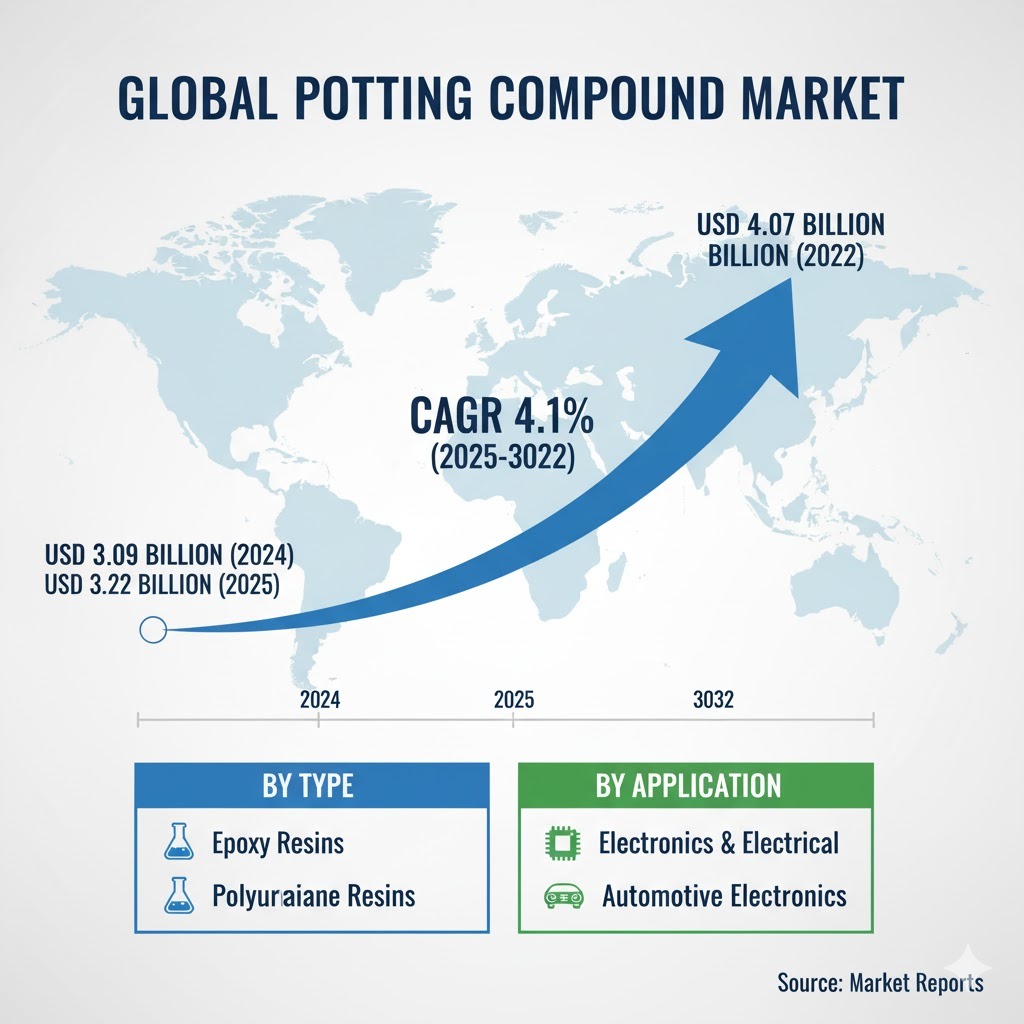
CAGR (2025–2032): 4.1%
The consistency in market expansion reflects growing safety standards and technical requirements placed on electrical systems used in automotive, industrial automation, health devices, and communication infrastructure.
Historical Drivers
1 Consumer Electronics Proliferation
Smartphones, laptops, home appliances, and wearable technology rely on miniaturized circuits requiring stronger environmental protection.
2 Automotive Industry Electrification
EV sales continue to rise sharply, contributing to high-value opportunities for resin-based potting materials in:
High-voltage wiring harnesses
Battery management systems
Motors & power control modules
Charging infrastructure electronics
EV growth rate globally: 25% yearly increase on average, requiring higher heat-resistant compounds.
3 Global Renewable Energy Deployment
Electronics used in inverters, power converters, and grid-connected systems must withstand:
Outdoor radiation
Long-term temperature cycling
Dust, water & corrosive gases
Investments in green power exceeding USD 1.8 trillion annually support potting compound demand.
Get the Complete Report & TOC at https://www.intelmarketresearch.com/materials-and-chemicals/13661/potting-compound-market
Market Economics & Investment Trends
Manufacturers increasingly shift toward high-performance systems tailored to:
Elevated voltage requirements
Flame retardancy (UL94 V-0 standard)
Lightweight and sustainable formulations
There is notable investment in:
Silicone-based compounds for thermal stability
Epoxy resins for adhesion and chemical durability
Bio-based compounds aligned with ESG initiatives and regulatory pressure
The industry is expected to transition toward high-margin specialized segments driven by IoT, smart manufacturing, and electric mobility.
Asia-Pacific — Market Leader
APAC’s leadership is anchored by:
China’s position as the largest electronics manufacturing destination
Expanding semiconductor ecosystem in Taiwan, South Korea, Japan
Heavy adoption in Indian EV and telecommunications sectors
Government-backed programs promoting domestic electronics boost volume consumption.
Europe — Strong Regulatory-Driven Demand
European industries emphasize:
High reliability components
Sustainability compliance
Automotive and industrial automation growth
Germany leads transformations in Industry 4.0, influencing advanced potting systems.
Get the Complete Report & TOC at https://www.intelmarketresearch.com/materials-and-chemicals/13661/potting-compound-market
North America — Technology & Defense-driven Innovation
Demand comes from:
Advanced computing
Aerospace & defense electronics
Electric vehicle penetration
High-power grid components
Competitor Analysis
The competitive landscape is moderately fragmented, with top players holding ~28% market share.
Differentiation increasingly depends on:
Higher thermal management demand in EV and power systems
Customized formulations for OEM-specific performance criteria
Smart manufacturing adoption that reduces curing times and energy usage
Global Potting Compound Market: Market Segmentation Analysis
This report provides a deep insight into the global Potting Compound Market, covering all its essential aspects. This ranges from a macro overview of the market to micro details of the market size, competitive landscape, development trend, niche market, key market drivers and challenges, SWOT analysis, value chain analysis, etc.
The analysis helps the reader to shape the competition within the industries and strategies for the competitive environment to enhance the potential profit. Furthermore, it provides a simple framework for evaluating and assessing the position of the business organization. The report structure also focuses on the competitive landscape of the Global Potting Compound Market. This report introduces in detail the market share, market performance, product situation, operation situation, etc., of the main players, which helps the readers in the industry to identify the main competitors and deeply understand the competition pattern of the market.
In a word, this report is a must-read for industry players, investors, researchers, consultants, business strategists, and all those who have any kind of stake or are planning to foray into the Potting Compound Market in any manner.
Market Segmentation (by Application)
Electronics & Electrical
Automotive Electronics
Renewable Energy Systems
Industrial Equipment
Aerospace & Defense
Market Segmentation (by Type)
Epoxy Resins
Polyurethane Resins
Silicone-based Compounds
Polyurethane Elastomers
Key Company
Henkel AG & Co. KGAA
Dow Chemical Company (Dow Corning)
Shin-Etsu Chemical Co. Ltd.
Momentive Performance Materials Inc.
Electrolube (HK Wentworth Ltd.)
CHT Group
Nagase & Co. Ltd.
H.B. Fuller Company
Wevo-Chemie GmbH
Elkem Silicones
Wacker-Chemie AG
Huitian New Materials Co. Ltd.
Huntsman Advanced Materials
Elantas GmbH
Lord Corporation
Geographic Segmentation
North America
Europe
Asia-Pacific
Latin America
Middle East & Africa
FAQ Section
1 What is the current market size of the potting compound market?
USD 3.09 billion in 2024.
2 What is the forecast revenue of the market by 2032?
USD 4.07 billion with a CAGR of 4.1%.
3 Which regions dominate the market?
Asia-Pacific is the largest, followed by Europe and North America.
4 Who are the key companies in the market?
Henkel, Dow Inc., Shin-Etsu Chemical, Momentive, H.B. Fuller, and others.
5 What drives the market growth?
EV adoption, electronics production, renewable energy investments, miniaturization, and rising reliability standards.
6 What are the key application areas?
Electronics, automotive, industrial equipment, renewable energy, aerospace & defense.
7 What are emerging trends in the market?
High-thermal conductivity potting systems, environment-friendly formulations, and smart curing technologies.
Get the Complete Report & TOC at https://www.intelmarketresearch.com/materials-and-chemicals/13661/potting-compound-market
About Us
Intel Market Research is a leading provider of strategic intelligence, offering actionable insights in information technology, digital media solutions, and communication infrastructure. Our research capabilities include:
Real-time competitive benchmarking
Global technology adoption monitoring
Country-specific regulatory and market analysis
Over 500+ technology reports annually
Trusted by Fortune 500 companies, our insights empower decision-makers to drive innovation with confidence.
🌐 Website: https://www.intelmarketresearch.com
📞 International: +1 (332) 2424 294
📞 Asia-Pacific: +91 9169164321
🔗 LinkedIn: Follow Us
Comments
Log in or sign up to join the conversation.