

Good Monday – err, Tuesday morning and welcome back. Since it’s the start of a new week, let’s get right to our objective review the key market models and indicators. The primary goal of this exercise is to remove any subjective notions and ensure that we stay in line with what “is” happening in the markets. So, let’s get started…
The State of the Trend
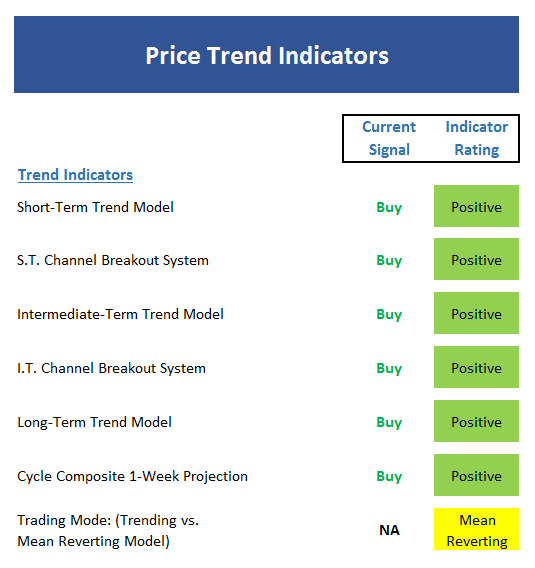
We start each week with a look at the “state of the trend.” These indicators are designed to give us a feel for the overall health of the current short- and intermediate-term trend models.
(Click on image to enlarge)
Executive Summary:
- The short-term Trend Model flipped to positive last week with the modest breakout to new highs. The test will be whether the move can be sustained.
- The break to new highs produced a buy signal on the short-term Channel Breakout System
- The intermediate-term Trend Model is still in good shape
- The intermediate-term Channel Breakout System is also positive
- No surprise here… The long-term Trend Model is positive
- The Cycle Composite points higher for the better part of the next two months.
- The Trading Mode models remain unconvinced and suggest the current trend is not strong.
- The bottom line is the current break is unimpressive so far.
The State of Internal Momentum
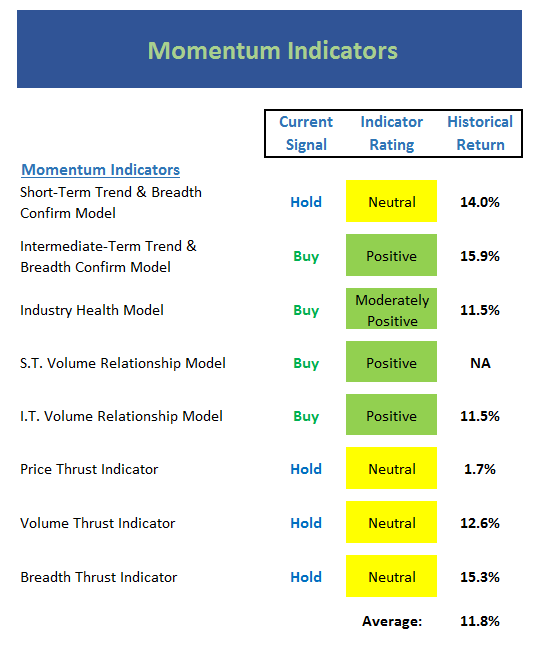
Next up are the momentum indicators, which are designed to tell us whether there is any “oomph” behind the current trend…
(Click on image to enlarge)
Executive Summary:
- It is surprising to see the short-term Trend and Breadth Confirm Model neutral here – this “should” be positive with S&P at new highs.
- However, the intermediate-term Trend and Breadth Confirm Model is positive – albeit by a slim margin.
- The Industry Health Model has improved – but also by a very slim margin. And frankly, the moderately positive reading is a bit misleading.
- The short-term Volume Relationship flipped to positive last week. But as you might guess by now, the move into the green zone is by the skinniest of margins..
- The intermediate-term Volume Relationship remains positive.
- The Price Thrust Indicator improved to neutral this week.
- There is no change in the Volume Thrust Indicator – still stuck in neutral
- The Breadth Thrust Indicator is also unimpressed so far with the recent move to new highs.
- The takeaway from this board is there is little “oomph” behind the current move at this time.
The State of the “Trade”
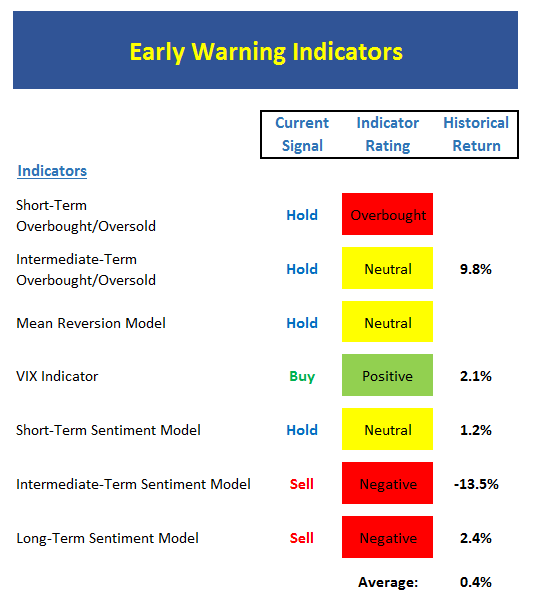
We also focus each week on the “early warning” board, which is designed to indicate when traders may start to “go the other way” — for a trade.
(Click on image to enlarge)
Executive Summary:
- From a near-term perspective, stocks are once again in an overbought condition – but a sell signal has not been given.
- From an intermediate-term view, stocks are neither overbought or oversold
- The Mean Reversion Model is neutral but closing in on sell signal territory
- The VIX Indicator is on a buy signal – however, the signal strength is waning quickly.
- From a short-term perspective, market sentiment is back to neutral and no longer a tailwind for the bulls.
- The intermediate-term Sentiment Model remains negative
- Longer-term Sentiment readings remain overly optimistic – a negative.
The State of the Macro Picture
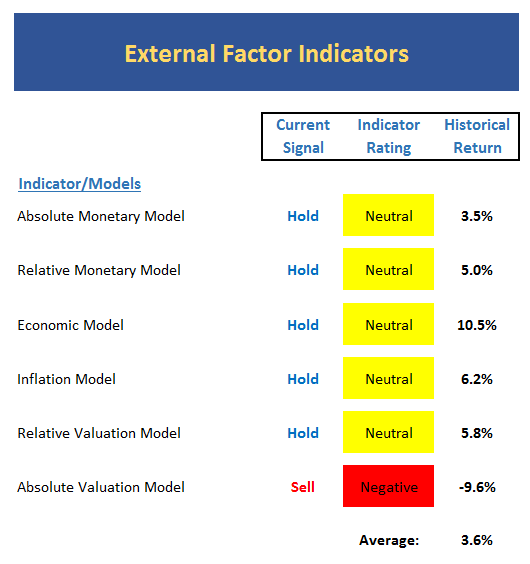
Now let’s move on to the market’s “external factors” – the indicators designed to tell us the state of the big-picture market drivers including monetary conditions, the economy, inflation, and valuations.
(Click on image to enlarge)
Executive Summary:
- Absolute Monetary conditions are improving within the neutral zone
- Our model measuring monetary conditions relative to conditions remains neutral
- After being out of sync for some time, our Economic Model (designed to call the stock market) is trying to get back in the game and has improved to neutral.
- The Inflation Model, which has done a fine job of “calling” the inflationary environment, continues to slide in the neutral zone
- Our Relative Valuation Model remains neutral but has upticked slightly in response to the recent uptick in earnings
- The Absolute Valuation Model remains negative, but has also improved slightly due to earnings
The State of the Big-Picture Market Models
Finally, let’s review our favorite big-picture market models, which are designed to tell us which team is in control of the prevailing major trend.
(Click on image to enlarge)
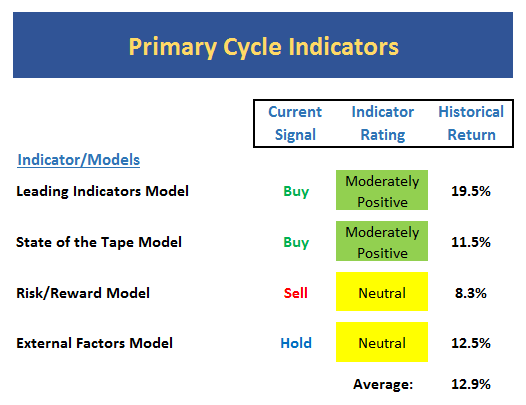
Executive Summary:
- The Leading Indicators model, which did a fine job during the last bear phase, has flipped back to a buy signal. But… again… only by the slimmest of margins.
- The Tape Model has improved ever so slightly
- The Risk/Reward model remains on a sell signal with a neutral reading. Note that the sell signal may have been influenced by the model’s monetary indicators.
- The External Factors model improved to neutral recently.
The Takeaway…
If you read through the bullet points on each indicator board this week, a theme should have become apparent. In short, while the big three indices are either at or near all-time highs, and the indicator readings have improved accordingly, the margin of improvement in terms of both price and the model readings is minimal. While the bulls definitely have time to correct this condition, it is something worth noting. In addition, the bulls no longer have the tailwinds of an oversold condition and negative short-term sentiment. And with the political minefield relating to Russia likely returning to the news cycle in the coming weeks, it might be a good idea to keep the champagne on ice for a while longer yet and make the bulls show us some oomph before getting too excited.
Thought For The Day:
The truth does not cease to exist when it is ignored…
Current Market Drivers
We strive to identify the driving forces behind the market action on a daily basis. The thinking is that if we can both identify and understand why stocks are doing what they are doing on a short-term basis; we are not likely to be surprised/blind-sided by a big move. Listed below are what we believe to be the driving forces of the current market (Listed in order of importance).
1. The State of Trump Administration Policies
2. The State of the U.S. Economy
3. The State of Earning Season
4. The State of World Politics



Comments
Log in or sign up to join the conversation.