

The global Portland Cement Price market witnessed mixed regional movements during the first quarter of 2026 as inflation, energy prices, construction demand, and industrial production costs continued to influence market fundamentals. While North America and Europe experienced upward pricing pressure due to elevated production costs and inflationary trends, the Asia-Pacific region recorded softer prices amid weak real estate demand and slowing construction activity.
According to ChemAnalyst Portland Cement Price: - https://www.chemanalyst.com/Pricing-data/portland-cement-2286
Portland cement remains one of the most essential construction materials globally, supporting infrastructure development, commercial projects, housing, transportation networks, and industrial expansion. As governments worldwide continue investing in urbanization and infrastructure modernization, tracking the Portland Cement Price Trend has become increasingly important for manufacturers, contractors, procurement teams, and investors.
What is Driving the Portland Cement Price in 2026?
Several macroeconomic and industry-specific factors influenced the Portland Cement Price Index during Q1 2026. Key drivers included:
Rising producer inflation
Escalating fuel and electricity costs
Slowing real estate activity in China
Construction sector demand recovery
Supply chain and freight cost fluctuations
Industrial production costs
Infrastructure spending policies
Since cement manufacturing is highly energy-intensive, fluctuations in coal, electricity, petroleum coke, and natural gas prices directly affect production economics. Additionally, transportation costs remain critical because cement is bulky and expensive to transport over long distances.
North America Portland Cement Price Trend
United States Portland Cement Prices Rise Amid Inflationary Pressures
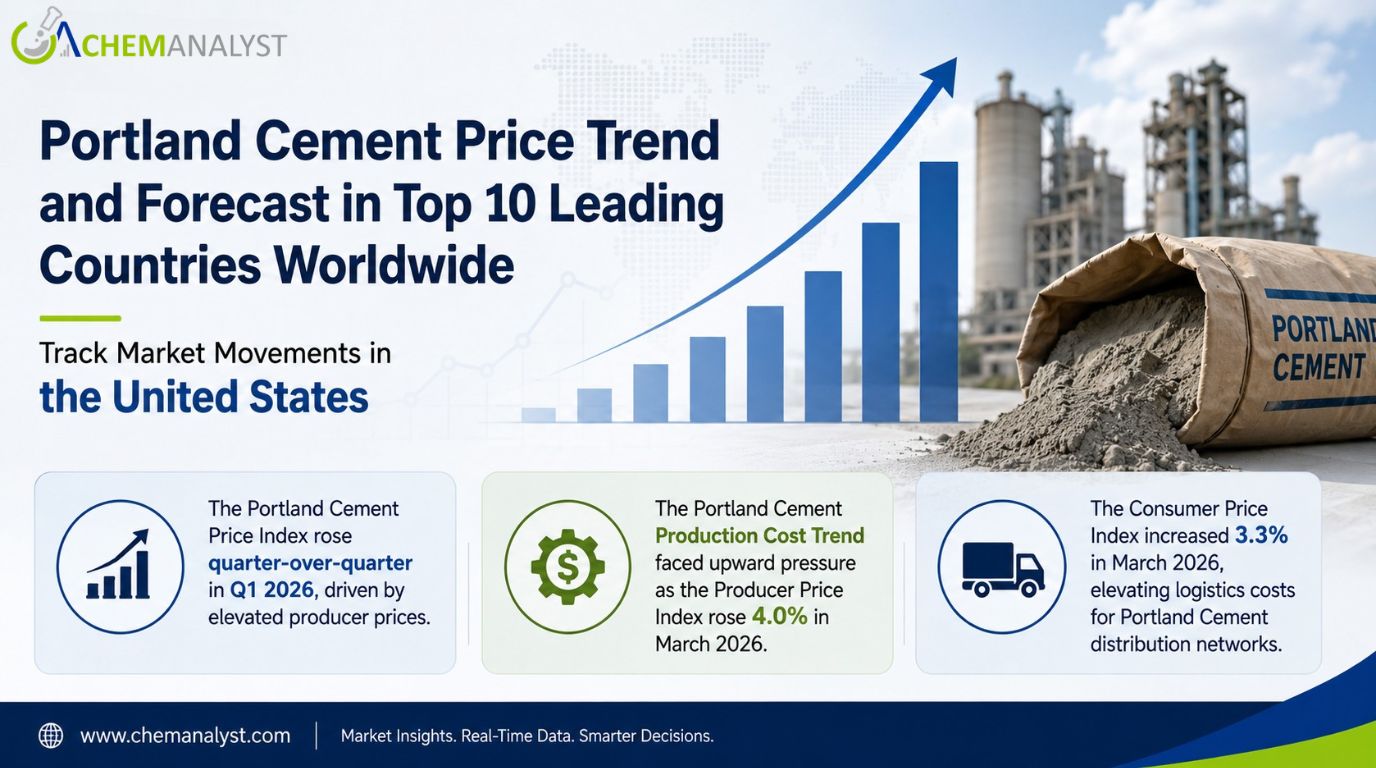
In North America, the United States recorded a quarter-over-quarter increase in the Portland Cement Price Index during Q1 2026. The market remained supported by elevated producer prices and continued infrastructure-related demand.
The Portland Cement Production Cost Trend in the U.S. moved upward as the Producer Price Index (PPI) increased by 4.0% in March 2026. Rising labor expenses, transportation charges, and fuel costs significantly affected cement manufacturing economics across the country.
The U.S. construction industry continued to benefit from public infrastructure investments, including highway modernization projects, commercial developments, and industrial construction activities. These projects maintained healthy procurement activity for cement suppliers despite broader inflationary concerns.
Additionally, higher energy prices contributed to rising kiln operation costs, particularly for manufacturers dependent on fossil fuel-intensive production methods. Cement producers also faced elevated maintenance and logistics expenses during the quarter.
Key Factors Affecting U.S. Portland Cement Prices
Rising Producer Price Index
Higher fuel and electricity expenses
Strong infrastructure spending
Increased transportation costs
Stable construction sector demand
Market analysts expect Portland Cement Prices in the United States to remain firm in the upcoming quarters if infrastructure investments continue and energy prices stay elevated.
APAC Portland Cement Price Analysis
China Portland Cement Prices Decline Due to Weak Real Estate Demand
In the Asia-Pacific region, China witnessed a decline in the Portland Cement Price Index during Q1 2026. The primary reason behind the downturn was weakening real estate demand and reduced construction activity across several provinces.
China’s property sector slowdown continued to negatively impact cement consumption levels. Residential and commercial construction projects remained subdued, reducing procurement requirements for major cement producers.
Although China’s Consumer Price Index (CPI) rose by 1.0% in March 2026 and the Producer Price Index increased by 0.5%, these inflationary indicators were not sufficient to offset declining demand fundamentals.
Manufacturers faced growing pressure from lower order volumes, increased competition, and excess production capacity. As a result, many producers adopted aggressive pricing strategies to maintain market share and inventory turnover.
Read the LinkedIn Article : - https://www.linkedin.com/pulse/portland-cement-price-trends-2026-energy-costs-inflation-singh-wutdc/
Key Factors Affecting China Portland Cement Prices
Weak real estate market activity
Reduced infrastructure construction demand
Rising factory-gate costs
Lower industrial procurement volumes
Competitive pricing among manufacturers
Despite short-term price weakness, analysts believe future government stimulus measures targeting infrastructure development could help stabilize China’s cement market later in 2026.
Europe Portland Cement Market Developments
Germany Portland Cement Prices Increase on Energy Cost Surge
In Europe, Germany reported a quarter-over-quarter rise in the Portland Cement Price Index during Q1 2026. The market was heavily influenced by escalating energy prices and persistent inflationary pressure.
Germany’s cement industry experienced higher operational costs as electricity and fuel prices remained elevated throughout the quarter. Since cement production relies heavily on high-temperature kiln operations, energy market volatility significantly affected manufacturing expenses.
In March 2026, Germany’s inflation rate reached 2.7%, contributing to higher input costs across industrial sectors. Cement producers also encountered increased logistics and raw material procurement expenses.
European environmental regulations and decarbonization initiatives further added compliance-related costs for cement manufacturers. Many producers invested in cleaner production technologies and emission-reduction systems, increasing operational expenditures.
Key Factors Affecting Germany Portland Cement Prices
Rising electricity and natural gas costs
Inflationary pressure across manufacturing sectors
Higher logistics expenses
Environmental compliance investments
Stable infrastructure and industrial demand
Industry experts anticipate that European Portland Cement Prices may continue experiencing volatility depending on regional energy market stability and industrial production trends.
Global Portland Cement Market Size and Industry Overview
The global cement industry remains one of the largest industrial sectors worldwide, supporting infrastructure, housing, and industrial expansion. Portland cement accounts for the majority of cement consumption due to its extensive application across construction projects.
Key application sectors include:
Residential construction
Commercial real estate
Industrial facilities
Roads and highways
Bridges and transportation infrastructure
Smart city projects
Renewable energy infrastructure
Rapid urbanization in emerging economies continues supporting long-term cement demand growth despite short-term economic uncertainties.
Governments worldwide are increasingly investing in public infrastructure to stimulate economic growth, which is expected to create sustained demand for Portland cement in the coming years.
Portland Cement Production Cost Trend
The Portland Cement Production Cost Trend remained elevated globally during Q1 2026 due to rising energy prices, labor costs, and transportation expenses.
The primary cost components in cement manufacturing include:
Energy Costs
Energy represents one of the largest expenses in cement production. Coal, petroleum coke, electricity, and natural gas price fluctuations directly affect manufacturing economics.
Raw Material Costs
Limestone, clay, gypsum, and other additives influence overall production expenses. Mining, extraction, and transportation costs also impact profitability.
Freight and Logistics
Cement transportation costs increased globally due to fuel price volatility and higher trucking charges.
Environmental Compliance
Decarbonization policies and emission reduction targets continue increasing operational investments for cement producers worldwide.
Construction Industry Demand and Portland Cement Prices
Construction activity remains the single largest driver of Portland Cement Price fluctuations globally.
Residential Construction
Housing demand strongly affects cement consumption patterns, particularly in emerging economies.
Infrastructure Development
Government-funded infrastructure projects significantly support cement procurement volumes.
Industrial Expansion
Manufacturing plants, warehouses, and logistics hubs continue driving cement demand in industrial regions.
Commercial Real Estate
Office buildings, retail complexes, and hospitality projects contribute to steady cement consumption.
Portland Cement Price Forecast for 2026
Industry analysts expect mixed regional pricing patterns throughout the remainder of 2026.
North America Outlook
Prices are likely to remain elevated due to:
Strong infrastructure investment
Rising labor costs
Inflationary pressure
Stable construction demand
APAC Outlook
China’s market may remain under pressure unless significant real estate stimulus measures are introduced.
Europe Outlook
European prices could remain volatile depending on:
Energy market conditions
Inflation trends
Environmental regulations
Industrial production recovery
Global supply-demand fundamentals, geopolitical developments, and fuel price movements will continue shaping the Portland Cement Price Forecast throughout the year.
Sustainability Trends in the Cement Industry
Sustainability has become a major focus area for global cement manufacturers. Companies are increasingly investing in:
Low-carbon cement technologies
Alternative fuels
Carbon capture systems
Renewable energy integration
Green construction materials
Environmental regulations are expected to reshape future production economics and pricing structures across the cement sector.
The transition toward sustainable cement production may increase operational costs in the short term but could improve long-term efficiency and environmental performance.
Key Takeaways on Portland Cement Price Trends
The Portland Cement Price market displayed notable regional divergence during Q1 2026.
The United States experienced price growth due to elevated producer inflation and infrastructure demand.
China recorded declining prices amid weak real estate activity and reduced construction demand.
Germany witnessed rising prices driven by surging energy costs and inflation.
Moving forward, global cement pricing will remain highly sensitive to energy markets, infrastructure investments, environmental regulations, and macroeconomic conditions.
For procurement professionals, contractors, investors, and manufacturers, monitoring regional Portland Cement Price Trends and Production Cost Trends will remain critical for strategic planning and market positioning throughout 2026.
Contact US:
Email-Id: - [email protected]
Contact No: - +1 (332) 258-6602
Address: - 420 Lexington Avenue, Suite 300
New York, NY
United States, 10170
Comments
Log in or sign up to join the conversation.