

The government’s tax proposals are to remove some unfairness in the tax system and are to be neutral to the budget: lower revenues from personal income taxes are to be offset by higher ones from corporate income taxes. But fiscal neutrality is not a remedy for an excessive 7% of GDP fiscal deficit, and financial markets are aware of it
Government’s tax proposals for 2027
At yesterday’s press conference, Prime Minister Donald Tusk and Finance Minister Andrzej Domański presented the following proposals for tax changes in Personal Income Tax (PIT) and Corporate Income Tax (CIT):
The first PIT threshold subject to the 12% rate is to be increased from PLN 120,000 to PLN 130,000.
A new 24% tax rate is to be introduced for income between PLN 130,000 and PLN 150,000, while income exceeding PLN 150,000 will continue to be taxed at 32%.
The so-called solidarity levy on income above PLN 1 million is to be increased from 4% to 5%.
The CIT rate for companies with annual revenues exceeding €50 million, as well as for tax capital groups, is to go up from 19% to 22%. The new rate will be close to the current EU average.
The revenue threshold for businesses using the lump-sum tax regime is to be reduced from the current €2 million to €250,000 from 2027 onwards.
Prime Minister Tusk said that the general government deficit must not exceed 7% of GDP in 2027. Being asked about the 2023 election promise to increase the tax-free allowance in PIT from PLN 30,000 to PLN 60,000, Tusk said that increasing it before 2028 was unlikely, although the government had not abandoned the idea. Minister of Finance and Economy Andrzej Domański gave his reassurance that the proposed measures are intended to be fiscally neutral. Both the PM and MinFin explained that the PIT changes are crafted to make the tax burden fairer.
Who is to gain, who is to lose
The main beneficiaries of the proposed PIT changes will be middle-income households, while large companies will bear additional costs through higher CIT. The changes are expected to affect 3.5 million taxpayers, generating annual savings of up to PLN 3,600 per taxpayer. Higher-income households and big companies will bear the associated fiscal cost.
Our opinion on the economic effects
A positive aspect of the proposals is that they are designed not to generate any additional deficit, demonstrating that the government recognises the lack of fiscal space for further widening of the budget imbalance. In the superficial public debate during recent weeks, some proposals were alarming – they were counted in tens of PLN billion. Hence, the minimum condition to assure fiscal stability was met.
However, the downside is that the authorities continue to postpone unpopular decisions regarding the necessary consolidation of public finances, resulting in the continued rapid accumulation of public debt. So, the sufficient conditions to exit from the excessive deficit were not met, and in contrast to the announced medium-term fiscal path from this spring, fiscal consolidation is not envisaged from 2027 onwards. A deficit of 7% of GDP is not an appropriate benchmark to show this effort. Rather, we believe a 3% of GDP deficit threshold in the EU is a more adequate yardstick for comparisons.
On the structural side, in our view, the increase in the CIT rate will have a negative impact on the valuations of Polish companies and may discourage medium-sized businesses from scaling up their operations. Higher CIT will also reduce the attractiveness of Poland for foreign capital and may even encourage some investors to reduce their exposure to the country. Also, Polish businesses may be more inclined to shift operations to places where corporate taxes are lower.
Overall, the proposed tax changes appear more appropriate for a country with a sound fiscal position, to avoid distortions and improve justice, yet they do not address the problem of the excessive general government deficit, which is to be the highest in the EU this year. The head of the Fiscal Council, Sławomir Dudek, commented that the neutrality of the new tax package is preferable to making further unfunded promises. But he stressed that any additional budget revenues should not be distributed immediately given that the deficit is excessive.
Financial market reaction
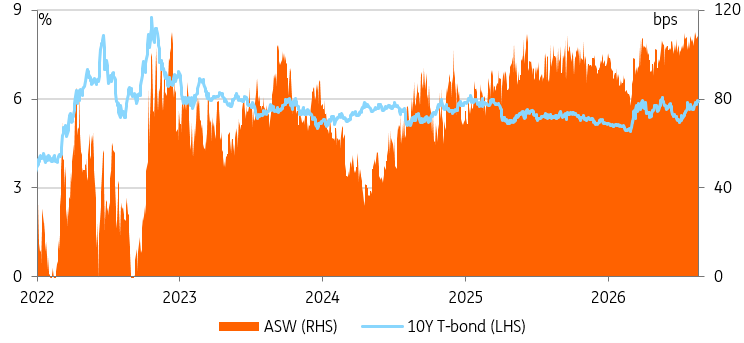
Financial markets are now awaiting the draft budget bill for the next year, due later this month. In our opinion, any further deterioration in the fiscal outlook would be met with a negative reaction in the domestic bond market and upward pressure on T-bond yields. A budget-neutral tax package did not trigger such a reaction. Nevertheless, Poland’s 10Y bond yields remain at elevated levels, similar to those in May this year, but due to different reasons (not because of expectations of higher interest rates).
Naturally, global factors on core fixed-income markets have added to the pressure on the Polish T-bonds market in recent weeks. However, domestic factors play a role too. Fiscal risks in Poland have been priced in already from late 2022, but the credit spread between 10Y bonds and 10Y IRS recently widened to even 109 basis points. Investors do not expect any meaningful fiscal consolidation to start in Poland before the general elections in autumn 2027, but a major fiscal adjustment will become an urgent and strategic task for the new government.
Polish 10Y T-bond yield (in %) and credit spread (in bp)



Comments
Log in or sign up to join the conversation.