


September’s data highlights Poland’s K-shaped economy: resilient industry contrasts slumping construction and weakness in sectors exposed to Asian competition. Hopes for an investment rebound are fading, while wage pressures remain moderate despite higher inflation. Producer price increases remain largely energy-led, with limited spillover
Higher inflation has a limited impact on wage growth.
Average wages in Poland rose by 5.9% year-on-year in September, up from 5.6% in August; both our forecast and consensus expected 6.0%. Volatile sectors drove the acceleration: agriculture, forestry, hunting and fishing rebounded to 6.8% from -11.9%, while mining and quarrying rose to 1.8% from -1.7%.
Underlying wage pressures are better reflected in services, where growth remained broadly stable. Accommodation and food services recorded 5.6% YoY versus 5.1% in August, transportation and storage 5.9% versus 6.0%, and information and communication 6.6% versus 7.1%.
Moderate services wage pressures limit the risk of entrenched services inflation and support gradual core disinflation. Manufacturing wage growth was also stable at 5.6% YoY, versus 5.5% in August.
Continued decline in corporate sector employment
Average employment fell by 0.8% YoY in September, matching both our forecast and consensus. Jobs declined by 7k from August to 6,360k and by almost 50k over 12 months. Most major sectors recorded declines, led by mining and quarrying (-9.1%) and professional, scientific and technical activities (-2.1%). Accommodation and food services grew by 2.0%.
The persistent decline partly reflects retirements not being fully offset by new labour market entrants. However, corporate sector data mainly covers firms employing at least 10 people. Changing employment arrangements and the growing role of foreign workers complicate interpretation, with these figures showing steeper declines than economy-wide data.
September’s labour market data confirms gradually easing wage pressures, with no clear inflation pass-through despite elevated and partly energy-driven price growth.
Construction slumps in September
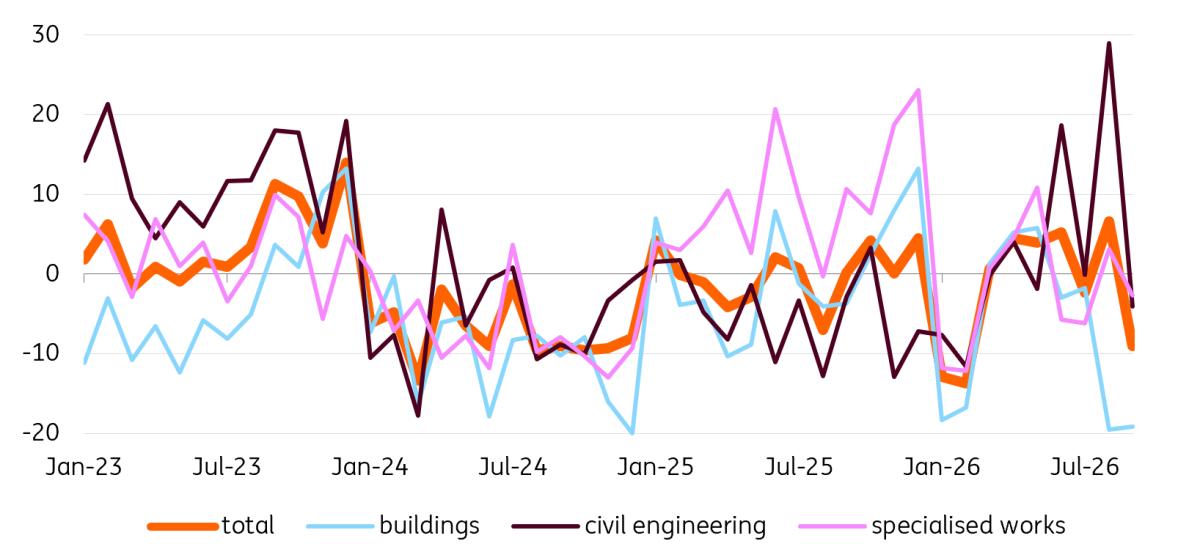
Construction output fell by 9% YoY, versus August’s 6.6% growth, our 2.7% forecast and the 3.4% consensus. Following August’s National Recovery Plan (NRP) grant milestone deadline, civil engineering fell by 4.1%, after 29% growth. Specialised construction declined by 2.7%, versus 3.1% growth. Buildings and structures fell by 19.2%, following a 19.5% decline in August, as residential construction continued to face an oversupply of unsold homes.
The data tempers hopes of a strong investment rebound in the second half of 2026. We still forecast 7.8% investment growth in 2026 and, following the CSO’s upward national accounts revision, 3.7% GDP growth. Investment’s contribution should remain solid, but the recovery looks moderate as the temporary NRP and Recovery and Resilience Facility boost fades.
Construction output by area, change in % YoY
Industrial output remains resilient to the fuel price shock
Industrial output grew by 4.6% YoY, versus 4.3% in August, our 2.0% forecast and the 3.1% consensus. Manufacturing rose by 4.0%, mining and quarrying by 12.9%, electricity, gas and hot water supply by 10.2%, and water supply and waste management by 8.2%.
The upside surprise came despite an unchanged working day and a high comparison base. Seasonally adjusted output rose by 3.4% MoM.
The performance remained uneven despite growth in 25 of 34 manufacturing divisions. Machinery repair and maintenance (+23.1% YoY), other transport equipment (+20.4%) and electrical equipment performed strongly. Asian competition weighed on clothing (-15.2%), furniture (-6.8%) and textiles (-5.9%). Motor vehicles, trailers and semi-trailers, accounting for 9.8% of industrial output, also declined.
Producer price inflation picked up significantly but remains confined to energy-related categories
Producer price inflation accelerated to 6.1% YoY from 4.8% in August, above our forecast and consensus of 5.7%, driven by global commodity prices.
Coke and refined petroleum products dominated price increases. Higher copper and coal prices lifted mining prices by 7.8% YoY, versus 6.8% in August. Despite rising energy costs, other categories show little pressure, suggesting limited spillovers beyond energy-related prices.
The bottom line? Today's data supports no change in 2026 NBP policy rates
Overall, September’s data reinforces Poland’s K-shaped recovery: a resilient industry contrasts with weak construction, tempering the growth outlook. Moderate wage pressures and limited spillovers from energy-led producer inflation favour gradual core disinflation. Taken together, the readings support our forecast of unchanged National Bank of Poland interest rates in 2026.



Comments
Log in or sign up to join the conversation.