


Poland is on course to run the EU's largest fiscal deficit in 2027 at 7.1% of GDP. While the draft budget is not as irresponsible as some investors had feared, given next year's general election and the populist ideas promoted by the ruling party and the opposition, fiscal consolidation has been delayed once again.
Macroeconomic assumptions seem reasonable
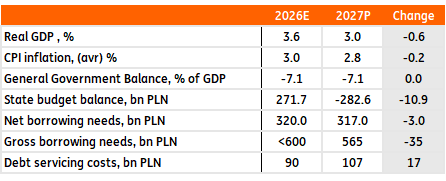
The macroeconomic assumptions underpinning the draft state budget do not appear particularly controversial. The government is forecasting GDP growth of 3.0% and CPI inflation of 2.8%. These projections are broadly in line with our baseline scenario, which envisages economic growth of 3.2% next year and consumer inflation of around 2.5%.
Similar to our expectations, the government also expects wage growth to continue moderating. According to the Ministry of Finance's projections, the average wage in the economy will increase by 5.9%, following estimated growth of 6.4% in 2026. The registered unemployment rate is forecast to stand at 6.0% at the end of 2027, compared with our projection of 5.9%.
Key variables in the 2027 draft state budget
Fiscal imbalance to remain high
The 2027 general government deficit is projected at 7.1% of GDP and will likely be the highest in the European Union next year. The 2026 deficit estimate was revised to 7.1% of GDP from 6.5% of GDP projected in the 2026 budget act due to, among other things, the fiscal costs of the temporarily lowered excise duty and VAT rate on fuels. The draft budget embraces fiscally neutral changes to direct taxes that were announced previously. The list of spending priorities remains long, including (1) security, (2) healthcare and (3) economic growth.
The 2027 draft budget bill means continued fiscal expansion and a lack of progress in the consolidation of public finances. Authorities are not taking steps to end the excessive deficit and bring it below 3% of GDP any time soon. As a result, public debt will continue mounting and may face limits envisaged in the public finance law in 2028 or 2029. The domestic definition of debt above 55% of GDP requires undertaking substantial austerity measures and the constitutional limit of 60% of GDP allows no deficit in the budget act next year.
Borrowing needs in 2027 will be lower amid fewer grants and loans from the EU
At first glance, projected gross borrowing needs for 2027 compare favourably with the expected 2026 outturn. While the details of the draft budget have yet to be released, we assume this largely reflects the timing of EU fund disbursements.
The scale of loans financed from European funds will be lower in 2027 than in 2026, following the completion of the National Recovery and Resilience Plan, reducing borrowing requirements financed through non-market sources.
In addition, timing mismatches in cash flows related to grants will generate smaller financing needs. Lower gross borrowing requirements are therefore unsurprising and in line with our expectations. These are cash flows and therefore do not affect the general government balance, although they are relevant from the perspective of managing state budget liquidity.
Muted market reaction
For financial markets, the key information on borrowing requirements will be the amount financed through market instruments, as this determines the supply of government securities. We do not expect this amount to be significantly higher than in the current year.
The net borrowing requirement for next year announced so far (PLN317bn) is close to this year's projected outturn (PLN320bn) and should not cause market concern, although the details and planned financing structure will be important.
Markets are aware of the difficulties involved in fiscal adjustment under the current political circumstances, including difficult cohabitation between the government and the president and next year's parliamentary elections. In our view, however, the fiscal plans should provide some reassurance to financial markets. Concerns about next year's budget have been reflected, among other things, in elevated spreads, including long-term asset swaps.



Comments
Log in or sign up to join the conversation.