


If you bought the same stock more than once, the shares you sell decide the size of the realized gain and whether it's short or long term. You usually have to make that call at the sale.
The position
When you hold several lots of one stock, choose the lot before you sell, because the default method may not be the one you would pick.
Same stock, same 100 shares, same sale price of 52. Depending on which shares you tell your broker you’re selling, the result on your tax records can be a 1,200 long-term gain, a 400 short-term gain, or a 300 short-term loss. Nothing about the trade changes except one setting, and it’s easy to go years without opening it.
That setting is the lot selection method. One hypothetical position is enough to show why it deserves a look before the sale, and where the choice gets harder than it seems.
The position
Say you’ve bought one stock three times. Each purchase is a separate tax lot, with its own cost basis and its own purchase date.
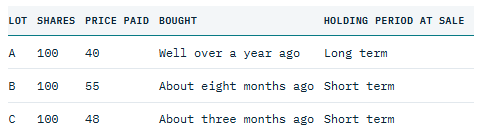
The stock now trades at 52. You want to sell 100 shares and keep 200.
Under IRS rules, a lot owned for longer than a year gives a long-term result when it’s sold, and a lot owned for a year or less gives a short-term one. The two are generally treated differently for tax. The count for the holding period generally starts the day after you buy, which matters for lots close to the line.
Three ways to sell the same 100 shares
= Realized result by lot, selling 100 shares at 52
Lot A: (52 - 40) x 100 = 1,200 gain, long term
Lot B: (52 - 55) x 100 = -300 loss, short term
Lot C: (52 - 48) x 100 = 400 gain, short term
Do nothing, and US brokers commonly apply first in, first out. The oldest shares go first. Here that’s Lot A, and the sale produces the 1,200 long-term gain.
With specific identification, you name the lot. Pick B and the sale produces a 300 short-term loss. Pick C and it produces a 400 short-term gain.
Lots don’t have to go whole, either. Where the platform allows it, you can sell 50 shares from B and 50 from C in one order, and the result is the sum of the two halves: (52 - 55) x 50 plus (52 - 48) x 50, which is -150 plus 200, a net short-term gain of 50.
Brokers may offer other preset methods too, such as highest cost first or last in, first out, and the menu differs from one broker to the next. Check what yours offers and what it applies when you haven’t chosen.
Which lot is the right one
Here the honest answer is conditional, and it’s the part that takes some thought.
Selling B books a loss now and leaves A and C in the account. It looks best for this year. It also means the shares you still hold have lower bases, 40 and 48, so a later sale at the same price realizes more gain. Picking the highest-cost lot generally defers gains; it doesn’t remove them.
Selling A books the largest gain of the three, and it’s long term, which you may prefer to a short-term result because the two are generally treated differently, though whether that suits you depends on your whole tax picture, and a trading account can’t see most of that.
Selling C sits in between: a modest short-term gain, with the long-term lot and the high-cost lot both kept for later.
So which one? It depends on your year. The lot that fits is the one that suits your situation this year, and the only way to act on that judgment is to make the choice before the order goes in, with your whole year of gains and losses in view and, if the numbers are large, a tax professional who can see the parts of the picture a brokerage statement leaves out.
When the loss lot has a trap
Selling Lot B at a loss invites a check. If you bought shares of the same stock within 30 days before that sale, or buy them within 30 days after, the IRS wash-sale rule can disallow the loss and add it to the basis of the replacement shares.
In this case Lot C was bought about three months ago, outside the window. Change one detail, so that C was bought two weeks before the sale, and the 300 loss on B could be caught; buy the stock back a week after selling B, and the same thing can happen from the other side of the window. That second version is the easy one to miss. The wash sale page covers how the rule works, and the wash-sale window calculator will show the dates on either side of a sale.
When to make the choice
Specific identification generally has to be chosen by the time of the sale. Deciding in April which lot you meant to sell in October is usually too late.
Two ways to handle that on most platforms:
Set a default method in your account’s tax or cost-basis settings.
Choose lots on the order ticket, where the platform offers it, each time you sell part of a position.
Where each lives varies by broker. Look before your next partial sale. After the trade, keep the confirmation or the lot detail that shows which shares were sold, because that record is what supports the choice later.
Where this stops applying
None of this is tax advice; it’s arithmetic. The IRS publishes the rules on basis, holding periods and wash sales. Applying them to your own return is a job for a tax professional. Rules and broker practices can change, so confirm the current position before relying on any of it.
Where this does not apply
Bought a stock only once? Then there’s one lot, and nothing to choose. Same when you sell the whole position, since every lot goes regardless of method, though the split between short-term and long-term results still depends on the dates.
Gains inside tax-advantaged retirement accounts are generally not taxed sale by sale, so the choice matters mainly in an ordinary taxable brokerage account.



Comments
Log in or sign up to join the conversation.