

Market Overview
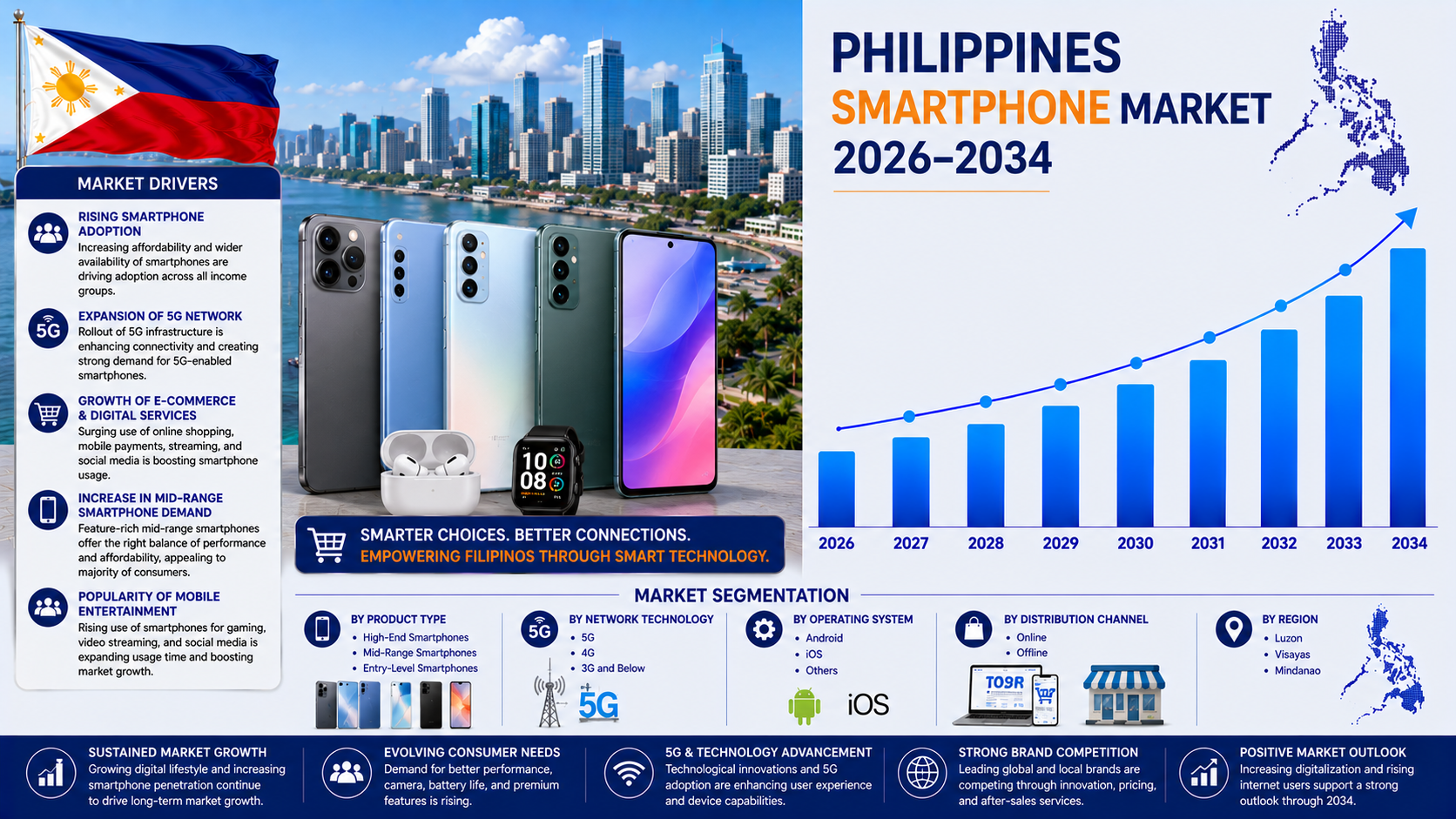
The Philippines smartphone market size reached USD 563.5 Million in 2025 and is projected to reach USD 588.1 Million by 2034, growing at a compound annual growth rate of 0.48% from 2026–2034. The market is expanding driven by increasing mobile internet penetration as telecom operators expand affordable 4G and 5G network coverage, surging digital payments and e-commerce adoption compelling smartphone ownership as an essential financial tool, and government-backed digital inclusion programmes broadening access across rural and underserved communities. OPPO's February 2026 launch of the Reno15 Series 5G in the Philippines, Samsung's Galaxy Unpacked announcement for February 2026 introducing next-generation devices to the Philippine market, and the World Bank's EUR 268.22 million digital infrastructure project targeting connectivity benefits for over 20 million Filipinos are collectively reinforcing the market's sustained growth trajectory throughout the forecast period.
Request for Sample Report: https://www.imarcgroup.com/philippines-smartphone-market/requestsample
Market Summary
Android dominates the operating system segment, commanding the overwhelming majority of Philippine market share driven by the broad availability of Android-based devices across all price tiers from ultra low-end to premium — aligning with the market's strong cost-conscious consumer base.
The mid-range price segment leads market demand, reflecting Filipino consumer preference for devices offering high-end features — including 120Hz AMOLED displays, multi-camera systems, and 5G connectivity — at accessible price points below PHP 15,000.
Online stores represent the fastest-growing distribution channel with a projected CAGR of 8.6% from 2026–2034, driven by e-commerce platform expansion, flash sales, and Xiaomi's online-first strategy generating strong unit volume through Shopee and Lazada.
Luzon commands the largest regional share, anchored by Metro Manila's high population density, higher average income levels, and concentration of authorised brand retail networks across National Capital Region and surrounding provinces.
Total Philippines smartphone imports reached USD 1.11 billion in 2025 — a significant year-on-year increase — reflecting robust domestic demand, the shift toward 5G-capable chipsets as mid-range import standard, and government incentives attracting expanded Samsung and Xiaomi manufacturing activity.
5G democratisation is the defining product trend of 2025–2026, with features including 108MP cameras, 120Hz refresh rates, and 8GB RAM now standard below PHP 8,000 — specifications that would have been mid-range just two years prior, compressing margins and accelerating consumer upgrade cycles.
Smartphone penetration is projected to exceed 95 million users by 2026, with first-time smartphone buyers in provincial Visayas and Mindanao — accessing GCash, Maya, eGov PH, and social commerce platforms for the first time — representing the market's fastest-growing demand segment.
Porter's Five Forces Analysis of the Philippines Smartphone Market
1. Threat of New Entrants — Low to Moderate
The Philippines smartphone market's intense competitive concentration among Chinese manufacturers — Xiaomi, OPPO, Vivo, realme, and Tecno — combined with Samsung and Apple's brand equity creates a formidable competitive baseline that new entrants must substantially outperform on price, specification, or distribution to meaningfully capture market share
E-commerce channel accessibility through Shopee and Lazada significantly lowers distribution entry barriers for new brands, enabling online-first market participation without the capital investment required to establish nationwide physical retail and after-sales service centre networks across Luzon, Visayas, and Mindanao
Philippine government incentives under the CREATE MORE Act — including four-to-six-year income tax holidays for strategic manufacturing investments — are attracting expanded Samsung and Xiaomi production footprints that create supply chain scale advantages difficult for smaller new entrants to replicate competitively
2. Bargaining Power of Suppliers — Moderate
Semiconductor and chipset suppliers including Qualcomm and MediaTek hold moderate leverage given the concentration of mobile processor supply among a limited number of globally dominant chip designers whose platform availability and pricing directly affect device cost structures and performance positioning across competing Philippine market brands
Display panel manufacturers — particularly Samsung Display and BOE supplying AMOLED panels increasingly adopted across mid-range Philippine market devices — hold growing leverage as OLED technology transitions from premium to mainstream specification, with limited alternative sources for high-quality flexible display supply at scale
The concentration of final device assembly among a small number of contract manufacturers and the ongoing Philippine government push toward local smartphone manufacturing — through Samsung's PHP 50 billion local manufacturing investment incentive — are progressively building domestic supply chain depth that modestly reduces dependency on fully imported device supply
3. Bargaining Power of Buyers — High
Individual Filipino consumers exercise strong purchasing leverage through instant price and specification comparison across Shopee, Lazada, and authorised brand e-stores, with flash sales and exclusive online launch pricing creating a highly transparent and competitive market where margin compression is structurally built into the distribution model
The market's extreme price sensitivity — with brands continuously pushing premium specifications into sub-PHP 8,000 price tiers to capture cost-conscious consumers — demonstrates the powerful structural leverage that Philippine buyers collectively exercise over competing manufacturers through their willingness to defer purchases until competitive price points are met
Large corporate, government, and enterprise buyers procuring smartphones in volume for employee digital enablement, MSME DigiPay adoption, and public digital services access hold meaningful procurement leverage through bulk purchasing arrangements and government tender processes that compel aggressive vendor pricing and support commitments
4. Threat of Substitutes — Low
Smartphones have no genuine functional substitute in the Philippine digital economy context, where mobile-first access to GCash, Maya, eGov PH, Shopee, Lazada, social media, telemedicine, and online education platforms makes smartphone ownership a prerequisite for full participation in modern Filipino economic and social life
Basic feature phones represent a declining legacy substitute that is progressively displaced by the downward specification migration of sub-PHP 5,000 Android entry-level smartphones, which now deliver sufficient capability for digital payment adoption, messaging, and social media access that previously required higher-priced devices
Tablets represent a partial substitute for content consumption and productivity use cases, though their cost, portability limitations, and telephony absence ensure they complement rather than replace smartphones as the primary personal digital device across all Filipino demographic segments
5. Competitive Rivalry — High
Market rivalry is intense and structurally compressive, with Xiaomi, Samsung, OPPO, realme, Vivo, Tecno, Infinix, and Apple competing simultaneously across every price tier from sub-PHP 3,000 entry-level to ultra-premium flagship segments — with Chinese brands collectively driving the specification-per-peso escalation that continuously raises competitive performance requirements for all market participants
OPPO's February 2026 Reno15 Series 5G launch — spanning three distinct models including the Reno15 F 5G with a 7,000mAh battery and Reno15 Pro 5G with a 6.32-inch compact AMOLED — exemplifies the multi-SKU competitive strategy through which brands simultaneously address multiple price tier segments and consumer preference profiles within a single product family launch
Samsung's Galaxy Unpacked February 2026 announcement and Xiaomi's online-first flash sale strategy represent distinct competitive approaches — premium brand investment versus volume-driven digital distribution — that are sustaining high rivalry intensity across both the upper and lower market price tiers throughout the forecast period
Market Trends
Increasing Mobile Internet Penetration
Rapid expansion of affordable 4G and 5G network coverage by Globe Telecom, PLDT-Smart, and DITO Telecommunity is converting previously connectivity-limited communities into active smartphone consumer markets, directly expanding the addressable device demand base across provincial Luzon, Visayas, and Mindanao. The World Bank's EUR 268.22 million Philippines Digital Infrastructure Project — targeting connectivity benefits for over 20 million Filipinos — is reinforcing government commitment to broadband expansion as a structural enabler of smartphone adoption. Mobile internet now supports online education, telemedicine, government e-services, and social commerce across previously unconnected communities, transforming smartphone ownership from a lifestyle choice into a practical economic necessity for first-time digital participants.
Growing Demand for Affordable 5G Smartphones
The democratisation of 5G technology across mid-range and budget smartphone tiers is the defining product trend reshaping the Philippine market, with manufacturers including Xiaomi, OPPO, POCO, realme, and Samsung progressively lowering the price threshold at which 5G connectivity, AMOLED displays, and multi-camera systems become accessible to mainstream Filipino consumers. OPPO's Reno15 Series 5G — launched across three models in February 2026 with 5G connectivity, AMOLED panels, and large battery capacities at accessible mid-range price points — exemplifies the competitive product development dynamic through which 5G capability is becoming a standard rather than premium differentiator. This specification democratisation compresses vendor margins while accelerating consumer upgrade cycles, sustaining strong unit volume replacement demand across all Philippine price tiers throughout the forecast period.
Shift Toward Digital Payments and E-Commerce
The structural entrenchment of mobile-first digital payment platforms — including GCash, Maya, and the government's DigiPay Initiative supporting MSME cashless adoption — is generating a self-reinforcing smartphone demand cycle in which digital payment accessibility drives smartphone ownership, which in turn expands digital commerce and financial inclusion participation across previously cash-dependent consumer segments. The Philippines e-commerce market projected at USD 24 billion by 2025 — growing at an estimated 17% annually — creates a persistent and expanding functional demand for smartphones capable of supporting diverse digital commerce, mobile banking, and payment application ecosystems. This digital transaction normalisation is progressively elevating smartphone from a communications device to an essential financial infrastructure access tool across all Filipino demographic and income segments.
Market Growth Drivers
Government Push for Digital Inclusion
The Philippine government's comprehensive digital inclusion agenda — spanning the DICT's accelerated 5G coverage expansion, the DigiPay Initiative promoting mobile payment adoption among MSMEs, digital ID rollout, and the expansion of eGov PH platform mobile services — is systematically converting digital access from an urban privilege into a nationwide infrastructure right that directly stimulates smartphone demand across previously underserved provincial communities. Government financial inclusion programmes promoting digital wallets and mobile banking effectively mandate smartphone ownership as the gateway to modern financial service participation, while online government service delivery increasingly requires mobile device capability. These digital transformation initiatives are sustainably expanding the addressable smartphone consumer base beyond organic demographic growth throughout the entire forecast period.
Youth-Driven Demand and App Ecosystem Growth
The Philippines' large and digitally native youth demographic — characterised by deep social media engagement, mobile gaming, short-form video consumption, e-learning participation, and peer-driven brand aspiration — represents the market's most commercially significant and product specification-demanding consumer segment, compelling manufacturers to deliver superior cameras, faster processors, larger displays, and longer battery life at continually competitive price points. The explosive growth of the Filipino mobile app ecosystem across messaging, ride-hailing, food delivery, e-learning, and mobile banking has transformed smartphones into multi-function life management platforms, generating consistent upgrade demand from consumers whose expanding app usage outpaces the capability of their existing devices. This youth-driven upgrade cycle and app ecosystem expansion are sustaining replacement demand independently of population growth across the forecast period.
Expanding 5G Infrastructure and Device Affordability
Globe Telecom's confirmed 5G network expansion to additional Philippine cities, combined with Samsung's PHP 50 billion local manufacturing investment incentive and Xiaomi's aggressive affordable 5G device launch strategy, are creating a simultaneous supply-side and infrastructure-side convergence that is accelerating 5G smartphone adoption beyond Metro Manila into provincial and regional markets. The DICT's acceleration of 5G coverage — establishing 5G-capable chipsets as a standard mid-range import requirement by 2025 — provides the network infrastructure foundation that justifies consumer investment in 5G-capable devices across the market's dominant mid-range and low-end price tiers. This infrastructure-device affordability convergence is the single most powerful near-term market growth mechanism, driving device upgrade and first-time purchase demand simultaneously across metropolitan and provincial Philippine markets throughout the forecast period.
Market Segments
By Operating System:
Android
iOS
Others
By Display Technology:
LCD Technology
OLED Technology
By RAM Capacity:
Below 4GB
4GB – 8GB
Over 8GB
By Price Range:
Ultra Low-End (Less Than USD 100)
Low-End (USD 100–USD 200)
Mid-Range (USD 200–USD 400)
Mid- to High-End (USD 400–USD 600)
High-End (USD 600–USD 800)
Premium (USD 800–USD 1,000)
Ultra-Premium (USD 1,000 and Above)
By Distribution Channel:
OEMs
Online Stores
Retailers
By Region:
Luzon
Visayas
Mindanao
Competitive Landscape
The market research report has provided a comprehensive analysis of the competitive landscape in the Philippines smartphone market. Competitive analysis covering market structure, key player positioning, top winning strategies, competitive dashboard, and a company evaluation quadrant with detailed profiles of all major companies has been included in the report. Key participants including Samsung, Xiaomi, OPPO, realme, Vivo, Tecno, Infinix, Apple, and Cherry Mobile compete across price tier specification leadership, 5G device democratisation, e-commerce channel investment, local manufacturing partnerships, and after-sales service network expansion throughout Luzon, Visayas, and Mindanao.
Latest News and Developments
February 2026: OPPO Philippines launched the Reno15 Series 5G on February 13, comprising the Reno15 F 5G, Reno15 5G, and Reno15 Pro 5G. The lineup featured AI-enhanced camera systems, Snapdragon chipsets across all three models, AMOLED displays, and battery capacities ranging from 6,500 to 7,000mAh — bringing 5G capability and premium specifications to accessible mid-range price tiers and reinforcing OPPO's competitive positioning across the Philippine market's most commercially significant consumer segment.
February 2026: Samsung announced its Galaxy Unpacked event for February 26, 2026 — with Smart Postpaid confirming pre-order availability — marking the Philippine market entry of Samsung's next-generation flagship Galaxy series. The announcement reinforced Samsung's commitment to the Philippine premium and upper mid-range smartphone segments, with pre-order confirmation from a major telecom operator signalling strong anticipated consumer demand ahead of the official device launch.
December 2025: Consumer search interest for new smartphone releases in the Philippines peaked significantly in December 2025 — reaching an index score of 77 against a January 2026 peak of 100 — reflecting strong holiday-season smartphone purchasing momentum and the concentration of brand promotional activity around the Christmas gifting period that consistently drives the highest annual sales volumes across the Philippine consumer electronics market.
December 2025: AI integration accelerated as a mainstream smartphone feature across the Philippine market, with OPPO, Vivo, and Samsung devices incorporating on-device AI capabilities including camera scene optimisation, intelligent battery management, and AI-driven voice assistants. The shift toward AI-enhanced mobile experiences — previously confined to premium flagship segments — began appearing in mid-range devices accessible to mainstream Filipino consumers, establishing AI capability as an emerging standard purchase consideration alongside camera quality and battery performance across the forecast period.
Note: If you require any specific information that is not covered currently within the scope of the report, we will provide the same as a part of the customization.
Speak to an analyst for a customized sample report: https://www.imarcgroup.com/request?type=report&id=28733&flag=C
About Us
IMARC Group is a global management consulting firm that helps the world's most ambitious changemakers to create a lasting impact. The company provides a comprehensive suite of market entry and expansion services. IMARC offerings include thorough market assessment, feasibility studies, company incorporation assistance, factory setup support, regulatory approvals and licensing navigation, branding, marketing and sales strategies, competitive landscape and benchmarking analyses, pricing and cost research, and procurement research.
Contact Us
IMARC Group
134 N 4th St., Brooklyn, NY 11249, USA
Email: [email protected]
Tel No.: (D) +91 120 433 0800
United States: +1-201-971-6302
Comments
Log in or sign up to join the conversation.