

Market Overview
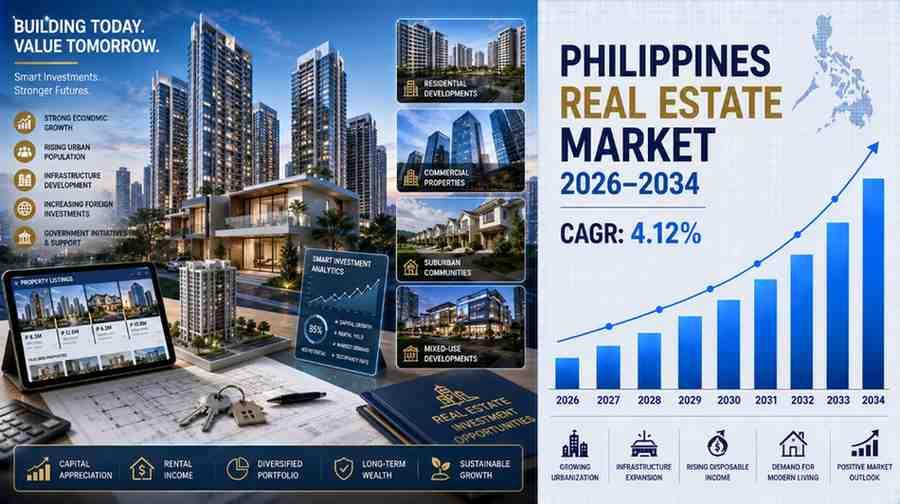
The Philippines real estate market is experiencing strong growth, driven by urbanization, infrastructure development, and rising foreign investments fueling demand across various segments, including residential, commercial, and industrial properties. The market size reached USD 94.4 Billion in 2025 and is projected to reach USD 135.9 Billion by 2034, growing at a compound annual growth rate (CAGR) of 4.12% from 2026 to 2034.
The market is strategically important to the Philippines' economy as it supports housing for a growing urban population, enables commercial and industrial expansion, attracts foreign investment, and creates jobs across construction, property management, and related services.
Request a Sample Report for In-Depth Market Insights: https://www.imarcgroup.com/philippines-real-estate-market/requestsample
Philippines Real Estate Market Summary
The Philippines real estate market encompasses a system where residential, commercial, industrial, and land properties are bought, sold, and rented through online and offline modes across the archipelago.
These properties are valued for their role in providing housing, enabling business operations, supporting industrial activities, and serving as investment assets.
The ecosystem includes property developers, real estate brokers and agents, investors (domestic and foreign), government agencies (DHSUD, PPP Center), banks and financial institutions, BPO companies, Overseas Filipino Workers (OFWs), and consumers across Luzon, Visayas, and Mindanao.
Major segments identified in the market include property (residential, commercial, industrial, land), business (sales, rental), mode (online, offline), and region (Luzon, Visayas, Mindanao).
The market is benefiting from urbanization and expanding middle class (56.43 Million individuals residing in urban areas in 2024, 48.7% of total population), infrastructure expansion and connectivity (Build Better More program), emergence of mixed-use and transit-oriented developments, growing demand for sustainable and affordable housing, thriving BPO sector, real estate digitalization and PropTech adoption, and remittance-driven investment from OFWs.
As per industry reports, in 2024, the U.S. and Philippines announced numerous bilateral economic ventures, encompassing the Luzon Economic Corridor in March, which aims to boost infrastructure in the Philippines.
PORTER'S FIVE FORCES ANALYSIS—PHILIPPINES REAL ESTATE MARKET
Bargaining Power of Suppliers—Moderate
Real estate suppliers include landholders, property developers, construction material suppliers, and contractors. Land ownership laws are complicated, and the titling system for land is fragmented. Foreign ownership prohibitions restrict outright land purchase to Filipino nationals or Filipino majority-owned corporations.
Developers frequently have to spend a lot of time and money to resolve conflicts or establish ownership prior to embarking on projects, giving existing landholders in prime locations significant bargaining power.
However, the rise of Special Economic Zones (SEZs) and government infrastructure projects is unlocking new land areas for development, diversifying supply sources.
Bargaining Power of Buyers—Moderate
Buyers include individual homebuyers, property investors, BPO companies, multinational corporations, and OFWs. The growing middle class and urbanization create strong demand, but buyers have options across different property types, locations, and price points.
OFWs invest their earnings in buying homes as a mode of financial security. Developers target this segment by providing payment schemes compliant with OFW cash flow, giving OFW buyers negotiating power.
The availability of online platforms for property listings and virtual tours increases buyer access to information and price comparison, enhancing buyer power.
Threat of New Entrants—Moderate
The real estate market has moderate barriers to entry. New entrants can enter through niche segments (affordable housing, mixed-use developments, industrial parks) or through partnerships with local firms.
The government's push for affordable housing through programs under DHSUD is prompting both public and private sector collaboration, creating opportunities for new entrants in the socialized housing segment.
However, established developers have significant land banks, brand recognition, and relationships with financial institutions and government agencies, creating barriers for unestablished entrants.
Threat of Substitutes—Low
Real estate has no direct substitute for providing physical space for living, working, commerce, and industry.
Renting is a substitute for homeownership, and vice versa, but both fall within the real estate market (sales vs. rental segments).
The trend toward co-living spaces and flexible office spaces represents product evolution rather than substitution away from real estate.
Competitive Rivalry—Moderate to High
The Philippines real estate market features competition among local developers, international investors, and specialized property firms. Developers are responding with innovative housing solutions including vertical developments and gated communities.
Competition is intensifying in provincial cities like Iloilo, Bacolod, Cagayan de Oro, and General Santos as investors and developers focus on emerging areas with cheaper land and reduced operating expenses.
Mixed-use and transit-oriented developments are a key competitive differentiator, with developers creating master-planned communities near transportation terminals.
MARKET GROWTH DRIVERS
Urbanization and Expanding Middle Class
The Philippines real estate market share is undergoing a significant transformation, driven by rapid urbanization and the expansion of the middle-class population. For instance, as per industry reports, in 2024, 56.43 Million individuals in Philippines, accounting for 48.7% of the total population, reside in urban areas. Cities like Metro Manila, Cebu, and Davao are observing accelerating demand for residential and commercial properties.
Homeownership is leading growth of affordable and mid-range housing projects as these are being prioritized by the rising middle class. Developers are responding with innovative housing solutions that include vertical developments and gated communities to cater to the needs of urban residents. Simultaneously, the influx of professionals into urban areas is driving the demand for co-living spaces and rental properties. This trend is also motivating mixed-use developments, where residential units are merged with retail, office, and recreational spaces.
Infrastructure Expansion and Connectivity
The aggressive infrastructure development of "Build, Build, Build" program (continued as "Build, Better, More") is altering the real estate market. According to the Philippines real estate market analysis, property demand in peripheral regions is making previously underdeveloped areas more accessible with investments made in transportation networks, including railways, highways, and airports.
Residential and commercial developments are clustering around transit-oriented locations which ensure convenience for commuters and businesses alike. Infrastructure improvements are elevating property values and attracting multinational corporations seeking prime office spaces in well-connected hubs. Additionally, the rise of Special Economic Zones (SEZs) around these projects is bolstering industrial real estate growth, providing a hike to logistics, warehousing, and manufacturing facilities.
Emergence of Mixed-Use and Transit-Oriented Developments
One of the most significant trends influencing the Philippines property market is the increasing demand for mixed-use and transit-oriented developments. These developments combine residential, commercial, and recreational areas into one master-planned setting—usually near transportation terminals. In Metro Manila and other major urban hubs such as Cebu and Davao, traffic congestion and long travel times have driven developers to provide communities in which residents can live, work, and have access to basic services without having to travel far.
These master-planned developments tie in with government-supported infrastructure initiatives such as the North-South Commuter Railway and the Metro Manila Subway. Local developers are also applying international urban planning concepts to Philippine conditions, including using climate-resilient designs to mitigate flooding and typhoons.
Thriving BPO Sector and Urban Housing Demand
The sustained growth of the Business Process Outsourcing (BPO) sector in the Philippines has had a profound impact on real estate development, especially in cities. Metro Manila, Cebu, Iloilo, and Davao have emerged as key destinations for BPO companies, drawing an uninterrupted stream of young working professionals in search of job opportunities.
This population growth around business districts has led to increasing demand for condominiums, rental apartments, and co-living facilities around or inside business hubs. Developers are meeting this with high-density residential properties with amenities specific to the BPO workforce, including 24/7 security, access to transport, and closeness to commercial outlets.
Foreign Filipino Workers and Remittance-Driven Investment
The steady supply of remittances from Overseas Filipino Workers (OFWs) is crucial in keeping real estate demand in the Philippines stable. Various OFWs invest their hard-earned earnings in buying homes for their families or investing in real estate as a mode of financial security. Real estate is usually considered as a fixed and tangible asset that captures their years of experience working abroad.
Properties in urbanized locations such as Metro Manila, Cebu, and Davao are particularly preferable because of their rental yield and proximity to job centers, schools, and commercial centers. This steady supply of capital from overseas sustains residential demand and propels mid-range and high-rise development schemes all over the country.
PHILIPPINES REAL ESTATE MARKET SEGMENTATION
Property Insights:
Residential
Commercial
Industrial
Land
Business Insights:
Sales
Rental
Mode Insights:
Online
Offline
Regional Insights:
Luzon
Visayas
Mindanao
COMPETITIVE LANDSCAPE
The Philippines real estate market features competition among local developers, international investors, and specialized property firms. Leading players differentiate through project scale, location portfolio, mixed-use and transit-oriented development capabilities, sustainability credentials, and partnerships with government and financial institutions. Developers are responding with innovative housing solutions that include vertical developments and gated communities.
Key players mentioned in the report include various property developers, real estate brokers, and investment firms. Notable industry developments include:
November 2024: Eton Solutions announced the launch of a specialized Fund Accounting Platform for Private Equity, Real Estate, and Fund of Funds firms. Built on the cloud native AtlasFive® platform, the solution integrates AI to enhance fund management, compliance, and operational efficiency.
October 2024: Capital Corp Merchant Banking announced a substantial investment proposal for a mega township development venture in the Philippines, highlighting the firm's efforts to aid revolutionizing and sustainable real estate and infrastructure development globally.
2024 Bilateral Agreements: As per industry reports, in 2024, the U.S. and Philippines announced numerous bilateral economic ventures, encompassing the Luzon Economic Corridor in March, which aims to boost infrastructure in the Philippines.
REGIONAL ANALYSIS
Luzon: As the region containing Metro Manila and other major urban centers, Luzon represents the largest real estate market in the Philippines. The region benefits from high population density (56.43 Million urban residents nationally), concentration of BPO companies, infrastructure megaprojects (North-South Commuter Railway, Metro Manila Subway), and Special Economic Zones. The Luzon Economic Corridor (announced March 2024) aims to boost infrastructure in the region.
Visayas: The Visayas region, including major cities like Cebu and Iloilo, is experiencing growing real estate demand driven by BPO sector expansion, tourism development, and infrastructure improvements. Developers are focusing on emerging provincial cities like Iloilo and Bacolod, which have cheaper land and reduced operating expenses. Mixed-use and transit-oriented developments are gaining traction.
Mindanao: Mindanao represents an emerging real estate market with significant growth potential driven by infrastructure development, industrial zone expansion, and growing urban centers like Davao and Cagayan de Oro. The region's improving security environment and government focus on balanced regional development support real estate growth. Affordable housing programs and industrial real estate (logistics, warehousing) are key growth segments.
RECENT INDUSTRY DEVELOPMENTS
May 2026: The Bangko Sentral ng Pilipinas (BSP) signaled it is considering an off-cycle interest rate hike after raising its benchmark rate to 4.50%, citing persistent inflationary pressures and rising fuel costs. Higher borrowing costs could affect mortgage demand, property purchases, and real estate financing activity.
May 2026: Philippine real estate developers and investors continued shifting focus toward regional growth hubs such as Cebu and Davao, driven by infrastructure improvements, decentralization trends, and increasing demand outside Metro Manila.
April 2026: Commercial real estate activity remained active across the office, retail, industrial, and residential segments, with market participants closely monitoring supply, demand, occupancy, and rental trends in key property markets.
April 2026: Fitch Ratings revised the Philippines' outlook from "stable" to "negative," citing risks from higher energy costs and slower public investment. The development raised concerns about its potential impact on property demand, investment activity, and construction growth.
February 2026: Industry analysts highlighted growing opportunities in mixed-use developments, industrial properties, and regional real estate projects, as investors increasingly focused on resilient property segments amid evolving market conditions.
Note: If you need any specific information that is not covered currently within the scope of the report, we will provide the same as a part of customization.
Speak to an analyst: https://www.imarcgroup.com/request?type=report&id=28690&flag=C
About Us
IMARC Group is a global management consulting firm that helps the world's most ambitious changemakers to create a lasting impact. The company provides a comprehensive suite of market entry and expansion services. IMARC offerings include thorough market assessment, feasibility studies, company incorporation assistance, factory setup support, regulatory approvals and licensing navigation, branding, marketing and sales strategies, competitive landscape and benchmarking analyses, pricing and cost research, and procurement research.
Contact Us
IMARC Group
134 N 4th St., Brooklyn, NY 11249, USA
Email: [email protected]
Tel No: (D) +91 120 433 0800
United States: +1-201-971-6302
Comments
Log in or sign up to join the conversation.