

Market Overview
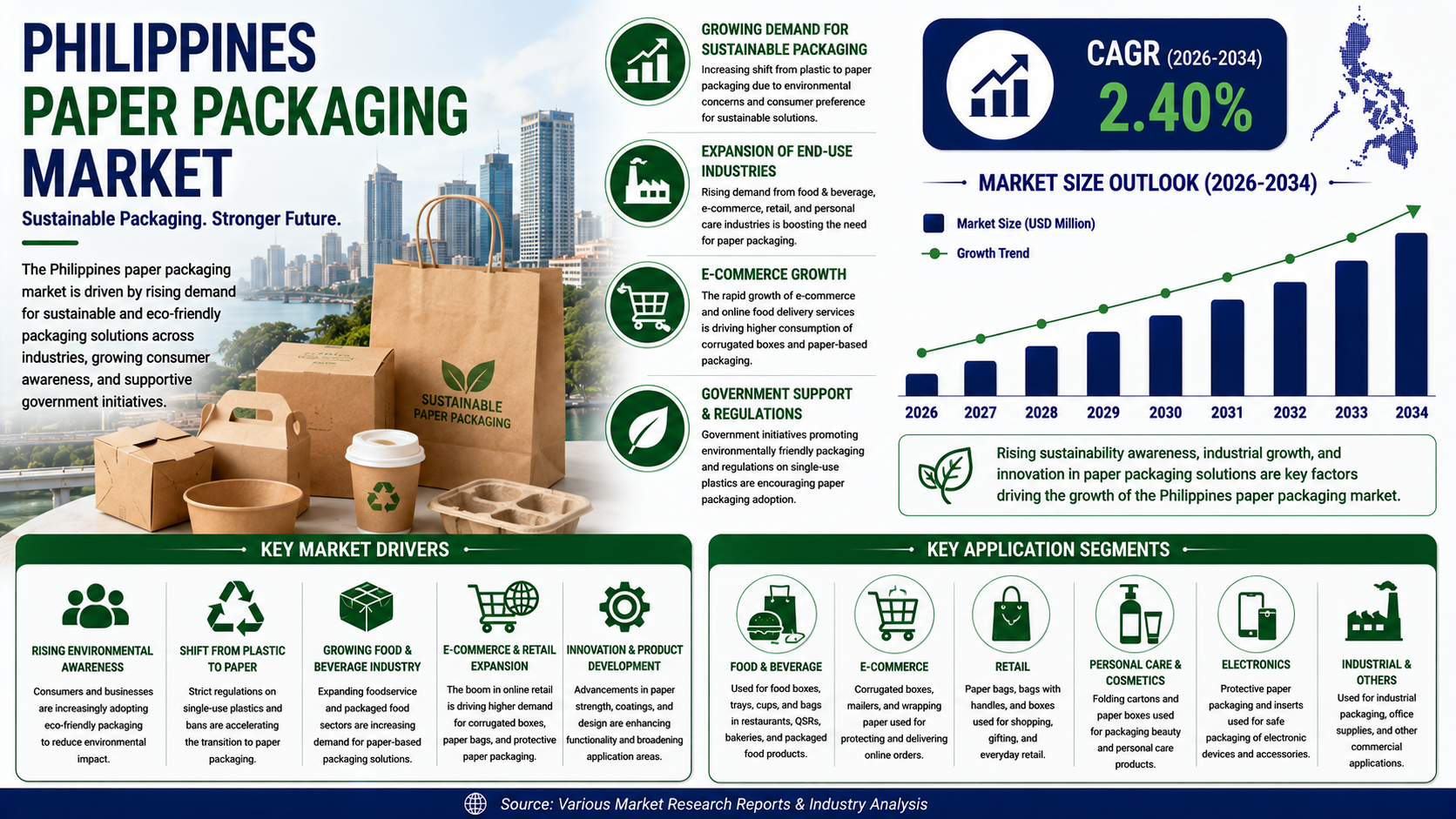
The Philippines paper packaging market is driven by rising sustainability demands, with businesses and consumers shifting away from single-use plastics toward recyclable and biodegradable options that align with eco-friendly values and regulatory requirements. Additionally, expanding food, beverage, personal care, and pharmaceutical sectors require safe, attractive, and functional packaging, making paper an ideal choice for balancing performance, aesthetics, and environmental responsibility. The market size reached USD 2.02 Billion in 2025 and is projected to reach USD 2.53 Billion by 2034, growing at a compound annual growth rate (CAGR) of 2.40% from 2026 to 2034.
The market is strategically important to the Philippines' economy as it supports the food and beverage, e-commerce, personal care, pharmaceutical, and consumer goods sectors, while enabling the transition away from single-use plastics toward sustainable packaging solutions.
Request a Sample Report for In-Depth Market Insights: https://www.imarcgroup.com/philippines-paper-packaging-market/requestsample
Philippines Paper Packaging Market Summary
The Philippines paper packaging market encompasses a system where paper packaging products (corrugated boxes, folding boxes and cases, liquid paperboard cartons, paper bags and sacks, and others) of various grades (solid bleached, coated recycled, uncoated recycled, and others) at different packaging levels (primary packaging, secondary packaging, tertiary packaging) serve end-use industries (food, beverage, personal care and home care, healthcare, and others).
These paper packaging products are valued for their role in providing safe, attractive, and functional packaging; offering recyclable and biodegradable alternatives to single-use plastics; protecting goods during transit; and enhancing brand image through sustainable packaging.
The ecosystem includes paper packaging manufacturers (Mondi), raw material suppliers, food and beverage companies, e-commerce businesses, personal care and pharmaceutical companies, retailers, and consumers across Luzon, Visayas, and Mindanao.
Major segments identified in the market include product type (corrugated boxes, folding boxes and cases, liquid paperboard cartons, paper bags and sacks, others), grade (solid bleached, coated recycled, uncoated recycled, others), packaging level (primary packaging, secondary packaging, tertiary packaging), end-use industry (food, beverage, personal care and home care, healthcare, others), and region (Luzon, Visayas, Mindanao).
The market is benefiting from sustainability and regulatory pressure (shift away from single-use plastics toward recyclable and biodegradable options), boom in e-commerce and online retail (e-commerce accounted for 14% of the country's digital economy in 2023, employing 87.3% of 9.68 million people in the sector), and growth in food, beverage and other end-user industries (urbanization and convenience-oriented lifestyles driving demand for safe, attractive, sustainable packaging).
The Philippine Statistics Authority reports that in 2023, e-commerce accounted for 14% of the country's digital economy and employed 87.3% of the 9.68 million people working in the sector.
PORTER'S FIVE FORCES ANALYSIS — PHILIPPINES PAPER PACKAGING MARKET
Bargaining Power of Suppliers — Moderate
Paper packaging suppliers include pulp and paper manufacturers, recycled material suppliers, and chemical suppliers. The push for sustainability and regulatory pressure is increasing demand for recycled and biodegradable materials, giving suppliers of eco-friendly inputs moderate leverage.
In May 2024, Mondi introduced TrayWrap, a sustainable secondary packaging solution made from 100% renewable, uncoated kraft paper, demonstrating that suppliers with innovative sustainable products have competitive advantages.
However, the presence of multiple suppliers across different grades (solid bleached, coated recycled, uncoated recycled) gives manufacturers options, reducing dependency on any single supplier.
Bargaining Power of Buyers — Moderate to High
Buyers include food and beverage companies, e-commerce businesses, personal care and pharmaceutical companies, and retailers. The Philippine Statistics Authority reports that e-commerce accounted for 14% of the country's digital economy in 2023, creating significant buyer volume.
The expansion of direct-to-consumer ventures and small online retailers has boosted the need for affordable, flexible solutions like mailers, pouches, and corrugated boxes, giving these buyers leverage over packaging suppliers.
Brands are redesigning their packaging strategies to meet sustainability demands, giving buyers negotiating power to choose suppliers offering eco-friendly, cost-effective options.
Threat of New Entrants — Moderate
The paper packaging market has moderate barriers to entry requiring capital investment in manufacturing facilities, supply chain relationships, and regulatory compliance. The growing demand for sustainable packaging creates opportunities for entrants specializing in recycled and biodegradable products.
Regulations aimed at reducing plastic waste are accelerating the shift toward paper packaging, encouraging new entrants focused on eco-friendly solutions.
However, established manufacturers have existing customer relationships, distribution networks, and scale advantages, creating barriers for unestablished entrants.
Threat of Substitutes — Moderate
Plastic packaging is a substitute for paper packaging, but sustainability concerns and regulatory pressure are driving substitution away from single-use plastics toward recyclable and biodegradable paper options.
Glass and metal packaging are substitutes for specific applications (beverages, canned goods) but are heavier and more expensive for e-commerce and lightweight applications.
The push for sustainability and consumer awareness of plastic's environmental impact makes paper packaging increasingly preferred over plastic substitutes.
Competitive Rivalry — Moderate
The Philippines paper packaging market features competition among established manufacturers (Mondi) and local suppliers across product types (corrugated boxes, folding boxes, paper bags, liquid paperboard cartons).
Differentiation occurs through product type, grade (solid bleached, coated recycled, uncoated recycled), packaging level (primary, secondary, tertiary), sustainability credentials, and end-use specialization.
In May 2024, Mondi introduced TrayWrap, a sustainable secondary packaging solution designed to replace plastic shrink wrap, demonstrating innovation-driven competition.
MARKET GROWTH DRIVERS
Sustainability and Regulatory Pressure
The push for sustainability is one of the strongest forces driving Philippines paper packaging market growth. Consumers are increasingly aware of the environmental impact of plastic, making paper-based alternatives more attractive. At the same time, businesses are adopting eco-friendly packaging to enhance their brand image and meet evolving market expectations. Regulations aimed at reducing plastic waste are accelerating this shift, encouraging companies to explore recyclable and biodegradable options.
Paper packaging also provides versatility, allowing manufacturers to balance function with environmentally responsible practices. From food products to retail goods, brands are redesigning their packaging strategies to meet these demands. In this context, paper packaging is no longer just an option—it has become a key part of corporate sustainability plans and a competitive advantage for businesses seeking to attract conscious consumers and comply with tightening environmental guidelines.
Boom in E-Commerce and Online Retail
The Philippine Statistics Authority reports that in 2023, e-commerce accounted for 14% of the country's digital economy and employed 87.3% of the 9.68 million people working in the sector, underscoring its massive impact on trade and consumer behavior. This surge has transformed shopping habits, creating a strong demand for practical and reliable packaging. Paper packaging has become a preferred option for online sellers because it is lightweight, protective, and customizable for branding while appealing to eco-conscious buyers seeking reduced plastic use.
The expansion of direct-to-consumer ventures and small online retailers has boosted the need for affordable, flexible solutions like mailers, pouches, and corrugated boxes. These paper options not only protect goods during transit but also enhance the unboxing experience—a growing competitive differentiator. As delivery volumes rise, paper packaging delivers the ideal balance of cost, sustainability, and functionality for the Philippine e-commerce market.
Growth in Food, Beverage and Other End-User Industries
The expansion of industries such as food and beverage, personal care, pharmaceuticals, and consumer goods is another major Philippines paper packaging market trend boosting the market growth. As lifestyles become more urbanized and convenience-oriented, there is a greater need for safe, attractive, and sustainable packaging that protects product quality. For food and drinks, paper packaging offers excellent shelf appeal while complying with hygiene and safety requirements.
In personal care and household products, paper solutions help brands deliver a premium, sustainable brand image that resonates with buyers. Even industrial sectors, such as agriculture and construction, increasingly rely on durable paper bags and sacks for bulk products, aligning with both performance needs and sustainability practices. This broad application across sectors ensures paper packaging remains versatile and indispensable, supporting businesses as they adapt to evolving consumer preferences and industry demands.
Product Innovation in Sustainable Packaging
Innovations in sustainable paper packaging are driving market growth. In May 2024, Mondi introduced TrayWrap, a sustainable secondary packaging solution designed to replace plastic shrink wrap for bundling food and beverage products. Made from 100% renewable, uncoated kraft paper from Mondi's Advantage StretchWrap range, it ensures recyclability within existing paper streams. Used by a Swedish coffee brand, TrayWrap secures products with minimal adhesive dots, featuring pre-punched folds for stability, stackability, visibility, and easy unpacking—offering an eco-friendly alternative to traditional plastic wraps. Such product innovations demonstrate how paper packaging manufacturers are developing solutions that meet both performance and sustainability requirements.
PHILIPPINES PAPER PACKAGING MARKET SEGMENTATION
Product Type Insights:
Corrugated Boxes
Folding Boxes and Cases
Liquid Paperboard Cartons
Paper Bags and Sacks
Others
Grade Insights:
Solid Bleached
Coated Recycled
Uncoated Recycled
Others
Packaging Level Insights:
Primary Packaging
Secondary Packaging
Tertiary Packaging
End-Use Industry Insights:
Food
Beverage
Personal Care and Home Care
Healthcare
Others
Regional Insights:
Luzon
Visayas
Mindanao
COMPETITIVE LANDSCAPE
The Philippines paper packaging market features competition among established manufacturers and local suppliers across product types, grades, and end-use industries. Leading players differentiate through product type, grade, sustainability credentials, packaging level specialization, and end-use industry expertise. Product innovation in sustainable packaging (recyclable, biodegradable, renewable materials) is a key competitive differentiator.
Key players include:
Mondi: In May 2024, Mondi introduced TrayWrap, a sustainable secondary packaging solution designed to replace plastic shrink wrap for bundling food and beverage products. Made from 100% renewable, uncoated kraft paper from Mondi's Advantage StretchWrap range, it ensures recyclability within existing paper streams. TrayWrap secures products with minimal adhesive dots, featuring pre-punched folds for stability, stackability, visibility, and easy unpacking.
REGIONAL ANALYSIS
Luzon: As the region containing Metro Manila and other major urban centers, Luzon represents the largest paper packaging market in the Philippines. The region benefits from concentration of food and beverage manufacturers, e-commerce distribution centers, personal care and pharmaceutical companies, and retail operations. Luzon's industrial zones and manufacturing facilities drive demand for corrugated boxes, folding boxes, and paper bags.
Visayas: The Visayas region, including major cities like Cebu, represents a growing paper packaging market driven by expanding food and beverage processing, e-commerce activity, and retail distribution. Cebu's logistics hubs support demand for secondary and tertiary packaging. The region's tourism industry drives demand for food and beverage packaging.
Mindanao: Mindanao represents an emerging paper packaging market with growth potential driven by agricultural processing (food and beverage), expanding e-commerce, and retail development. Davao's growing economy supports demand for paper bags, corrugated boxes, and primary packaging. As manufacturing and distribution infrastructure develops, Mindanao's market share is expected to grow.
RECENT INDUSTRY DEVELOPMENTS
June 2026: The Philippines' paper packaging sector benefited from rising demand for sustainable packaging solutions as manufacturers and consumer goods companies increasingly shifted away from plastic packaging. Across Asia, paper-based packaging inquiries surged amid supply disruptions and higher plastic costs, strengthening opportunities for paper cartons, paper pouches, and corrugated packaging producers.
May 2026: The rapid expansion of e-commerce and food delivery services in the Philippines continued to drive demand for corrugated boxes, paper bags, and protective paper packaging materials. The country's digital economy remained one of the fastest-growing in Southeast Asia, supporting packaging consumption across retail and logistics sectors.
April 2026: Sustainability initiatives among consumer goods manufacturers accelerated the adoption of recyclable and biodegradable packaging formats. Paper packaging producers benefited from increasing corporate commitments to reduce plastic waste and improve packaging recyclability.
March 2026: Growth in the Philippine manufacturing sector supported demand for industrial and transport packaging solutions. Continued expansion in food processing, consumer goods, electronics, and logistics activities increased the need for paperboard and corrugated packaging products.
February 2026: The Philippines maintained strong economic momentum, with unemployment at approximately 5.1% and sustained growth in consumer spending and retail activities. These trends supported higher consumption of packaged goods and increased demand for paper-based packaging solutions.
January 2026: Packaging manufacturers continued investing in eco-friendly packaging innovations as brand owners increased their focus on sustainability, recyclable materials, and circular economy initiatives. The shift toward paper-based alternatives remained a key driver for the Philippine paper packaging market.
Note: If you need any specific information that is not covered currently within the scope of the report, we will provide the same as a part of customization.
Speak to an analyst: https://www.imarcgroup.com/request?type=report&id=40565&flag=C
About Us
IMARC Group is a global management consulting firm that helps the world's most ambitious changemakers to create a lasting impact. The company provides a comprehensive suite of market entry and expansion services. IMARC offerings include thorough market assessment, feasibility studies, company incorporation assistance, factory setup support, regulatory approvals and licensing navigation, branding, marketing and sales strategies, competitive landscape and benchmarking analyses, pricing and cost research, and procurement research.
Contact Us
IMARC Group
134 N 4th St., Brooklyn, NY 11249, USA
Email: [email protected]
Tel No: (D) +91 120 433 0800
United States: +1-201-971-6302
Comments
Log in or sign up to join the conversation.