

Market Overview
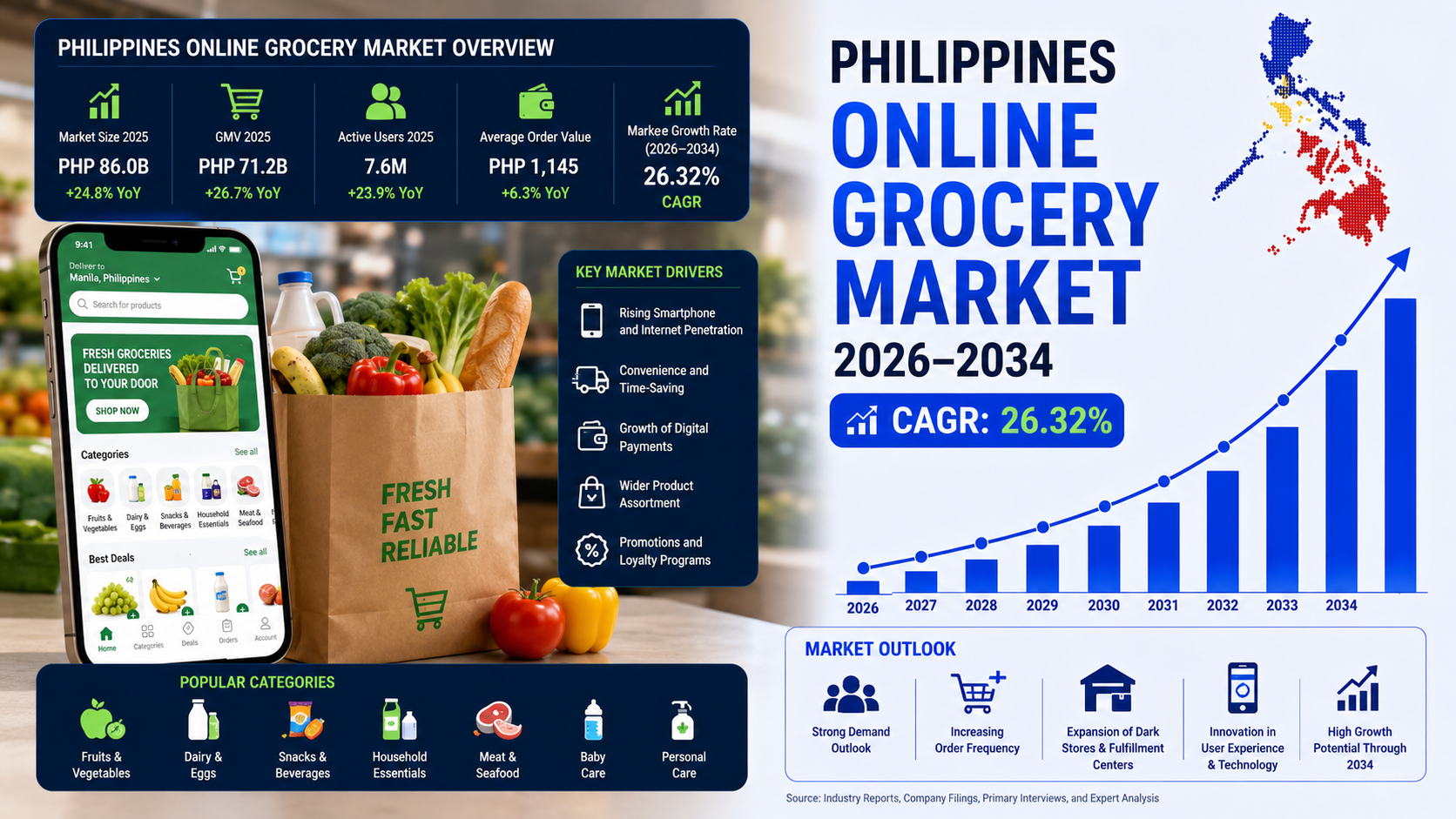
The Philippines online grocery market is experiencing explosive growth, driven by digital transformation that continues reshaping how Filipino consumers purchase daily essentials, with mobile applications and digital wallets driving unprecedented adoption across urban and provincial areas. The market size reached USD 3.9 Billion in 2025 and is projected to reach USD 32.3 Billion by 2034, growing at a compound annual growth rate (CAGR) of 26.32% from 2026 to 2034.
The convergence of improved internet infrastructure, smartphone proliferation, and evolving consumer preferences toward convenience-driven shopping experiences has fundamentally altered the grocery retail landscape throughout the archipelago. The market is strategically important to the Philippines' economy as it enables the nation to modernize its retail sector, create new logistics and technology jobs, and provide convenient access to daily essentials for a growing urban middle class.
Philippines Online Grocery Market Summary
The Philippines online grocery market encompasses a system where consumers purchase daily essentials (vegetables and fruits, dairy products, staples and cooking essentials, snacks, meat and seafood, and others) through digital platforms using web-based or app-based interfaces.
These grocery products are valued for their role in providing convenience, time savings, and access to a wide range of products with delivery options, particularly for time-scarce urban households.
The ecosystem includes pure marketplace and hybrid marketplace platforms, traditional retailers expanding omnichannel presence, digital payment providers (GCash, Maya), logistics and last-mile delivery partners, dark stores and micro-warehouses, and consumers across Luzon, Visayas, and Mindanao.
Major segments identified in the market include product type (staples and cooking essentials at 29%, vegetables and fruits, dairy products, snacks, meat and seafood, others), business model (pure marketplace at 50%, hybrid marketplace, others), platform (app-based at 57%, web-based), purchase type (one-time at 78%, subscription), and region (Luzon at 57%, Visayas, Mindanao).
The market is benefiting from pervasive smartphone adoption and mobile internet penetration, digital payment infrastructure maturation, urbanization and time scarcity among dual-income households, and improved internet connectivity.
The Philippines online grocery sector is shifting from pandemic-driven adoption to normalized, digital-first shopping, with innovations such as dark stores, micro-warehouses, and motorcycle-based last-mile delivery expanding reach beyond major cities.
PORTER'S FIVE FORCES ANALYSIS—PHILIPPINES ONLINE GROCERY MARKET
Bargaining Power of Suppliers—Moderate
Grocery supply is distributed across thousands of traditional retailers, supermarkets, sari-sari stores, and suppliers, but large supermarket chains like Metro Retail and WalterMart have significant bargaining power.
Pure marketplace architectures (50% market share) enable rapid geographic expansion without capital-intensive inventory investments, transferring inventory risk to merchant partners.
Platforms provide merchant partners with access to digital payment infrastructure, delivery logistics, and marketing reach that would otherwise require prohibitive investments, creating platform dependence for many small-scale retailers.
Bargaining Power of Buyers—High
Filipino consumer shopping patterns demonstrate strong promotional sensitivity and price consciousness that favor flexible purchasing over subscription commitments.
Multiple merchant participation on pure marketplaces creates competitive dynamics that benefit consumers through pricing pressure and product variety, giving buyers the ability to compare offerings across merchants instantly.
One-time transactions (78% market share) enable consumers to capitalize on flash sales, seasonal discounts, and platform-specific promotions by shifting purchases across competing services like Grab, foodpanda, Lazada, and MetroMart.
Low switching costs between platforms increase buyer power and force platforms to compete aggressively on price, speed, and service quality.
Threat of New Entrants—Moderate
The Philippines e-commerce market is anticipated to expand at a CAGR of 11.38% from 2024 to 2028, with Gross Merchandise Value expected to rise from USD 14.2 Billion in 2023 to USD 24.8 Billion by 2028, creating an attractive environment for new entrants.
Asset-light pure marketplace models have manageable entry barriers, but operational efficiency requires sustained investments favoring capitalized players.
Established platforms like Grab, foodpanda, and Lazada have significant brand recognition, user bases, and logistics infrastructure, creating barriers for new entrants.
Entry barriers through asset-light marketplaces remain manageable, yet building last-mile delivery networks in the Philippines' archipelagic geography requires substantial investment.
Threat of Substitutes—Moderate to High
Traditional wet markets (palengkes) and physical supermarkets remain strong substitutes, particularly for consumers who value tactile product inspection and personal vendor relationships.
Cultural preferences for fresh ingredients and frequent market visits translate digitally into sporadic online orders rather than scheduled deliveries, with many households exhibiting variable grocery needs.
However, Metro Manila's notorious traffic congestion transforms grocery shopping into significant time investments that justify delivery service premiums for dual-income households.
Work-from-home arrangements create daytime delivery windows previously unavailable, reducing substitution for convenience-focused segments.
Competitive Rivalry—High
The market demonstrates moderate concentration with established digital platforms (Grab, foodpanda, Lazada) competing alongside traditional retailers (Metro Retail, WalterMart) expanding omnichannel presence.
Differentiation occurs through delivery speed (quick commerce with 15-minute delivery promises), freshness assurance, pricing transparency, payment flexibility, and user experience.
Pure-play digital platforms leverage technology-first approaches emphasizing delivery speed and user experience, while traditional retailers pursue omnichannel strategies integrating physical stores with digital ordering.
Competition centers on delivery speed, freshness assurance, pricing transparency, and payment flexibility, with players exploring partnership models including last-mile collaborations and cross-platform loyalty integrations.
Request a Sample Report for In-Depth Market Insights: https://www.imarcgroup.com/philippines-online-grocery-market/requestsample
MARKET GROWTH DRIVERS
Pervasive Smartphone Adoption and Mobile Internet Penetration
The Philippines ranks among Southeast Asia's highest smartphone penetration markets, with mobile devices serving as primary internet access points across urban and provincial areas. Affordable smartphone availability through installment plans places devices within reach of middle and lower-income segments. The Philippines smartphone market size reached USD 563.5 Million in 2025, highlighting the widespread availability of devices that support mobile-first commerce and underpin app-driven grocery adoption. Telecommunications providers continuously invest in network infrastructure upgrades, expanding coverage and bandwidth capabilities. This connectivity transformation eliminates historical barriers to online transactions, enabling real-time browsing, price comparison, and seamless checkout. Younger demographics demonstrate pronounced comfort with mobile interfaces, translating digital fluency into grocery purchasing behaviors. Platform optimization for mobile-first engagement creates self-reinforcing adoption cycles.
Digital Payment Infrastructure Maturation and E-Wallet Proliferation
Digital wallets including GCash, Maya, and platform-specific solutions eliminate cash-on-delivery dependencies that historically complicated online grocery transactions. In October 2025, e-wallet usage in the Philippines has surged at the grassroots level, with a 2025 report finding that about half of surveyed sari-sari store owners saw a 75% increase in e-wallet transactions between January and August, and 85% used GCash while 15% used Maya for business operations, underscoring how digital wallets are rapidly becoming everyday payment tools beyond urban commerce.
In May 2025, Philippine fintech BillEase partnered with Maya Business to embed its Buy-Now-Pay-Later (BNPL) service into Maya's QR Ph-enabled payment gateway and point-of-sale terminals, allowing shoppers to split purchases into installments at checkout without a credit card, a move that strengthens mobile checkout flexibility across digital and physical retail channels. Instant payment confirmation provides transaction certainty while reducing delivery complications and fraud risks. Integration between platforms and payment providers creates frictionless checkout requiring minimal user input beyond biometric authentication. E-wallets expand financial inclusion by providing banking-adjacent services to unbanked segments, transforming payment from friction into competitive advantage.
Urbanization and Time Scarcity Among Dual-Income Households
Metro Manila's notorious traffic congestion transforms grocery shopping into significant time investments that justify delivery service premiums. Dual-income households prioritize convenience over marginal cost savings, recognizing opportunity costs of commuting, navigating crowds, and checkout lines. Traffic conditions in Metro Manila have been shown to slow travel speeds significantly, with ride-hailing data indicating that peak-hour travel times can increase by about 20%–25% due to congestion, reinforcing why urban residents increasingly turn to online delivery services for groceries and essentials.
Work-from-home arrangements create daytime delivery windows previously unavailable. Young professionals demonstrate pronounced digital commerce comfort, transferring online behaviors from fashion and electronics into groceries. Extended working hours and lengthy commutes compress domestic task availability, elevating delivery from luxury to practical necessity. The value proposition encompasses time savings, stress reduction, and lifestyle enhancement. Accelerating urbanization toward metropolitan employment intensifies convenience imperatives.
Mobile-First Shopping Experience Optimization
Platform operators prioritize smartphone-native interfaces accommodating Filipino shopping behaviors through visual-heavy browsing, vernacular language support, and intuitive navigation for varying digital literacy levels. In August 2025, Robinsons Supermarket officially expanded its online grocery ordering options by enabling customers to order via platforms like Foodpanda, GrabMart, and MetroMart through its digital channels, reinforcing how integrated mobile interfaces are becoming central to major supermarket chains' customer experience strategies. One-click reordering, personalized recommendations, and voice search capabilities enhance user convenience. Platforms address connectivity challenges with offline cart functionality and compressed image loading. Push notifications balance promotions with delivery updates, maintaining engagement without fatigue. Desktop interfaces decline in relevance as smartphones dominate internet access nationwide.
Quick Commerce and Ultra-Fast Delivery Proliferation
Platforms compete intensely on fulfillment speed, with dark store networks across Metro Manila and secondary cities enabling minute-range deliveries rather than hours. Social commerce startup SariSuki's rapid grocery-delivery arm Supah vowed to deliver groceries within 15 minutes across key Metro Manila districts through a network of strategically located dark stores and first-party riders, putting hyper-fast fulfillment at the center of its value proposition. Micro-fulfillment centers use data analytics for high-velocity inventory stocking while minimizing spoilage. Motorcycle-based fleets navigate congested traffic efficiently. Real-time tracking builds consumer confidence. Speed transitions from convenience feature to competitive necessity, requiring substantial infrastructure investments yet generating defensible advantages through superior customer experiences.
PHILIPPINES ONLINE GROCERY MARKET SEGMENTATION
Product Type Insights:
Staples and Cooking Essentials (29% share in 2025)
Vegetables and Fruits
Dairy Products
Snacks
Meat and Seafood
Others
Business Model Insights:
Pure Marketplace (50% share in 2025)
Hybrid Marketplace
Others
Platform Insights:
App-Based (57% share in 2025)
Web-Based
Purchase Type Insights:
One-Time (78% share in 2025)
Subscription
Regional Insights:
Luzon (57% share in 2025)
Visayas
Mindanao
COMPETITIVE LANDSCAPE
The Philippines online grocery market demonstrates moderate concentration with established digital platforms competing alongside traditional retailers expanding omnichannel presence. Pure-play digital platforms leverage technology-first approaches emphasizing delivery speed and user experience, while traditional retailers pursue omnichannel strategies integrating physical stores with digital ordering. International e-commerce giants extend established logistics networks from adjacent categories into groceries, bringing substantial capital and operational expertise. Regional players differentiate through localized assortments, vernacular support, and community partnerships that multinationals struggle replicating.
Key players include:
Ever Supermarket
foodpanda
GERALD.ph
Grab
Lazada Group
Metro Retail
MetroMart
Shop Suki
Supervalue, Inc.
Valuemart
WalterMart Delivery
In February 2025, foodpanda Philippines announced it is boosting its grocery delivery arm, pandamart, by focusing on value, convenience, and innovative features to meet rising consumer demand for quick and efficient online shopping. Grab has been expanding its GrabMart operations across Metro Manila, partnering with supermarkets such as Ultramega and convenience stores like Lawson and Shell Select to broaden its product offerings and delivery footprint, helping boost on-demand grocery purchases in everyday life. Philippines-based supermarket WalterMart partnered with logistics provider 2GO to operationalize its e-commerce grocery delivery service across Metro Manila, ensuring same-day delivery of daily essentials and pantry staples directly to consumers' homes.
REGIONAL ANALYSIS
Luzon (57% share): Luzon exhibits clear dominance in the Philippines online grocery market, anchored by Metro Manila's high population density, advanced digital infrastructure, substantial middle-class consumer base, and concentration of logistics networks enabling rapid delivery fulfillment. The capital region hosts the nation's highest smartphone penetration rates, digital payment adoption, and internet connectivity speeds that facilitate seamless online grocery experiences. Affluent and middle-class segments prevalent in Luzon demonstrate willingness to pay delivery premiums for convenience, supporting viable platform unit economics. Established retail infrastructure including supermarkets and convenience stores transitioning into omnichannel operations concentrates in Luzon's urban centers.
Visayas: The Visayas region, including major cities like Cebu, represents a growing market for online grocery. As platforms establish viable business models in Luzon's high-density markets, they subsequently expand into Visayas. The region benefits from improving digital infrastructure and a growing middle class. Social commerce and app-based platforms are gradually increasing their footprint in Visayas' urban centers.
Mindanao: Mindanao represents an emerging market for online grocery, with growth driven by increasing smartphone adoption and digital payment usage. While the region faces infrastructure challenges, platforms are beginning to expand into Mindanao's major urban centers like Davao. As digital literacy improves and last-mile delivery networks develop, Mindanao's market share is expected to grow.
RECENT INDUSTRY DEVELOPMENTS
May 2026: Philippine online grocery platforms accelerated expansion of same-day delivery, AI-driven inventory systems, and digital payment integration as rising urban demand strengthened online food and household purchases nationwide.
May 2026: Staples and cooking essentials accounted for approximately 29% of the Philippines online grocery market in 2025, driven by recurring household demand for rice, cooking oil, noodles, and pantry products. App-based grocery platforms held around 57% market share, while pure marketplace business models accounted for nearly 50% of the sector.
April 2026: Online grocery operators increased investment in cold-chain logistics, dark stores, and regional fulfillment hubs to improve delivery efficiency across Metro Manila, Cebu, Davao, and surrounding urban areas.
March 2026: Luzon accounted for approximately 57% of the Philippines online grocery market activity, supported by higher internet penetration, urban population density, and stronger digital payment adoption. One-time purchases represented around 78% of transactions across online grocery platforms.
February 2026: Retail sales of packaged food products in the Philippines reached approximately US$17.8 billion in 2024, while staple foods accounted for around 36.6% of total packaged food sales. Small local grocery stores or “sari-sari” stores continued dominating distribution with approximately 63.5% market share.
January 2026: The Philippine online grocery market reached approximately USD 3.9 billion in 2025, driven by increasing smartphone penetration, digital wallet usage, and stronger consumer preference for convenience-based shopping.
December 2025: Government digital infrastructure initiatives continued supporting e-commerce growth after the World Bank approved approximately EUR 268.22 million (US$287.24 million) for the Philippines Digital Infrastructure Project aimed at improving internet access for over 20 million Filipinos.
November 2025: Digital grocery and retail platforms expanded partnerships with e-wallet providers including GCash and Maya as cashless transactions became increasingly common across online grocery purchases and food delivery services.
September 2025: AI-powered retail technology adoption accelerated among sari-sari stores after Packworks reported approximately 46% sales increases within two weeks among participating stores using data-driven inventory recommendation systems. The company stated more than 300,000 sari-sari stores were integrated into digitally enabled retail programs.
August 2025: Philippine online grocery demand strengthened further amid rising internet usage and mobile commerce adoption. Industry reports highlighted that the Philippines had approximately 115.8 million people in 2024, with Gen Z and Millennials driving digital grocery purchasing trends.
July 2025: Online grocery retailers increased focus on bulk purchasing, subscription-based delivery models, and eco-friendly packaging solutions as consumers prioritized convenience, affordability, and sustainability in household shopping.
2025: The Philippine retail market continued benefiting from rapid urbanization, middle-class expansion, and digital commerce adoption, while food and beverages remained the country’s largest retail category with approximately USD 48.92 billion in sales during 2024.
Note: If you need any specific information that is not covered currently within the scope of the report, we will provide the same as a part of customization.
Speak to an analyst: https://www.imarcgroup.com/request?type=report&id=28732&flag=C
About Us
IMARC Group is a global management consulting firm that helps the world's most ambitious changemakers to create a lasting impact. The company provides a comprehensive suite of market entry and expansion services. IMARC offerings include thorough market assessment, feasibility studies, company incorporation assistance, factory setup support, regulatory approvals and licensing navigation, branding, marketing and sales strategies, competitive landscape and benchmarking analyses, pricing and cost research, and procurement research.
Contact Us
IMARC Group
134 N 4th St., Brooklyn, NY 11249, USA
Email: [email protected]
Tel No: (D) +91 120 433 0800
United States: +1-201-971-6302
Comments
Log in or sign up to join the conversation.