

Market Overview
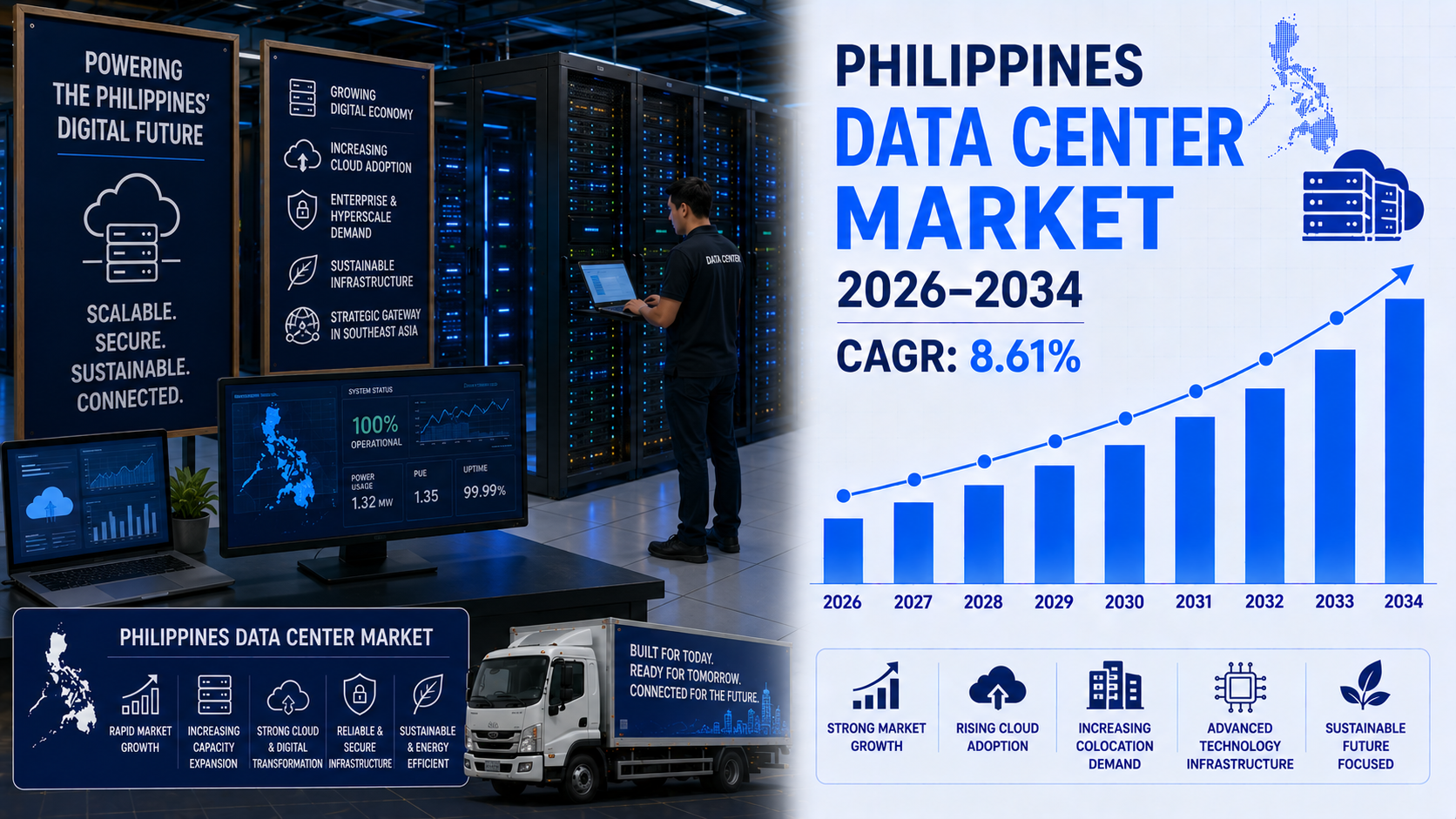
The Philippines data center market is experiencing robust growth, driven by digital transformation that creates massive amounts of data through a variety of channels, along with the rising frequency and sophistication of cybersecurity threats. The market size reached USD 1,043.5 Million in 2025 and is projected to reach USD 2,226.9 Million by 2034, growing at a compound annual growth rate (CAGR) of 8.61% from 2026 to 2034.
According to the Philippine Statistics Authority (PSA), the digital economy of the Philippines in 2023 amounted to PhP 2.05 trillion, contributing 8.4 percent to the country's gross domestic product (GDP). The market is strategically important to the Philippines' economy as it enables the nation to support its digital transformation agenda, enhance cybersecurity posture, and attract foreign investment in IT infrastructure.
Request a Sample Report for In-Depth Market Insights:
https://www.imarcgroup.com/philippines-data-center-market/requestsample
Philippines Data Center Market Summary
The Philippines data center market encompasses a system where data center infrastructure (solutions and services) is deployed to store, process, and manage data generated by digital transformation, cloud computing, IoT devices, and online transactions.
These data centers are valued for their role in providing scalability, agility, cost-effectiveness, advanced security features, and disaster recovery capabilities to businesses undergoing digital transformation.
The ecosystem includes data center operators, cloud service providers, colocation providers, hyperscale operators, edge computing providers, enterprises (large and SMEs), government agencies, and end users across BFSI, IT and telecom, energy, and utilities sectors.
Major segments identified in the market include component (solution, services), type (colocation, hyperscale, edge, others), enterprise size (large enterprises, small and medium-sized enterprises), end user (BFSI, IT and telecom, government, energy and utilities, others), and region (Luzon, Visayas, Mindanao).
The market is benefiting from the Philippine government's active promotion of the digital economy, including favorable policies for foreign investment, tax incentives, and the newly passed Public Service Act (PSA) allowing full foreign ownership of telecommunications and data infrastructure.
Rising cybersecurity attacks, surge in cloud computing and OTT demand, and expanding mobile and internet penetration are driving sustained expansion across all application categories.
PORTER'S FIVE FORCES ANALYSIS—PHILIPPINES DATA CENTER MARKET
Bargaining Power of Suppliers—Moderate
Data center suppliers include providers of IT equipment (servers, storage), cooling systems, power infrastructure, and construction services. Large global brands have significant bargaining power, but the presence of multiple suppliers reduces complete dependency.
Power supply and energy reliability remain challenges, with inconsistent power supply and high electricity costs in the Philippines. Frequent outages or voltage fluctuations increase operational risks, forcing operators to invest heavily in backup systems.
The limited availability of a skilled workforce in technical domains (facility management, electrical engineering, cybersecurity) gives specialized labor suppliers moderate bargaining power.
Bargaining Power of Buyers—Moderate to High
Large enterprises and hyperscale cloud providers (e.g., Alibaba Cloud) have significant bargaining power due to the volume of their data center requirements and ability to choose between multiple colocation and service providers.
Small and medium-sized enterprises (SMEs) and startups increasingly rely on cloud storage and data analytics, but building in-house infrastructure is cost-prohibitive, creating demand for affordable colocation and managed hosting solutions.
Buyers can choose between colocation, hyperscale, and edge data centers based on their latency, scalability, and cost requirements, creating price sensitivity in the market.
Threat of New Entrants—Moderate
Data center development requires significant capital investment, land, power infrastructure, fiber connectivity, and regulatory approvals, creating high barriers for smaller entrants.
The Philippine government's favorable policies for foreign investment, tax incentives through BOI and PEZA, and the Public Service Act allowing full foreign ownership have improved investor confidence and lowered barriers for multinational entrants.
However, infrastructure gaps outside Metro Manila (inadequate fiber networks, poor transportation access, limited skilled labor) hinder expansion into emerging regions.
Threat of Substitutes—Low
Data centers are essential infrastructure for digital transformation, cloud computing, AI workloads, and IoT data processing, with no direct substitutes for their core functions (storage, processing, management).
Edge computing complements rather than substitutes traditional data centers, as both are required for different latency and processing requirements.
The increasing reliance on cloud-based solutions and digital streaming makes data centers indispensable for hosting and administering cloud platforms.
Competitive Rivalry—Moderate to High
The market features global data center operators (Equinix, Digital Edge, EdgeConneX), regional players (Space DC), local providers (VITRO Inc., ePLDT), and cloud service providers (Alibaba Cloud).
Differentiation occurs through geographic footprint, energy efficiency, security certifications, pricing models, and value-added services (managed hosting, disaster recovery, compliance support).
With growing demand for hyperscale and edge infrastructure, competition is intensifying, particularly in Metro Manila and emerging hubs like Davao, Cebu, and Clark.
MARKET GROWTH DRIVERS
Digital Transformation Creating Massive Data Volumes
According to the Philippine Statistics Authority (PSA), the digital economy of the Philippines in 2023 amounted to PhP 2.05 trillion, contributing 8.4 percent to the country's gross domestic product (GDP). Businesses that undergo digital transformation create massive amounts of data through a variety of channels, including online transactions, consumer interactions, IoT devices, and digital apps. This exponential expansion in data volume demands a strong data center infrastructure capable of effectively storing, processing, and analyzing the data.
Cloud computing services provide scalability, agility, and cost-effectiveness and are frequently used in digital transformation. Businesses in the Philippines are progressively transferring their IT infrastructure, applications, and workloads to the cloud to support their digital transformation. This transition to cloud-based solutions increases demand for data center services to host and administer cloud platforms and services.
Artificial intelligence (AI) and the Internet of Things (IoT) are key technologies driving digital transformation in a variety of industries. AI-powered applications and IoT devices generate massive amounts of data, which must be processed, stored, and managed efficiently. Data centers provide the infrastructure required to run AI workloads, handle IoT data, and perform real-time analytics.
Rising Cybersecurity Attacks Driving Demand for Secure Data Centers
An article published in 2023 on the Asia Pacific Foundation of Canada shows that hackers leaked a substantial amount of personal data from the Philippine Health Insurance Corporation (PhilHealth) in which 13 million people were affected by the data breach, including overseas Filipino workers. With the rising frequency and sophistication of cybersecurity threats, organizations in the Philippines are emphasizing data protection. Data centers use advanced security features including firewalls, intrusion detection systems, encryption, and multi-factor authentication to protect critical information and reduce the danger of cyber assaults.
Data center providers frequently hire specialist cybersecurity experts that specialize in threat detection, incident response, and security best practices. Businesses can improve their cybersecurity capabilities and protect against changing cyber threats by employing data center operators' specialized expertise and resources. Data centers assist firms in complying with regulatory demands by building strong security controls, conducting frequent audits, and maintaining compliance certification. Data centers provide disaster recovery and business continuity solutions, such as data backup, replication, and failover capabilities, to assist enterprises in recovering rapidly from cyber events.
Surge in Cloud Computing and OTT Demand
The increasing demand for cloud services and over-the-top (OTT) content is significantly driving data center growth in the Philippines. Businesses, educational institutions, and media platforms rely on scalable cloud infrastructure to deliver seamless online services, requiring high-capacity, low-latency data environments. This growing reliance on cloud-based solutions and digital streaming is prompting hyperscale and colocation providers to invest in local facilities to reduce latency and improve performance.
With more enterprises migrating to hybrid cloud models, the need for robust data infrastructure continues to rise, making the Philippines a strategic location for cloud service providers aiming to strengthen regional coverage and service delivery.
Favorable Government Policies and Economic Incentives
The Philippine government's active promotion of the digital economy includes favorable policies for foreign investment, tax incentives, and streamlined processes for data center development. Agencies like the Board of Investments (BOI) and PEZA offer fiscal benefits to investors setting up IT infrastructure, helping to attract multinational companies. The newly passed Public Service Act (PSA), which allows full foreign ownership of telecommunications and data infrastructure, has further improved investor confidence.
These supportive regulatory frameworks not only foster a more competitive market but also accelerate infrastructure development in both urban and secondary regions, positioning the country as a growing data center destination in Southeast Asia.
Expanding Mobile and Internet Penetration
The Philippines data center market growth is witnessing a steady increase in mobile and internet usage, driven by affordable smartphones, improved connectivity, and a digitally engaged young population. With over 76 million internet users and growing 5G deployment, there is a surge in data consumption across services like video streaming, online gaming, and fintech. To manage and store the massive volume of user data efficiently, data center infrastructure must scale rapidly.
This rising digital activity requires robust backend support, including high-capacity, low-latency data centers located closer to end-users. The continuous expansion of mobile networks and digital services creates an urgent need for resilient and geographically distributed data center facilities across the country.
PHILIPPINES DATA CENTER MARKET SEGMENTATION
Component Insights:
Solution
Services
Type Insights:
Colocation
Hyperscale
Edge
Others
Enterprise Size Insights:
Large Enterprises
Small and Medium-sized Enterprises
End User Insights:
BFSI
IT and Telecom
Government
Energy and Utilities
Others
Regional Insights:
Luzon
Visayas
Mindanao
COMPETITIVE LANDSCAPE
The Philippines data center market features a competitive landscape of global data center operators, regional players, local providers, and cloud service providers. Leading players differentiate through geographic footprint, energy efficiency, security certifications, pricing models, and value-added services. The market is seeing strong foreign investment, with global tech giants seeking to localize their services for better performance and compliance.
Key players include:
Alibaba Cloud
Digital Edge (Singapore) Holdings Pte. Ltd
EdgeConneX Inc
Equinix, Inc.
Space DC Pte Ltd.
VITRO Inc.
REGIONAL ANALYSIS
Luzon: As the region containing Metro Manila, Luzon remains the primary data center hub in the Philippines, benefiting from relatively advanced connectivity and power infrastructure, concentration of enterprise customers, and the presence of major data center operators. The region leads in colocation, hyperscale, and edge infrastructure development.
Visayas: The Visayas region, including emerging cities like Cebu, offers promising opportunities for data infrastructure expansion. These areas benefit from improving power stability, real estate availability, and growing business ecosystems, driving Philippines data center market demand. Decentralizing data center investments into Visayas helps improve national network resilience and ensures localized data processing capabilities.
Mindanao: While Metro Manila remains the primary hub, emerging cities like Davao in Mindanao offer opportunities for data infrastructure expansion. Investing in secondary cities reduces congestion and dependency on a single metro area, creating a more distributed and reliable digital infrastructure landscape. As enterprises and government agencies in Mindanao adopt cloud-based solutions, the need for nearby facilities is growing.
RECENT INDUSTRY DEVELOPMENTS
May 2026: The International Finance Corporation (IFC) proposed an investment package of up to US$170 million to support YCO Global’s data center expansion in the Philippines. The plan includes the development of two data centers in Batangas with a combined capacity of 50 MW, highlighting growing investor confidence in the country's digital infrastructure sector.
May 2026: Industry experts warned that the Philippines must strengthen its power infrastructure to support the rapid growth of the data center industry. Black & Veatch emphasized the need for grid modernization and additional domestic energy capacity to attract large-scale data center investments.
May 2026: The United States and the Philippines advanced discussions on a long-term economic security zone framework under the Pax Silica initiative, which includes support for technology supply chains, computing infrastructure, and data center development.
April 2026: The United States and the Philippines announced plans to develop a 4,000-acre industrial hub in New Clark City focused on AI, semiconductor manufacturing, and data infrastructure, reinforcing the country's position as a growing digital infrastructure destination.
March 2026: Industry reports highlighted strong momentum in the Philippine data center sector, driven by hyperscale deployments, cloud adoption, expanding submarine cable connectivity, and enterprise digital transformation across banking, telecommunications, and e-commerce industries.
Note: If you need any specific information that is not covered currently within the scope of the report, we will provide the same as a part of customization.
Speak to an analyst: https://www.imarcgroup.com/request?type=report&id=23525&flag=C
About Us
IMARC Group is a global management consulting firm that helps the world's most ambitious changemakers to create a lasting impact. The company provides a comprehensive suite of market entry and expansion services. IMARC offerings include thorough market assessment, feasibility studies, company incorporation assistance, factory setup support, regulatory approvals and licensing navigation, branding, marketing and sales strategies, competitive landscape and benchmarking analyses, pricing and cost research, and procurement research.
Contact Us
IMARC Group
134 N 4th St., Brooklyn, NY 11249, USA
Email: [email protected]
Tel No: (D) +91 120 433 0800
United States: +1-201-971-6302
Comments
Log in or sign up to join the conversation.