

Market Overview
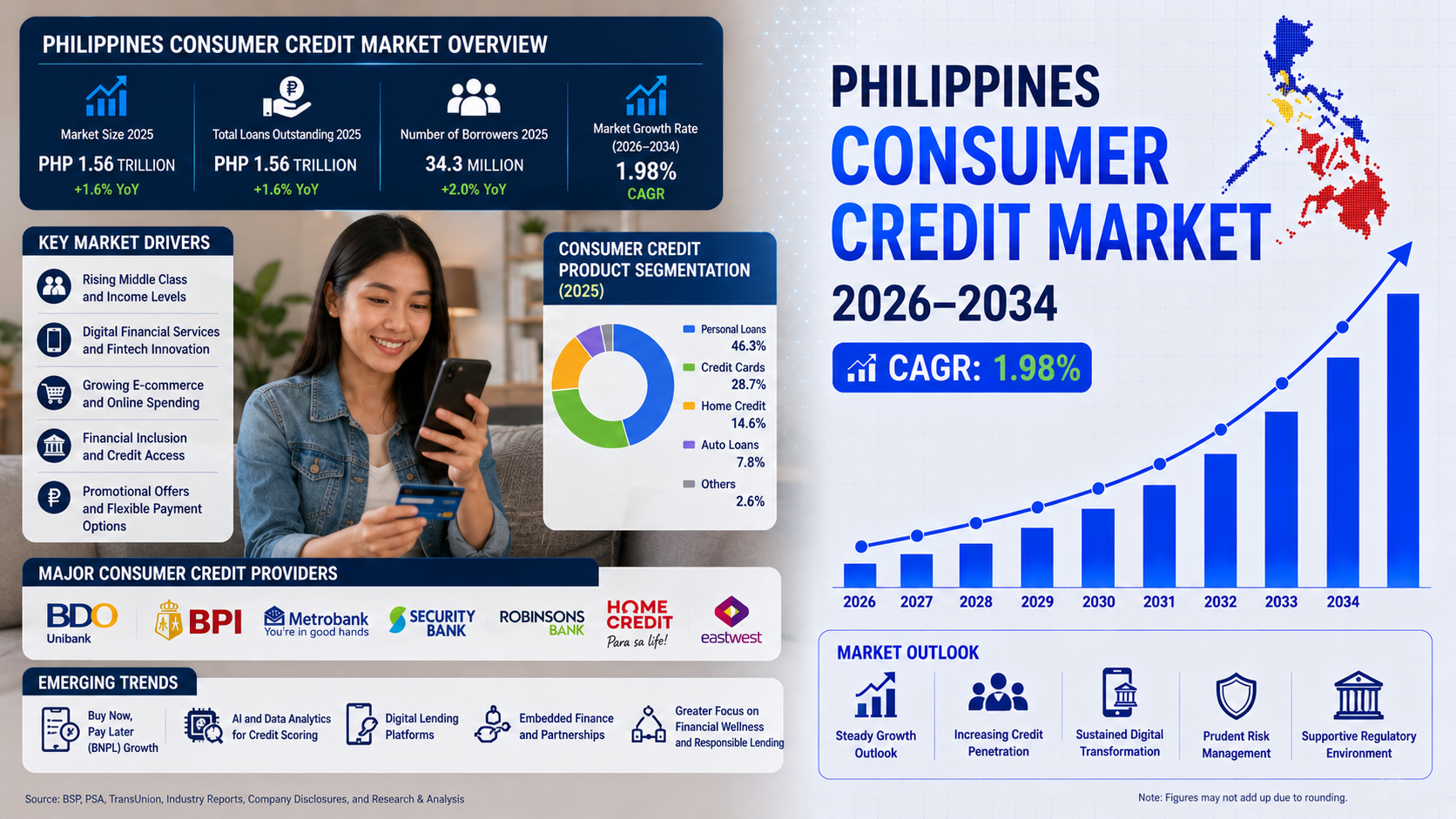
The Philippines consumer credit market is expanding as more people gain access to varied credit options like revolving credit, personal loans, and digital lending platforms. Fintech innovations, mobile apps, and Buy Now Pay Later solutions are increasing convenience and financial inclusion, especially among younger and underserved segments. The market size reached USD 55.1 Million in 2025 and is projected to reach USD 66.1 Million by 2034, growing at a compound annual growth rate (CAGR) of 1.98% from 2026 to 2034.
While traditional banks and neobanks both play a role, regulatory frameworks and responsible lending practices continue to shape market dynamics. This evolving ecosystem underscores the growing relevance of the Philippines consumer credit market share. The market is strategically important to the Philippines' economy as it enables households to manage planned expenses (tuition, home repairs, unexpected needs), supports financial inclusion, and provides credit access to underserved segments.
Request a Sample Report for In-Depth Market Insights: https://www.imarcgroup.com/philippines-consumer-credit-market/requestsample
Philippines Consumer Credit Market Summary
The Philippines consumer credit market encompasses a system where credit products (revolving credits, non-revolving credits) are offered by issuers (banks and finance companies, credit unions, and others) through various service types (credit services, software and IT support services) and payment methods (direct deposit, debit card, and others).
These consumer credit services are valued for their role in providing households with financial flexibility for planned expenses, tuition payments, home repairs, and unexpected needs, while promoting financial inclusion and responsible borrowing.
The ecosystem includes issuers (banks, finance companies, credit unions, neobanks like Tonik), fintech firms (Salmon Group Ltd), regulators (central bank), digital lending platforms, mobile banking apps, and consumers across Luzon, Visayas, and Mindanao.
Major segments identified in the market include credit type (revolving credits, non-revolving credits), service type (credit services, software and IT support services), issuer (banks and finance companies, credit unions, others), payment method (direct deposit, debit card, others), and region (Luzon, Visayas, Mindanao).
The market is benefiting from smoother credit supply conditions with balanced lending standards, broader consumer credit reach as credit becomes a sensible solution for planned costs, digital innovation and regulatory momentum, and the rise of digital-only neobanks and fintech platforms.
The central bank is crafting guidelines to level the playing field among digital-ready institutions and ensuring safeguards through sandbox environments and digital-centric licensing rules.
PORTER'S FIVE FORCES ANALYSIS — PHILIPPINES CONSUMER CREDIT MARKET
Bargaining Power of Suppliers — Moderate
Credit suppliers include banks, finance companies, credit unions, and digital lending platforms. The presence of traditional banks alongside neobanks (Tonik) and fintech firms (Salmon Group Ltd) gives consumers multiple options.
In March 2025, Tonik, the Philippines' first digital-only neobank, surpassed one million cumulative loans since its launch, demonstrating that digital-first suppliers are expanding choice and competition.
Regulatory frameworks and responsible lending practices shape supplier behavior, but the increasing number of fintech entrants reduces any single supplier's dominance.
Bargaining Power of Buyers — Moderate
Borrowers include Filipino households across urban and rural areas, with increasing access to mobile banking enabling people to understand credit choices and avail themselves when needed.
The popularity of Buy Now Pay Later solutions, mobile apps, and digital lending platforms increases buyer choice and convenience. Consumers can compare terms, interest rates, and repayment options across multiple providers.
As financial literacy increases and access expands, more consumers see credit as a normal aspect of planning finances rather than something to be shunned, giving them confidence to seek favorable terms.
In January 2025, a central bank report revealed that while demand for household loans remained steady, banks were preparing to slightly tighten lending standards, which may temporarily reduce buyer power for riskier segments.
Threat of New Entrants — Moderate
The Philippines consumer credit market is seeing significant new entrants, particularly in the digital lending space. In June 2025, fintech firm Salmon Group Ltd secured substantial funding to accelerate its expansion in the Philippines.
The central bank's sandbox environments and digital-centric licensing rules support safer innovation, making it easier for compliant digital entrants to enter the market.
However, regulatory frameworks, responsible lending requirements, and the need for BSP regulation (Salmon has a BSP-regulated bank and financing arm) create barriers for unregulated entrants.
Threat of Substitutes — Moderate
Informal lending sources (family, friends, informal moneylenders) are substitutes for formal consumer credit. However, the shift toward organized lending with clear terms and feasible repayment schedules is reducing reliance on informal sources.
Savings and personal funds are substitutes for borrowing, but for planned expenses like tuition and home repairs, credit offers useful flexibility.
The increasing popularity of mobile banking and digital credit platforms is making formal credit more accessible, reducing the attractiveness of informal substitutes.
Competitive Rivalry — Moderate to High
The Philippines consumer credit market features competition among traditional banks, finance companies, credit unions, digital-only neobanks (Tonik), and fintech platforms (Salmon Group Ltd).
Differentiation occurs through digital user experience, approval speed, interest rates, repayment flexibility, customer service, and financial literacy support.
In March 2025, Tonik surpassed one million cumulative loans, demonstrating the scale achievable through AI-driven underwriting and a credit-first strategy. In June 2025, Salmon Group Ltd secured new funding to broaden its financial services reach using AI and cutting-edge technology.
The central bank's efforts to level the playing field among digital-ready institutions are intensifying competition while keeping consumer protection front and center.
MARKET GROWTH DRIVERS
Smoother Credit Supply Conditions
The credit environment in the Philippines is becoming more balanced, with financial institutions adjusting to consumer needs while still managing risk. As more households explore borrowing options, the market is responding by refining its approach—not by limiting access, but by introducing clearer expectations around repayment and eligibility. In January 2025, a central bank report revealed that while demand for household loans remained steady, banks were preparing to slightly tighten lending standards to keep risk levels in check.
Rather than signaling restriction, this reflects a credit landscape that's learning to evolve with borrower behavior. The result is a lending environment that feels more stable and predictable, offering consumers confidence in both availability and fairness. Households are also becoming more strategic, applying for credit with clearer goals and understanding the long-term impact of their borrowing choices. Together, these trends indicate a maturing system that values sustainability over short-term volume. As institutions and consumers align expectations, we're seeing stronger resilience and smarter borrowing habits shaping the Philippines consumer credit market trends.
Broader Consumer Credit Reach
The Philippines consumer credit market is slowly becoming more inclusive, with more Filipinos becoming confident in using credit as a financial tool. Previously considered a last option, credit is now considered by many families as a sensible solution for coping with planned costs, e.g., tuition, home repairs, or unexpected needs. In the latter part of 2024, national polls started showing a change in consumer attitude, where more people showed willingness towards organized lending, particularly if terms are clear and repayment feasible.
This change isn't caused by gimmicky campaigns; it's due to sustained awareness efforts, better lending practices, and better access online. The increasing popularity of mobile banking has enabled people in urban and rural areas to easily comprehend their credit choices and avail themselves of it when the need arises. With financial literacy increasing and access expanding, increasingly more consumers are seeing credit as a normal aspect of planning finances and not as something to be shunned. All these are building good grounds for wholesome Philippines consumer credit market growth.
Digital Innovation and Regulatory Momentum
The Philippines' consumer credit market is getting a real lift from digital innovation and evolving regulatory support, quietly reshaping how people access and understand credit. As digital tools expand from e-wallets and mobile lending platforms to digital IDs and open finance frameworks, consumers are finding it easier to engage with formal credit, even in places once labeled underserved.
On the regulatory front, the central bank is playing a vital role in steering this shift: it's crafting guidelines to level the playing field among digital-ready institutions and ensuring safeguards through sandbox environments and digital-centric licensing rules. That kind of approach supports safer innovation while keeping consumer protection front and center. What's more, efforts around digital payments, consumer fintech literacy, and responsible lending standards are helping build trust and making credit feel less like a mystery and more like a tool people can use with understanding. All of this is fostering a more inclusive ecosystem by blending speed, simplicity, and security.
PHILIPPINES CONSUMER CREDIT MARKET SEGMENTATION
Credit Type Insights:
Revolving Credits
Non-revolving Credits
Service Type Insights:
Credit Services
Software and IT Support Services
Issuer Insights:
Banks and Finance Companies
Credit Unions
Others
Payment Method Insights:
Direct Deposit
Debit Card
Others
Regional Insights:
Luzon
Visayas
Mindanao
COMPETITIVE LANDSCAPE
The Philippines consumer credit market features a competitive landscape of traditional banks, finance companies, credit unions, digital-only neobanks, and fintech platforms. Leading players differentiate through digital user experience, approval speed, interest rates, repayment flexibility, AI-driven underwriting, and customer service. The central bank's sandbox environments and digital-centric licensing rules support innovation while keeping consumer protection front and center.
Key players include:
Tonik (Philippines' first digital-only neobank)
Salmon Group Ltd (fintech firm with BSP-regulated bank and financing arm)
Traditional banks and finance companies
Credit unions
REGIONAL ANALYSIS
Luzon: As the region containing Metro Manila and other major urban centers, Luzon represents the largest consumer credit market in the Philippines. The region benefits from higher financial literacy, greater mobile banking penetration, and concentration of banks, finance companies, and digital lending platforms. The increasing popularity of mobile banking has enabled people in Luzon's urban and rural areas to easily comprehend credit choices.
Visayas: The Visayas region, including major cities like Cebu, is experiencing growing consumer credit access driven by digital innovation and mobile banking expansion. Fintech platforms and digital lending services are reaching previously underserved segments. The region's economic growth and urbanization are contributing to increased credit demand for planned expenses including tuition and home repairs.
Mindanao: Mindanao represents an emerging consumer credit market with significant growth potential as digital tools expand access to formal credit in once-labeled underserved areas. Mobile banking and digital lending platforms are enabling residents to understand credit choices and avail themselves when needed. As financial literacy increases, consumers in Mindanao are increasingly seeing credit as a normal aspect of financial planning.
RECENT INDUSTRY DEVELOPMENTS
June 2026: The Philippine central bank reported that outstanding consumer loans of universal and commercial banks reached approximately PHP 1.67 trillion as of March 2026, representing a 24.4% year-on-year increase. Growth was primarily driven by rising demand for credit cards, auto loans, and salary-based lending products.
May 2026: Credit card lending remained one of the fastest-growing consumer credit segments. Outstanding credit card receivables increased by approximately 29% year-on-year, supported by higher consumer spending and increased adoption of cashless payment solutions.
April 2026: The Philippine economy expanded by 5.4% year-on-year in Q1 2026, while household consumption remained the largest contributor to GDP growth. Strong consumer spending continued to support demand for personal loans, installment financing, and credit card products.
March 2026: The Bangko Sentral ng Pilipinas (BSP) reported that total bank lending grew by approximately 11.8% year-on-year, with consumer loans continuing to outpace overall credit growth. Consumer credit accounted for an increasing share of retail banking portfolios.
February 2026: Digital lending platforms continued expanding financial access across the Philippines. The country maintained one of Southeast Asia's highest rates of e-wallet adoption, with millions of consumers using digital financial services for borrowing, payments, and credit-related transactions.
January 2026: The Credit Card Association of the Philippines (CCAP) reported continued growth in card issuance and transaction volumes as consumers increasingly utilized revolving credit and installment payment facilities for retail purchases and everyday spending.
January 2026: Household consumption remained resilient amid easing inflation, which averaged around 2–3%, improving purchasing power and supporting demand for consumer financing products including personal loans, auto loans, credit cards, and buy-now-pay-later (BNPL) services.
Note: If you need any specific information that is not covered currently within the scope of the report, we will provide the same as a part of customization.
Speak to an analyst: https://www.imarcgroup.com/request?type=report&id=42056&flag=C
About Us
IMARC Group is a global management consulting firm that helps the world's most ambitious changemakers to create a lasting impact. The company provides a comprehensive suite of market entry and expansion services. IMARC offerings include thorough market assessment, feasibility studies, company incorporation assistance, factory setup support, regulatory approvals and licensing navigation, branding, marketing and sales strategies, competitive landscape and benchmarking analyses, pricing and cost research, and procurement research.
Contact Us
IMARC Group
134 N 4th St., Brooklyn, NY 11249, USA
Email: [email protected]
Tel No: (D) +91 120 433 0800
United States: +1-201-971-6302
Comments
Log in or sign up to join the conversation.