

Market Overview
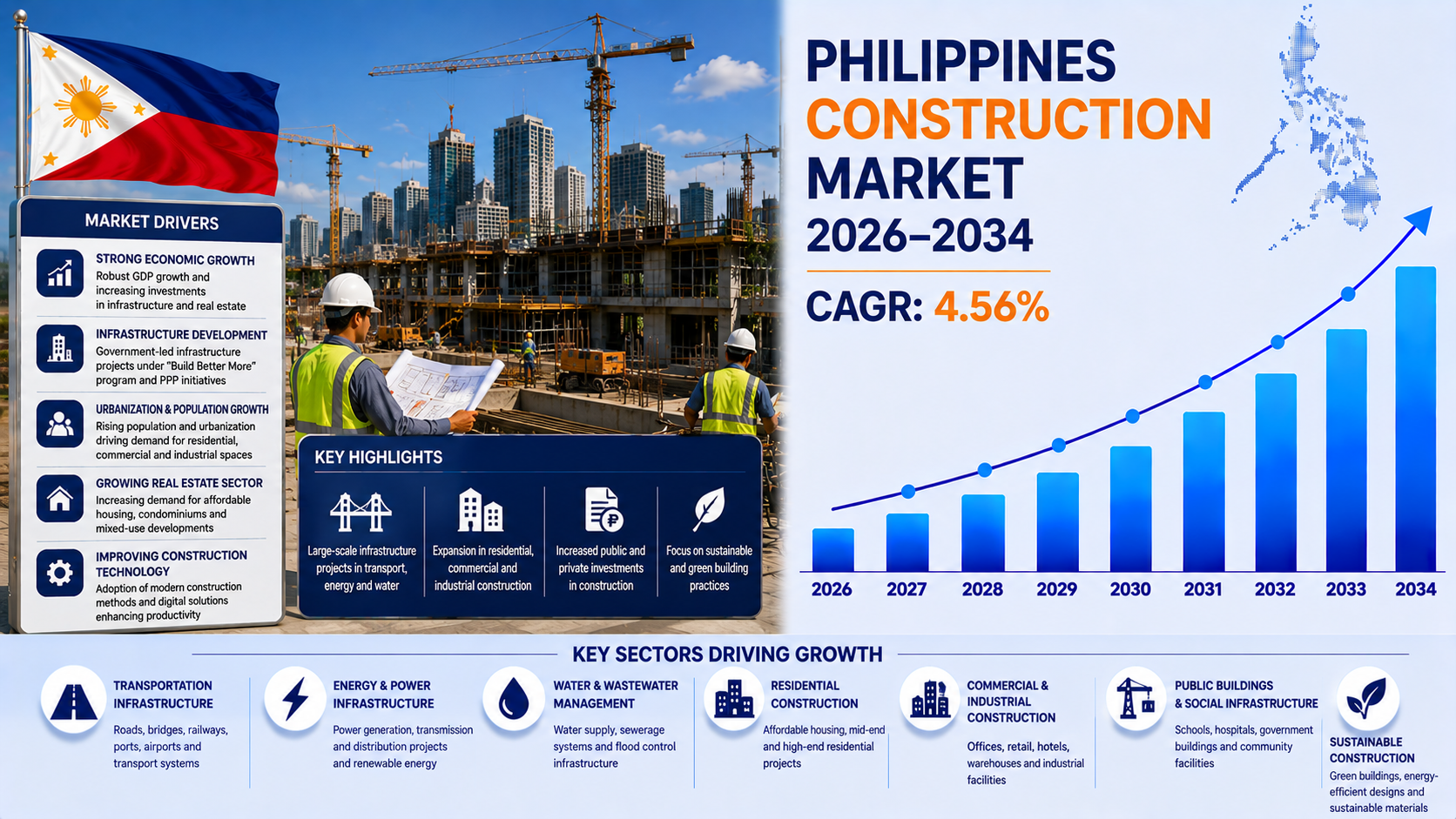
The Philippines construction market size reached USD 41.3 Billion in 2025 and is projected to reach USD 61.7 Billion by 2034, growing at a compound annual growth rate of 4.56% from 2026 to 2034. The market is expanding, driven by rising infrastructure investments under the government's ambitious public-private partnership pipeline; rapid urbanization fuelling residential and commercial construction demand; and growing foreign direct investment in industrial and economic zone development. The Philippine PPP Center's rollout of 187 infrastructure projects valued at PHP 2.6 trillion as of April 2025, the DTI-CIAP and Philippine Constructors Association's 5th Philippine Construction Congress in November 2024, and the construction sector's expanded contribution to 7.7% of GDP in the first semester of 2025 are collectively reinforcing the market's strong and sustained growth trajectory throughout the forecast period.
Request for Sample Report: https://www.imarcgroup.com/philippines-construction-market/requestsample
Market Trends
Government Infrastructure Initiatives and PPP Expansion
Large-scale government infrastructure programs are the most structurally significant trend shaping the Philippines construction market, with the PPP Center announcing 187 infrastructure projects valued at PHP 2.6 trillion as of April 2025 across transportation, health, and information technology sectors. The Society of Construction Law Philippines and DTI-CIAP signed an MoU to develop standardized contract templates and conduct awareness campaigns, improving project execution consistency. Public-private partnerships are simultaneously attracting foreign capital into road networks, rail systems, airports, and bypass roads that enhance logistics efficiency and stimulate industrial and commercial development across Luzon, Visayas, and Mindanao.
Emphasis on Sustainable and Green Building Practices
Growing environmental awareness and evolving regulatory standards are compelling Philippine construction firms to adopt eco-friendly materials — including recycled concrete, bamboo, and low-carbon cement — alongside smart building systems featuring light automation, ventilation control, and water management. In November 2024, DTI-CIAP and the Philippine Constructors Association convened the 5th Philippine Construction Congress, bringing together industry leaders and experts to discuss sustainable construction, regulatory innovation, and green building trends. Developers are seeking green building certifications in residential, commercial, and industrial projects, driving innovation in environmentally responsible construction methodologies and aligning the industry with international sustainability objectives throughout the forecast period.
Urban Housing Boom and Vertical Development
Rapid urbanization across Philippine metropolitan areas is propelling substantial residential construction growth, with rising population density and an expanding middle class fueling demand for both affordable housing and premium high-rise condominiums. Families seeking modern homes near central business districts, schools, and commercial centers are accelerating vertical housing project development across Metro Manila, Cebu, and Davao. Government-subsidized affordable housing programs targeting low-to-middle-income households are supplementing private developer activity, while construction's value-added rising to PHP 1,079,645 million in the first semester of 2025 confirms the housing sector's robust and structurally significant contribution to overall construction market momentum.
Market Growth Drivers
Industrial and Economic Zone Expansion
The progressive expansion of industrial and economic zones across the Philippines is generating sustained and large-scale construction demand for manufacturing facilities, logistics centres, warehouses, and associated infrastructure. These development zones strengthen the nation's industrial foundation, enhance trade competitiveness, and create consistent long-term project pipelines for construction contractors, material suppliers, and engineering service providers. As domestic and foreign manufacturers establish and expand Philippine production facilities, construction firms are positioned as essential enablers of the country's industrial growth strategy, ensuring continuous demand for construction services and materials across Luzon, Visayas, and Mindanao's designated economic development corridors throughout the forecast period.
Growing Foreign Direct Investment
Foreign direct investments continue to provide essential capital, technical expertise, and international best practices that are materially elevating the Philippines construction market scale, quality, and competitiveness. Global investors are channelling funds into real estate, commercial developments, and large-scale infrastructure projects, creating new opportunities for both domestic and international construction firms. The Philippine banking system's construction loan outstanding grew 13.4% year-on-year in the first eight months of 2024, reflecting sustained financial sector confidence in construction market fundamentals. FDI-driven partnerships with local companies generate employment, accelerate technology transfer, and introduce sustainable construction methodologies that progressively raise industry standards across all building sectors.
Public-Private Partnerships as a Project Pipeline Driver
Public-private partnerships are the most commercially significant structural mechanism driving sustained construction project flow across the Philippines, enabling the government to leverage private sector expertise, capital, and operational efficiency for infrastructure delivery without proportional strain on public fiscal resources. PPPs across expressways, rail systems, airports, and water supply networks provide construction firms with a continuous and long-term project pipeline that insulates market activity from cyclical economic fluctuations. The PPP Center's 187-project pipeline—comprising 95 solicited projects worth USD 21 billion and 78 unsolicited projects worth USD 37 billion—demonstrates the program's scale as a market growth engine throughout the 2026–2034 forecast period.
Porter's Five Forces Analysis of the Philippines Construction Market
1. Threat of New Entrants — Low to Moderate
High capital requirements for heavy construction equipment, bonding capacity, and qualified engineering workforce create substantial barriers favouring established contractors with proven project delivery credentials over smaller new market entrants
PPP bidding requirements and government contractor accreditation processes mandate demonstrated technical and financial capacity, effectively limiting large infrastructure project access to pre-qualified firms with established regulatory relationships
Modular construction, prefabrication, and technology-driven project delivery are progressively lowering barriers in the residential and commercial building segments, enabling new-format operators to compete without full heavy infrastructure capability
2. Bargaining Power of Suppliers — Moderate to High
Steel, cement, and construction aggregate suppliers—given global commodity price volatility and the Philippines' dependence on imported steel—hold meaningful pricing leverage over construction firms, with material cost escalation consistently cited as the sector's most significant margin pressure
Skilled labor contractors, including engineers, architects, and specialized tradespeople, exercise growing leverage as rapid construction sector expansion and overseas employment migration compress the qualified domestic labour supply available to competing project developers
Domestic cement manufacturers and regional construction material producers hold moderate leverage in provincial markets where logistics costs and supply distances limit the practical availability of competing imported material alternatives
3. Bargaining Power of Buyers — Moderate
Government agencies and PPP procurement authorities exercise strong buyer leverage through competitive bidding processes, standardised contract conditions, and consolidated project award decision-making that compels construction firms to submit highly competitive technical and financial proposals
Large private developers including Ayala Land, SM Prime, and DMCI Homes hold substantial procurement leverage over construction contractors through multi-project framework agreements and the ability to allocate project mandates across competing qualified builders
Individual residential and small commercial buyers hold limited leverage but collectively represent a high-volume buyer segment whose price sensitivity constrains developer margins in the affordable and mid-market housing construction segments
4. Threat of Substitutes — Low
Physical construction of residential, commercial, industrial, and infrastructure assets has no genuine functional substitute in the Philippine context, where population growth, urbanisation, and economic development create non-discretionary and structurally growing built environment demand
Prefabricated and modular construction techniques represent an evolving delivery methodology rather than a substitute for the construction sector itself, improving project efficiency and speed while remaining part of the broader construction value chain
Remote work and digital collaboration tools modestly reduce incremental commercial office space demand in specific submarkets but cannot substitute for the fundamental built environment requirements of a growing population of 118 million across the archipelago
5. Competitive Rivalry — High
Major construction conglomerates including EEI Corporation, D.M. Consunji Inc., Megawide Construction Corporation, and Sta. Clara International compete intensely for flagship PPP, infrastructure, and large-scale residential contracts through EPC capabilities, precast manufacturing assets, and government relationship strength
GlobalData's forecast of 6.2% real construction industry growth in 2025 and the government's PHP 2.6 trillion PPP pipeline are sustaining high competitive intensity as both domestic leaders and international engineering firms pursue an expanding but competitively contested project award market
The convergence of green building requirements, BIM adoption mandates, and technology integration expectations in government project specifications is progressively differentiating capable technology-forward contractors from traditional operators and reshaping competitive positioning across all building sectors
Market Segments
By Sector:
Residential
Commercial
Industrial
Infrastructure
Energy and Utilities
Institutional
By Region:
Luzon
Visayas
Mindanao
Competitive Landscape
The market research report has provided a comprehensive analysis of the competitive landscape in the Philippines construction market. Competitive analysis covering market structure, key player positioning, top winning strategies, competitive dashboard, and a company evaluation quadrant with detailed profiles of all major companies has been included in the report. Key participants compete across residential, commercial, industrial, infrastructure, energy, and institutional construction sectors through PPP project participation, EPC capability, sustainable building certification investment, BIM technology adoption, and government accreditation relationships throughout Luzon, Visayas, and Mindanao.
Latest News and Developments
May 2026: A nine-story condo-hotel under construction in Angeles City collapsed, triggering one of the country's most significant construction-related incidents of the year. The accident resulted in at least four fatalities, 26 people rescued, and 17 people reported missing, prompting investigations into construction safety compliance and building permit violations.
May 2026: The Philippine government launched an investigation into the Angeles City building collapse after reports indicated that the project was approved as a 9-story structure but was allegedly undergoing construction of a 10th-floor swimming pool. Authorities are reviewing potential safety and regulatory violations.
May 2026: Infrastructure Secretary Vince Dizon reported that several of the country's largest construction firms expressed interest in participating in upcoming government infrastructure projects under the ongoing national development program, highlighting continued private-sector engagement in public construction works.
April 2026: The Philippine Statistics Authority (PSA) reported that the total value of approved construction projects reached approximately PHP 49.1 billion in March 2026. Residential buildings accounted for PHP 18.7 billion, while the average construction cost increased 15.0% year-on-year to PHP 12,987.74 per square meter.
April 2026: Industry reports highlighted continued momentum in infrastructure expansion, urban high-rise developments, industrial projects, and modular construction adoption across the Philippines, driven by government infrastructure initiatives and private-sector investments.
Note: If you require any specific information that is not covered currently within the scope of the report, we will provide the same as a part of the customization.
Speak to an analyst for a customized sample report: https://www.imarcgroup.com/request?type=report&id=28749&flag=C
About Us
IMARC Group is a global management consulting firm that helps the world's most ambitious changemakers to create a lasting impact. The company provides a comprehensive suite of market entry and expansion services. IMARC offerings include thorough market assessment, feasibility studies, company incorporation assistance, factory setup support, regulatory approvals and licensing navigation, branding, marketing and sales strategies, competitive landscape and benchmarking analyses, pricing and cost research, and procurement research.
Contact Us
IMARC Group
134 N 4th St., Brooklyn, NY 11249, USA
Email: [email protected]
Tel No.: (D) +91 120 433 0800
United States: +1-201-971-6302
Comments
Log in or sign up to join the conversation.