

Perumal and Padmavathi Thayar, the divine couple of Tirumala and Tiruchanur, are worshipped as the embodiment of grace, prosperity and marital harmony. Devotees across South India revere Lord Perumal, known as Sri Venkateswara, together with his consort Padmavathi Thayar, and the pair is regarded as the very picture of a devoted and auspicious couple.
Their story is a rich blend of Puranic legend, temple tradition and living devotion. It tells of Lord Vishnu leaving Vaikuntha for the Seshachala hills, of a divine wedding attended by the gods, and of a bridegroom who took a loan for his own marriage. In this blog, we explore who Perumal and Padmavathi Thayar are, what their form symbolises, the legend behind their union, and why they remain so dear to families everywhere. This guide is brought to you by Gold Plating Art Studio, home of handcrafted South Indian bronze and brass idols.
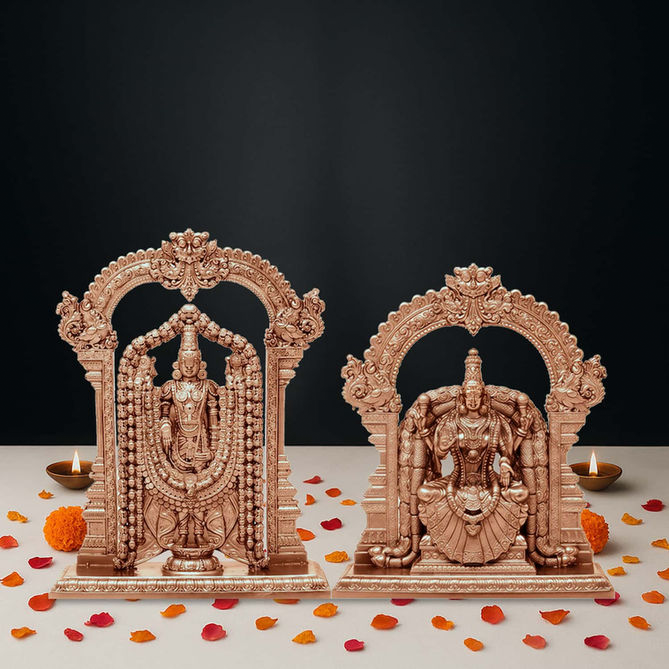
Who Are Perumal and Padmavathi Thayar?
Perumal is the beloved name by which Lord Vishnu is worshipped across Tamil Nadu and the wider South. Thayar, meaning "Mother," is the name for his consort, the Goddess Lakshmi. When devotees speak of Perumal and Padmavathi Thayar, they refer to Lord Venkateswara and his wife Padmavathi, the divine pair of the Tirumala–Tiruchanur tradition.
Perumal as Sri Venkateswara
Perumal here is Sri Venkateswara, also called Srinivasa and Balaji, the Lord who dwells on the Venkatadri hill at Tirumala. He is believed to have come to Earth in the Kali Yuga to protect and bless his devotees, and he is among the most widely worshipped forms of Vishnu.
Padmavathi Thayar as Alamelu Manga
Padmavathi Thayar is also known as Alamelu Manga, which means "the lady who dwells on the lotus." Tradition holds that she is Goddess Lakshmi herself, born on Earth to become the bride of Lord Venkateswara. Devotees look to her as the compassionate Mother who carries their prayers to the Lord.
The Meaning of Perumal and Thayar
In Tamil devotional tradition, Perumal means "the great one," and Thayar means "mother." Together they describe a divine couple who are worshipped as Father and Mother of the universe, and the idols of the two are traditionally worshipped side by side.
Iconography and Symbolism of Perumal and Padmavathi Thayar
Traditional idols of the divine couple follow well-established iconography. Bronze and brass idols carry the same symbolism, so each detail has a meaning worth understanding.
Perumal's Standing Form and the Namam
Lord Perumal is shown standing tall on a lotus pedestal, wearing a tall crown and a rich array of ornaments. On his forehead is the namam, the sacred Vaishnava mark, which shows his identity as Vishnu.
The Shankha and Chakra
In his upper hands he holds the conch (shankha) and the discus (chakra). The conch stands for the primal sound of creation, while the discus represents the power that protects dharma and removes evil.
The Hands of Refuge
In the traditional Venkateswara form, one lower hand points toward his feet, offering them as refuge to the devotee, while the other rests at the hip. Devotees see this as a message that the ocean of worldly life becomes shallow for those who surrender to him.
Padmavathi Thayar's Lotus and Gestures
Padmavathi Thayar is shown seated or standing on a lotus, holding lotus flowers in her upper hands, while her lower hands show the gestures of fearlessness (abhaya) and boon-giving (varada). The lotus stands for purity, prosperity and spiritual awakening.
The Divine Pair Together
When shown together, Perumal and Thayar express the union of divine strength and divine compassion. The Lord protects and the Mother intercedes, and the two are worshipped as one indivisible presence.
The Legend of Perumal and Padmavathi Thayar
The story of their union is told in several connected stages, each of which reveals something about the Lord and the Goddess.
Lakshmi Leaves Vaikuntha
According to the Puranic tradition, the sage Bhrigu once tested the three great gods to decide who was the greatest. When he reached Vishnu, he struck the Lord's chest, the place where Lakshmi resides. Lakshmi was hurt and left Vaikuntha, and Vishnu, deeply troubled by her departure, followed her to Earth in search of her.
Vishnu Settles on the Seshachala Hills
Vishnu came down to the Venkatadri hill and took shelter in an anthill under a tamarind tree. There, an elderly woman named Vakula Devi cared for him like a mother, and the Lord lived among the hills for a long time.
The Meeting with Padmavathi
In time, the Lord met a maiden named Padmavathi, the daughter of King Akasa Raja, who ruled the land of Narayanavanam. Tradition tells us that she was Lakshmi herself, reborn on Earth. Drawn to each other by a divine bond, the two agreed to marry, and the king gave his blessing to the match.
The Divine Wedding and the Loan from Kubera
To hold the wedding in a manner fit for a king's daughter, the Lord needed wealth, and it is said that he borrowed a large sum from Kubera, the god of wealth, promising to repay it with interest. The gods, sages and celestial beings gathered for the wedding, and Brahma himself is said to have presided over the ceremony. Devotees believe the offerings they make at Tirumala help repay this loan to this day.
Padmavathi Takes Her Abode at Tiruchanur
After the wedding, Padmavathi took her abode at Tiruchanur, near Tirupati, while the Lord remained on the hill at Tirumala. Even today, devotees consider a visit to the Padmavathi Temple to be part of a complete pilgrimage.
Temples and Festivals of Perumal and Padmavathi Thayar
The divine couple is worshipped in two great shrines, along with countless temples and home altars across South India.
Sri Venkateswara Temple, Tirumala: The famous hill shrine in Andhra Pradesh where the Lord stands as Sri Venkateswara, one of the most visited pilgrimage places in the world.
Sri Padmavathi Ammavari Temple, Tiruchanur: The temple of the Goddess at Alamelumangapuram near Tirupati. Tradition links it to the sacred tank, the Padma Sarovaram, in which the Goddess is said to have appeared on a golden lotus.
Brahmotsavam: The grand annual festival at Tirumala, when the Lord is taken in procession on a variety of vahanas.
Karthika Brahmotsavam: The annual festival at Tiruchanur, ending with the Panchami Theertham, a holy dip in the temple tank.
Padmavathi Parinayotsavam: The celebration of the divine wedding, observed each year with special rituals.
Spiritual Significance of Perumal and Padmavathi Thayar
The worship of the divine couple speaks to many aspects of family and spiritual life.
Blessings for Marriage and Family Harmony
Because their union is one of the most celebrated in tradition, Perumal and Padmavathi are worshipped for happy and lasting marriages. Families pray to them for harmony, understanding and mutual devotion between husband and wife.
Prosperity and Relief from Burdens
The Lord who borrowed from Kubera is worshipped as a giver of wealth and as a compassionate helper of those under financial strain. Padmavathi, as Lakshmi, is the bestower of prosperity, so the pair together are prayed to for abundance and stability in the household.
Refuge and Surrender
The hand pointing to the Lord's feet is an invitation to surrender. Devotees seek his shelter in times of fear, confusion and hardship, trusting that the divine couple will protect them.
The Mother as Intercessor
In the Vaishnava tradition, the Mother is believed to plead for the devotee before the Lord. Approaching Perumal along with Thayar is therefore considered especially auspicious.
Why Is This Divine Couple Different from Other Divine Pairs?
Hindu tradition honours many divine couples, but Perumal and Padmavathi have a character of their own.
A wedding story rooted in the Earth: Unlike many couples who are together from the beginning, their union is a marriage arranged on Earth, with a king's blessing and a wedding attended by the gods.
The bridegroom who took a loan: The tale of Kubera's loan makes the Lord approachable, and it has shaped the tradition of offerings at Tirumala.
Lakshmi as a bride: Padmavathi is Lakshmi in the form of a princess, which links her closely to the human world.
Two shrines, one pilgrimage: The tradition of visiting both Tirumala and Tiruchanur reflects how the Lord and the Goddess are inseparable.
Different from Lakshmi Narayana: In the Lakshmi Narayana form, the pair is shown together in Vaikuntha, while Perumal and Padmavathi are tied to a particular Earthly story and to the hills of Tirumala.
A model of harmony: Their union is worshipped as an example of understanding and devotion between husband and wife.
Conclusion
Perumal and Padmavathi Thayar are much more than a divine couple in a temple story. They are the Lord who gives refuge, the Mother who intercedes, and a picture of harmony and prosperity for every household. Their legend teaches devotion, humility and faith, and their worship brings comfort to countless families. Keeping their image in bronze or brass in the pooja room is a way to welcome that grace into your everyday life.
Comments
Log in or sign up to join the conversation.