

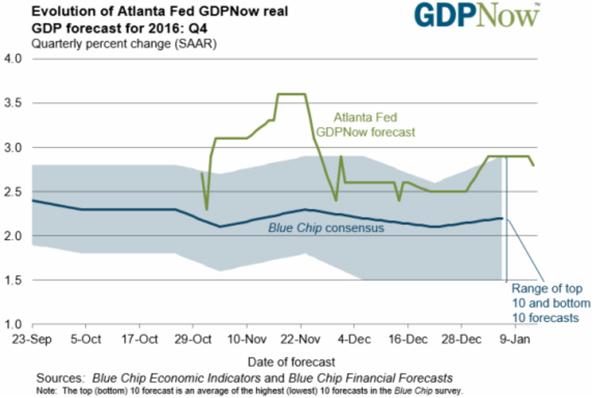
...The economic data on the homefront has been improving, as evidenced by the 3.2% real GDP growth rate for the third quarter and the upward revision from 2.5% to 2.8% for the fourth quarter 2016 GDP, as reported by the Atlanta Fed on January 13th. Meanwhile, the Trump administration is aiming to introduce legislation on tax reform, deregulation, and infrastructure spending during his first 100 days in office. Many market participants, including me, expect these initiatives to lead to stronger economic growth in 2017, which could also be accompanied by higher inflation. Accordingly, the market has been working to get its mind around the possibility that the FOMC could be more active in raising the fed funds rate in 2017 than it has been during the last decade. To be sure, it wouldn't take much for that to be the case. Two rate hikes in a single year would qualify!
Written by Bryan Perry
Time and new incoming data will tell, but the views expressed by the incoming FOMC presidents to this point make it sound like they are open to a rate hike soon, even though they think the pace of policy rate normalization should be gradual. This sounds like a page out of the Fed's 2016 playbook, and may be construed as the new Fed being more reactive than proactive, which could incite more market volatility...
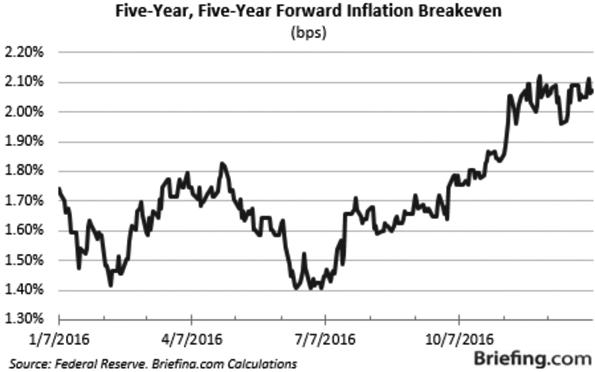
Five-year, Five-year Forward Inflation Breakeven Rates
Five-year, Five-year Forward Inflation Breakeven Rates have attracted considerable attention by investors given that they are one of the measures of longer-term inflation expectations that the Fed tracks. The Fed views this measure of inflation expectations as less affected by cyclical factors, such as energy prices, and thus providing a better measure of how well the market thinks it is meeting its goal of longer-term price stability. The latest reading implies what market participants expect inflation to be in the next five years.
The expectation for "five-year, five-year forward inflation" (chart, below) rose two basis points to 2.07%, remaining much higher than its pre-election level. The upward momentum in inflation expectations has ebbed in recent weeks. It may take fiscal action from the new Congress and Trump to push expectations significantly higher. The average hourly earnings growth of 2.9% (year-over-year) does indicate that upstream prices are rising, and that should eventually filter down into the prices for goods and services.
...They say on Wall Street that "perception is reality." Translation: The reason the financial sector vaulted 20% higher after the election wasn't because the big banks would suddenly post decent fourth-quarter earnings. It's because Mr. Market sees an inflationary landscape where higher interest rates are coming.


.webp)
Comments
Log in or sign up to join the conversation.