

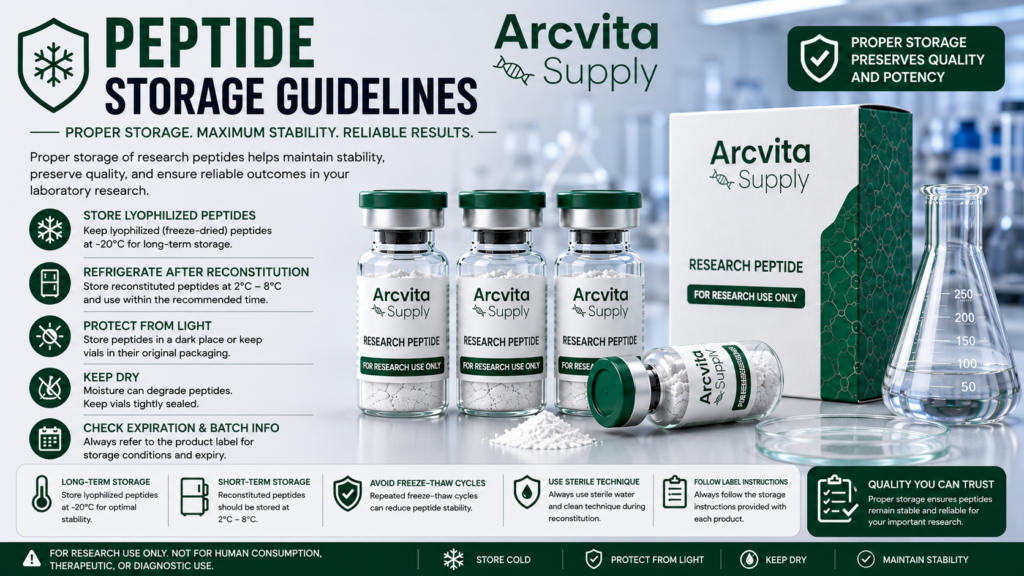
Proper storage is an important part of maintaining the quality and stability of research peptide samples. Peptides can be sensitive to temperature, moisture, light, oxygen, and repeated handling. Even when a peptide is manufactured and packaged under appropriate conditions, unsuitable storage after purchase or during laboratory use can affect its physical and chemical properties.
Following reliable peptide storage guidelines can help researchers manage samples more effectively and reduce avoidable exposure to environmental conditions. Storage requirements can vary depending on the peptide, formulation, container, and research protocol, so product-specific instructions should always be considered before establishing laboratory procedures.
Why Proper Peptide Storage Matters
Peptides are chains of amino acids with different physical and chemical characteristics. Some may be relatively stable under appropriate conditions, while others can be more sensitive to environmental factors.
Temperature fluctuations, humidity, light exposure, and improper handling may contribute to changes in peptide quality. For research laboratories, maintaining consistent storage conditions is therefore an important part of sample management.
Proper storage can help researchers:
Maintain organized research samples
Reduce unnecessary environmental exposure
Minimize repeated temperature fluctuations
Protect samples from moisture and contamination
Maintain clear identification and labeling
Follow appropriate laboratory procedures
Researchers should always refer to the manufacturer's documentation because recommended storage conditions can differ between individual peptide products.
Understanding Lyophilized Peptide Storage
Many research peptides are supplied in a lyophilized, or freeze-dried, form. Lyophilization removes much of the water from the material, which can improve stability during storage when appropriate conditions are maintained.
Lyophilized peptides should generally be kept according to the storage conditions specified by the manufacturer. Depending on the specific peptide, this may involve refrigerated or frozen storage.
Before opening a stored vial, researchers should consider allowing the container to reach an appropriate temperature according to the product instructions. This can help reduce condensation that may occur when a cold container is exposed to warmer laboratory conditions.
Keeping the vial properly sealed is also important. Exposure to moisture can be undesirable for materials that are supplied in a dry form.
Temperature and Peptide Stability
Temperature is one of the most important factors in peptide storage. Excessive heat and repeated temperature changes may affect the stability of some peptide materials.
Research laboratories should use appropriate temperature-controlled storage equipment and monitor conditions regularly. A storage area should also be organized so that samples are not unnecessarily exposed to room temperature.
Common considerations include:
Follow the storage temperature stated by the manufacturer.
Avoid unnecessary temperature fluctuations.
Keep samples away from heat-producing equipment.
Minimize the amount of time samples remain outside controlled storage.
Use appropriate monitoring procedures for laboratory refrigerators or freezers.
There is no single temperature that is appropriate for every peptide. Researchers should therefore avoid applying a universal storage rule to all peptide products.
Protecting Peptides From Light
Some research compounds may be sensitive to light exposure. Direct or prolonged exposure to strong light can potentially affect certain materials.
For this reason, researchers should follow product-specific recommendations regarding light protection. Where appropriate, samples can be maintained in their original packaging or another suitable container that provides the required protection.
Laboratories should also avoid leaving peptide vials unnecessarily exposed on work surfaces, particularly near direct sunlight or strong laboratory lighting.
Managing Moisture and Humidity
Moisture can be an important consideration when storing lyophilized peptide materials. Because these products are supplied in a dry state, unnecessary exposure to humidity may affect the material.
Researchers should keep containers tightly closed when samples are not being handled. Vials should only be opened when necessary, and appropriate laboratory handling practices should be followed.
A dry and controlled storage environment can help reduce unnecessary exposure to humidity.
Storage of Reconstituted Peptides
Storage considerations can change after a lyophilized peptide has been reconstituted. Once a peptide is dissolved in a liquid, its stability may differ from that of the original dry material.
The appropriate storage conditions for a reconstituted peptide depend on factors such as:
The specific peptide
The concentration
The solvent or buffer used
Container compatibility
Intended research use
Manufacturer recommendations
Researchers should follow the product documentation and established laboratory protocols when determining how a prepared peptide solution should be stored.
Repeated temperature changes should generally be avoided where the research protocol permits. If a laboratory needs to access a sample repeatedly, appropriate sample-management procedures should be established to minimize unnecessary handling.
Avoid Repeated Freeze-Thaw Cycles
Repeated freezing and thawing can be an important consideration when working with sensitive research samples. Multiple temperature changes may contribute to changes in some peptide preparations.
Where appropriate, laboratories may use an organized aliquoting strategy based on their validated research protocol. Dividing a prepared sample into suitable portions can reduce the need to repeatedly expose the entire sample to temperature changes.
However, researchers should determine whether aliquoting is appropriate for the specific peptide and research application.
Proper Peptide Handling Practices
Storage and handling are closely connected. Even when a sample is kept at the recommended temperature, poor handling can introduce unnecessary risks.
Researchers should:
Keep peptide containers clearly labeled.
Record relevant batch or sample information.
Keep storage areas organized.
Avoid unnecessary exposure to room temperature.
Keep containers properly sealed.
Use appropriate laboratory handling procedures.
Follow the supplier's storage instructions.
Monitor refrigerators and freezers when required by laboratory procedures.
Good documentation can make it easier to identify individual samples and maintain consistent laboratory practices.
Labeling and Organization
Proper labeling is another important part of peptide storage. Each vial or container should be clearly identifiable according to the laboratory's documentation system.
Useful information may include the product name, batch or lot information, preparation date, concentration where applicable, and any other details required by the laboratory's procedures.
An organized storage system can help researchers locate samples efficiently and reduce unnecessary handling of neighboring products.
Common Peptide Storage Mistakes
Several avoidable mistakes can affect research sample management. These include leaving vials exposed to unsuitable temperatures, repeatedly removing samples from cold storage, failing to protect sensitive materials from light, or leaving containers open longer than necessary.
Other common issues include poor labeling, inadequate storage monitoring, and applying the same storage conditions to every peptide without checking product-specific instructions.
The best approach is to treat each research peptide according to its documented storage requirements rather than relying on assumptions.
Frequently Asked Questions
What is the best temperature for storing research peptides?
There is no universal storage temperature for every peptide. The appropriate temperature depends on the individual peptide and its formulation. Researchers should follow the manufacturer's product-specific storage instructions.
Should lyophilized peptides be refrigerated?
Some lyophilized peptides may be stored under refrigerated conditions, while others may require different conditions. Always check the manufacturer's recommendations for the specific product.
How should reconstituted peptides be stored?
Storage requirements for reconstituted peptides depend on the peptide, solvent, concentration, and research protocol. Researchers should follow product documentation and validated laboratory procedures.
Can peptides be exposed to light?
Some peptides may be sensitive to light. Researchers should follow the product's instructions and avoid unnecessary exposure to direct or intense light when protection is recommended.
Why should repeated freeze-thaw cycles be minimized?
Repeated temperature changes can affect the stability of some peptide preparations. Appropriate sample-management practices may help reduce unnecessary freeze-thaw exposure.
Final Thoughts
Following appropriate peptide storage guidelines is an essential part of responsible laboratory sample management. Temperature control, protection from moisture and light, proper labeling, careful handling, and minimizing unnecessary temperature fluctuations can all contribute to better storage practices.
Because peptide stability can vary considerably between products, researchers should not rely on one storage method for every compound. Manufacturer documentation and established laboratory protocols should always take priority.
Research peptides discussed in this guide are intended for laboratory research use only. Researchers should use appropriate laboratory procedures, documentation, and safety practices when handling and storing research materials.
Comments
Log in or sign up to join the conversation.