

Uber (UBER) claims the antidote to its steady and steep losses is size and growth. However as Uber has increased in size it has not seemed to be able to improve its financials and bottom line even amidst what has been a very accommodating market and regulatory climate for the company in recent years.
As technological, market, and regulatory threats increase, Uber's nebula-like easy growth expansion may soon begin hitting hurdles and even walls. Uber still may someday achieve a positive bottom line through combining a true mega-platform in a wide variety of goods and services - however, at the moment the company's financials and moves make that hope seem increasingly distant and worrying.
Can "Scale" Save Uber?
Uber CEO Dara Khosrowshahi said in an August 2019 interview with Bloomberg that Uber's path to profitability is "[s]cale, scale." And indeed Uber has been getting bigger - extraordinarily so - in recent years. As bookings have boomed, from Q2 2017 to Q2 2019 monthly active customers have soared respectively from 57 million to 99 million (+73%) and trips from 889 million to 1.677 billion (+99%).
(Click on image to enlarge)
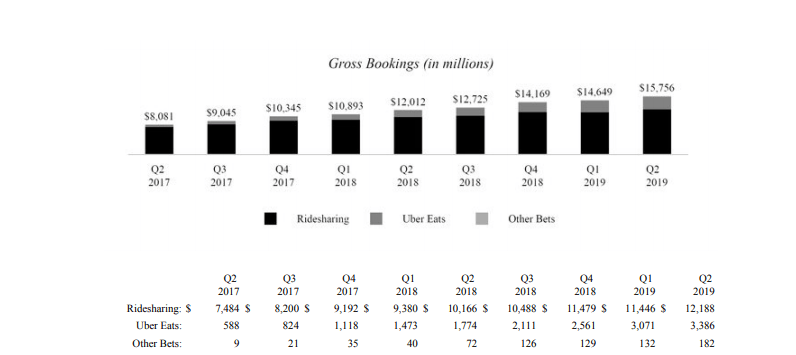
(Source: Uber Q2 2019 SEC 10-Q)
However, CEO Khosrowshahi's theory has been put to the test and, if based off the most recent trends and evidence, seems to not give much confidence. Adjusted net revenue has increased from $1.63 billion in Q2 2017 to $2.873 billion in Q2 2019 (+76%) but Adjusted EBITDA has continued to see significant losses. While Adjusted EBITDA showed signs of improving significantly from late 2017 to early 2018 since then losses have increased again to even deeper and redder levels as the company’s top line has grown.
(Click on image to enlarge)
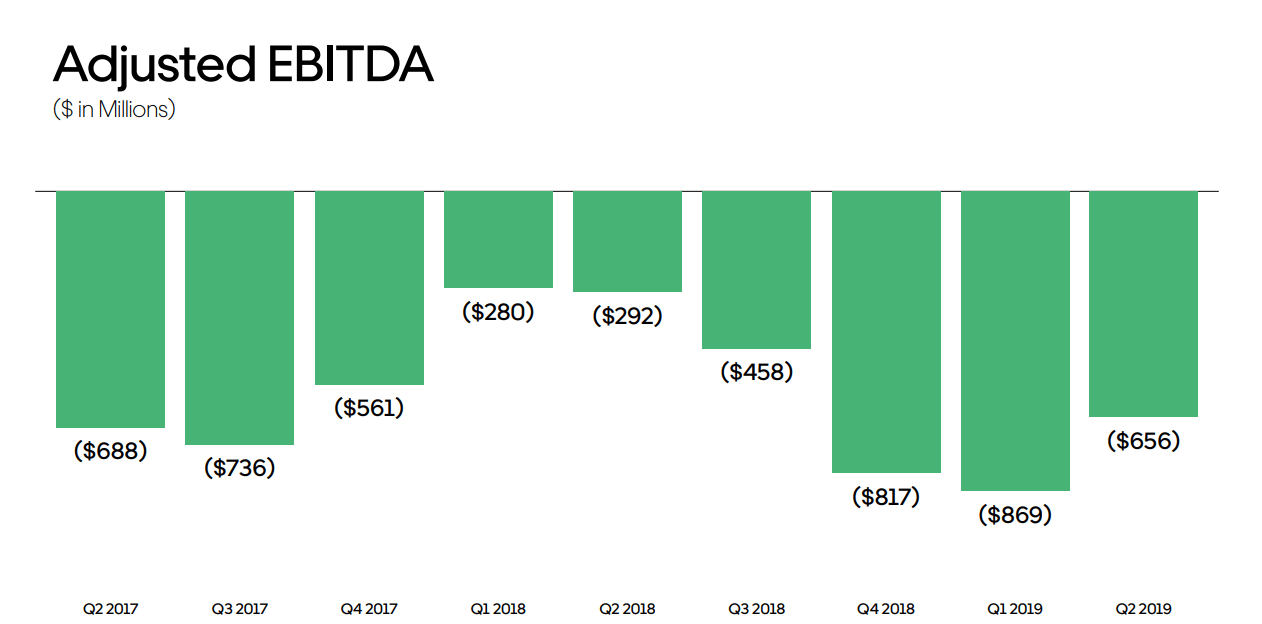
(Source: Uber Q2 2019 - Supplemental Data Presentation)
These past few years should have been Uber's golden age. It had broken through immense regulatory hurdles as the taxi industry gave way to it and it was finally able to operate freely across the country as the regulatory war seemed won. This also was at a time when Uber operated in an oligarchic monopoly with only Lyft and legacy taxis as true rivals.
However, times have now changed. Not only are regulatory threats increasing - such as California's recent labor law which likely will crunch Uber's already thin net revenue from its ride bookings - but Uber is facing extensive competition in many of the services it’s trying to expand into as well as its core ride-sharing segment. The possibility of cars and car services supported by artificial intelligence is rapidly approaching as well as these technologies are increasingly finessed, approved by government authorities, and rolled out to market.
If Uber was to make money from its operations it stands that it should already be very close to doing so. Instead in the past twelve months it has lost $2.8 billion in EBITDA on $10.934 billion in adjusted net revenue at a time when the company is already well past any early development stage where it’s still trying to get its name and brand out there. Cash flow from operating activities has steepened from $(450) million in the first six months of 2018 to $(1.644) billion in the first six months of 2019. If Uber's path to profitability is "scale" growth - where is there left to grow and when does the fabled profit point from that scale finally come?
The Uber-Netflix Analogy
All of this is giving Uber still a major benefit of the doubt in its recent Q2 2019 $(5.485) billion loss from operations, which Uber attributes to largely a $3.9 billion stock compensation expense due to its IPO.
In many ways Uber's story reminds me of Netflix (NFLX). Netflix's growth story was premised on continual growth that would eventually result in irremovable market share inertia - similar to Facebook - and consequently pricing power and, finally, profitability.
This hope eventually fell to the gravity of reality Netflix saw continued increased content costs, operating cash burn, increasingly inhibited and unsteady growth, and finally an increasingly crowded content field which now has capped seemingly its once rosy future and pushed away the hope of pricing power, market inertia, and serious earnings.
Uber's growth theory appears similar to what Netflix's story was. That vision is that Uber may face razor thin margins right now from its core platform but once it grows to mammoth size it will be able to capture the market, raise prices, and see the gravy train roll in. As with Netflix, the trends point in the opposite direction with increased financial turmoil and structural, market, and regulatory headwinds increasing.

(Source: The Verge)
Uber is not completely a lost cause. The company may still well pull itself into the realm of profitability through properly capitalizing on artificial intelligence and self-driving cars, through resisting regulatory and competitive threats, and building a multi-stem mega-platform featuring everything including food delivery, bikes, freight, trains, and much more. This is a far more ambitious vision for the company's evolution that Netflix's was and still may give the company a serious chance of achieving the mythical "scale" it's aiming for - and possibly positive earnings for itself and its stockholders. I wouldn't bet for sure on it, but it remains a legitimate possibility.
Conclusion
Uber's "golden age" has perhaps come and passed with little bottom line to show for it. The company has captured the public imagination and revolutionized the daily lives of the countless millions - riders, drivers, stakeholders, and those otherwise affected - it interacts with.
However at the same time the company's operations and indicators raise serious concerns for Uber's own profitability. As the company increases in scale it is struggling to show positive trends on either the financial or trend fronts with now increasing regulatory and market headwinds threatening future growth.
Uber retains the possibility of building its hoped for mega-platform - and with it perhaps profitability - but at the moment it is difficult to justify that expectation.

Comments
Log in or sign up to join the conversation.