PayPal Without A Buyer

PayPal shares slumped after reported buyout talks with Stripe and Advent collapsed, forcing a pivot back to its standalone turnaround.

Source: DepositPhotos

When a struggling company receives a serious buyout offer, investors get a sudden gift. They no longer have to rely entirely on a complex turnaround to succeed. For a few weeks this summer, that was the story for PayPal. But reports late Thursday that Stripe and Advent had ended their pursuit sent the stock sharply lower Friday. With none of the companies publicly confirming the talks or their collapse, investors are back to pricing PayPal mainly on a major internal restructuring and a branded checkout business that still has to regain momentum.

Main Note

PayPal Returns to a Pure Execution Story

PayPal (PYPL) Quote

Verdict: The reported withdrawal of Stripe and Advent removes the easiest path to a quick payoff. Investors must now decide whether PayPal’s cost cuts and technology overhaul can fund a real turnaround without weakening the products needed to win back branded checkout share.

What happened

Reports late Thursday said Stripe and Advent International had ended their pursuit of PayPal, and Reuters later cited an unnamed source saying the group was no longer pursuing a deal. The consortium had offered $60.50 per share, valuing PayPal at roughly $53 billion. PayPal’s board reportedly considered the bid inadequate and raised regulatory and financing concerns, but the company had not formally responded to the proposal. PayPal, Stripe and Advent all declined to comment.

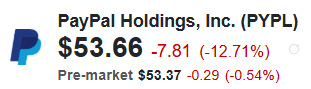
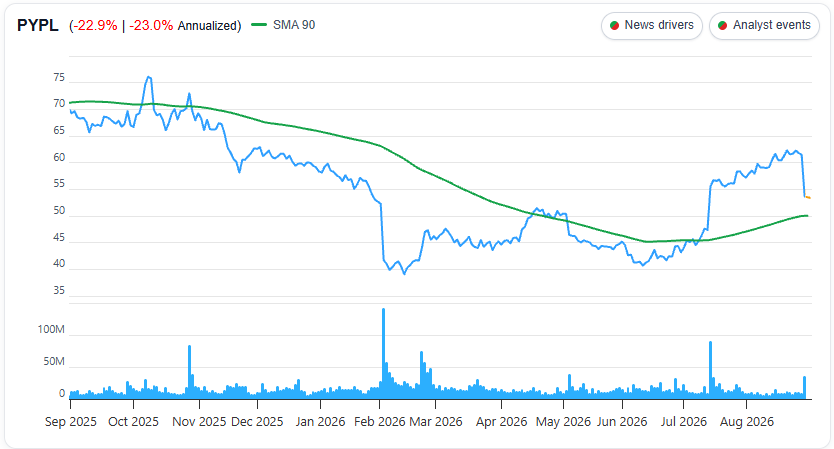
The stock fell 12.7% to close at $53.66 on Friday and was little changed in the low $53 range before Monday’s open. The move gave back most of the deal driven rally, although the shares still sat above the $47.37 closing price from the day before the offer was first reported. With no active buyer in view, the market is back to evaluating PayPal mainly on its standalone fundamentals.

PayPal (PYPL) 1 Year Chart

PayPal (PYPL) 1 Year Chart

Why it matters

The acquisition rumors provided a temporary distraction from a difficult reality. Core branded checkout growth has slowed drastically in the face of frictionless mobile wallets. Without a buyer, PayPal must rely entirely on its own management team to strip out redundant layers and automate operations using artificial intelligence.

What changed in the thesis

The investment bet shifts from a possible exit event to a multi year restructuring. PayPal is reportedly planning to reduce its workforce by roughly 20% over the next two to three years while targeting at least $1.5 billion in gross run rate savings across the broader transformation. Management has also laid out a roadmap to reduce organizational layers through 2027, improve productivity through 2028 and modernize technology with AI through 2029. Investors have to believe PayPal can lower costs without starving the products and engineering work needed to regain momentum.

What the market may be missing

The pessimism might be ignoring the sheer scale and financial armor of the standalone business. PayPal processed over $486 billion in payment volume during the second quarter alone, up 10% year over year. It holds over $15 billion in cash and investments and generates massive free cash flow, giving the board immense firepower to aggressively repurchase shares while the operational changes take root.

Valuation and expectations

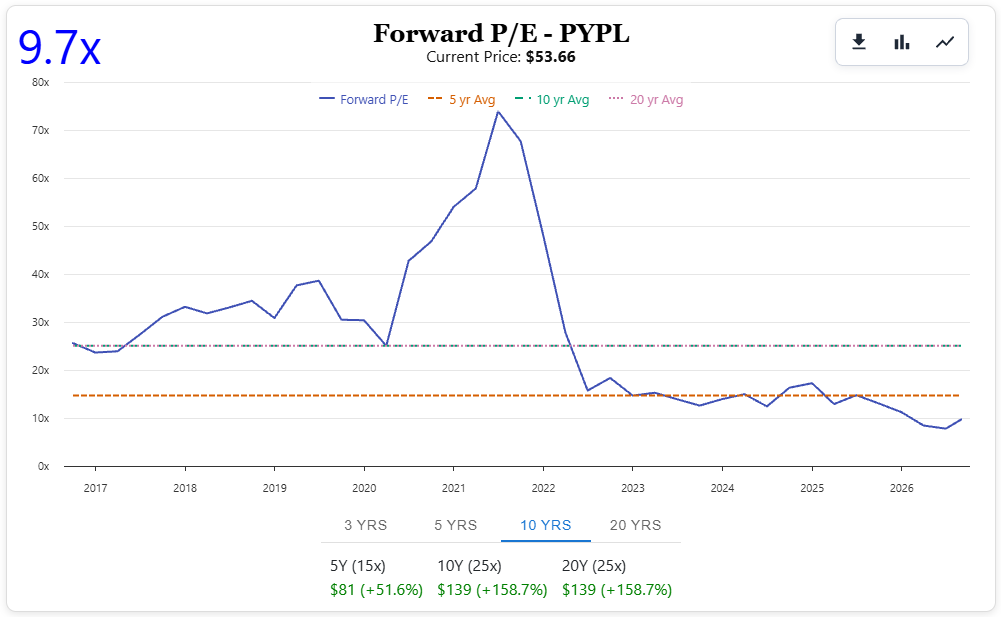
Stripped of most of the deal speculation, the stock now trades at roughly 11 times forward earnings. That is a real discount to an industry median near 15 times, but the discount is not random. PayPal’s adjusted operating margin fell 248 basis points in the second quarter, and management expects adjusted earnings to decline in the low single digits in the third quarter. The valuation is cheap, but it already assumes the turnaround will take time.

PayPal (PYPL) Forward PE Ratio

PayPal (PYPL) Forward PE Ratio

Bottom line

If the engineering cuts destroy product momentum, the current low multiple is a trap. But if the separated business units can maintain volume growth while aggressive share repurchases shrink the float, the bar for outperformance is now remarkably low.

Pre Market Pulse

  • Federal Reserve Chair Kevin Warsh struck a hawkish tone at Jackson Hole on Friday, lifting market expectations that the Fed could raise rates in September.

  • U.S. stock futures were only modestly lower early Monday and Treasury yields eased after Friday’s jump. The fresher pressure point is oil, with Brent back above $90 after renewed fighting involving the United States and Iran raised another inflation risk.

Why it matters this morning

A tighter rate path would make execution risk more expensive, while another oil shock would add pressure to inflation and consumer spending. That is an unfriendly backdrop for companies asking investors to wait through a long and expensive turnaround.

Peer Read Through

Block

Acts as a direct rival in merchant processing and consumer wallets. Block cut more than 4,000 jobs earlier this year, yet Square gross payment volume still grew 13% in the second quarter and Cash App gross profit rose 31%. That makes it a useful, if unusually aggressive, benchmark for PayPal’s cost cutting experiment.

Adyen

The European enterprise payments giant thrives as a neutral processor. It is perfectly positioned to capture enterprise market share if PayPal struggles through its internal reorganization.

Apple

Apple Pay is the main structural threat to the legacy PayPal button. As it captures more frictionless mobile transactions, it directly drives the deceleration of PayPal branded checkout volume.

Group takeaway

The payments ecosystem is not waiting for PayPal to fix its internal architecture. Faster rivals are steadily capturing the incremental transaction volume that PayPal used to dominate by default.

What to Watch

  • Growth metrics for the branded checkout segment in the upcoming third quarter report.

  • Detailed financial disclosures separating the Venmo and Braintree business units to reveal underlying profitability.

  • Progress on the $1.5 billion run rate savings target and updates on specific automation rollouts replacing human headcount.

  • Any accelerated share repurchase announcements using the massive cash pile.

Bottom line

The buyout rumors offered a free pass on the fundamental questions. Now the market needs proof that a smaller PayPal can still compete with the largest technology platforms in the world.

STOCKS IN THIS ARTICLE

Also Mentions:

Comments