


Market data: close of Monday, November 23; loan prices of Tuesday, November 24, 2026.
This article is for educational purposes only. It is not investment advice and not a recommendation to buy or sell anything. Loans, bonds, credit default swaps and stocks carry a high risk of loss.
Four construction loans for a data center campus leased to Oracle in New Mexico, $18 billion in all, are valued at 85.5 and 88.4 cents on the dollar. Three of them were marked down to about 91 four weeks before Oracle's force majeure notice. At 85 they pay about 8.5 percentage points over the benchmark rate, while insuring Oracle's own debt costs 3.4: the market is pricing a building that may never be finished, and Oracle's credit explains less than half of it.
What we found
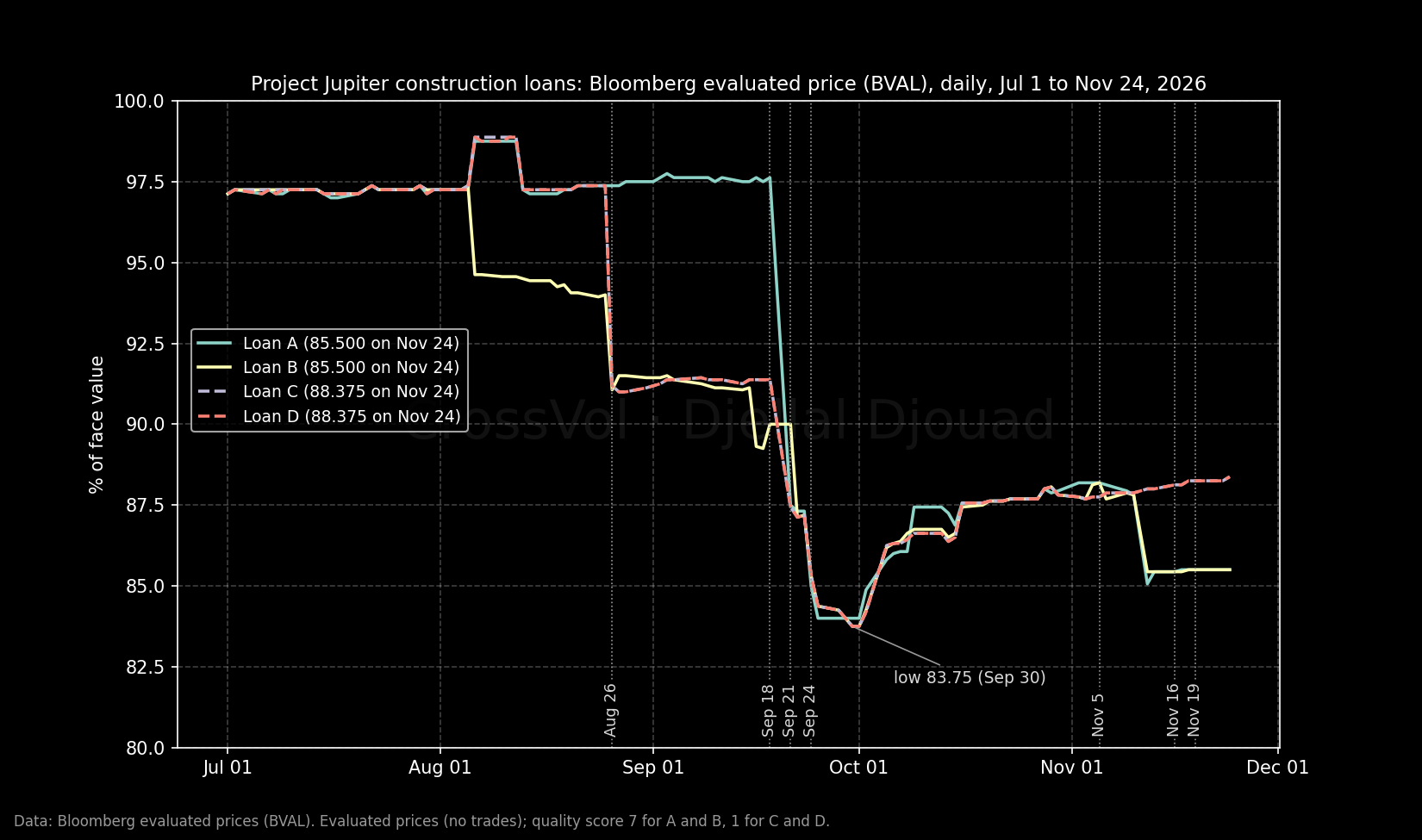
The markdown came before the news. On Wednesday, August 26, Bloomberg's evaluated prices for loans B, C and D fell to about 91, from 94 for B and 97.4 for C and D, 29 days before Oracle's force majeure notice was reported. Loan A held near 97.6 until the FT story of Friday, September 18, and lost 10.1 points on the next business day.
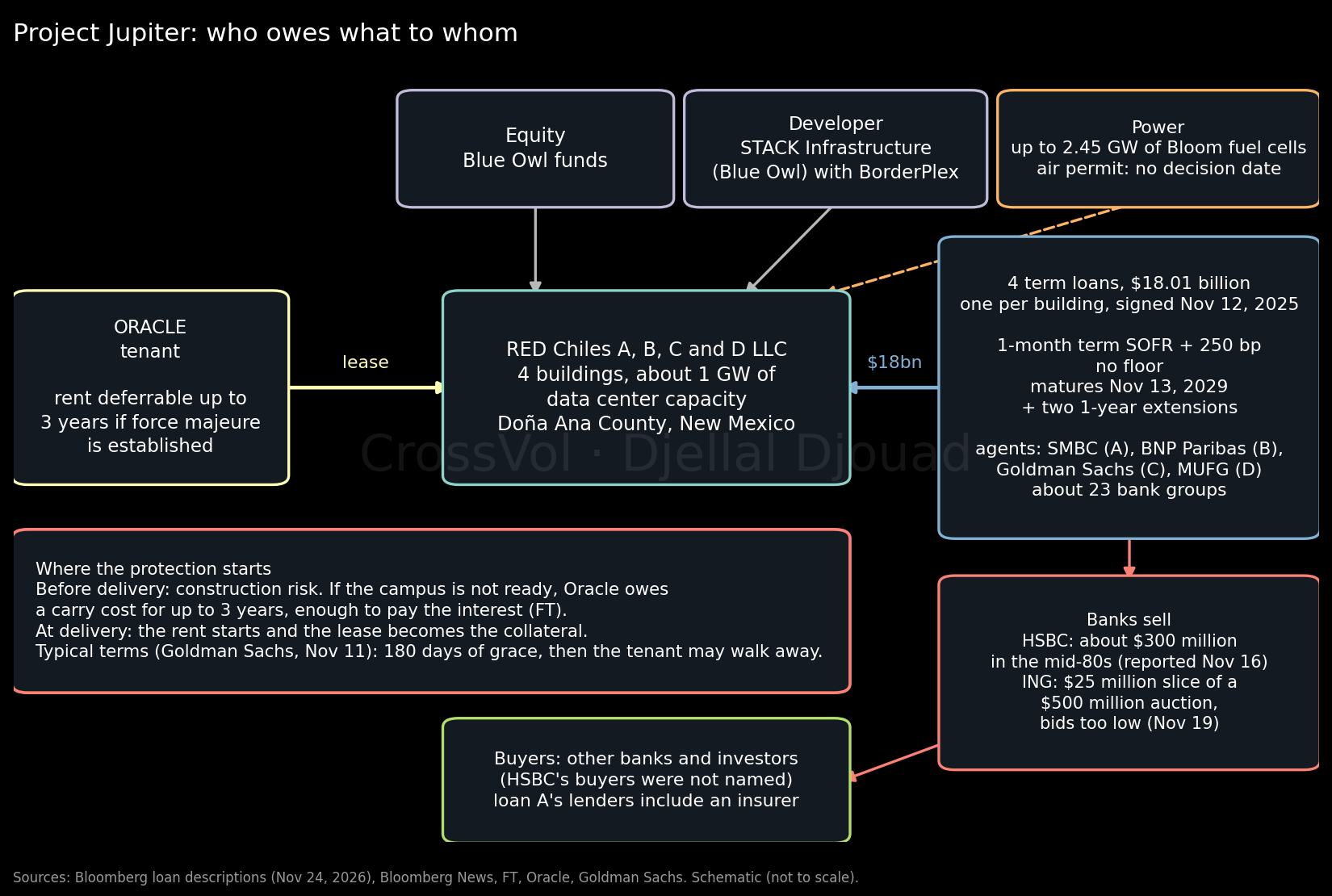
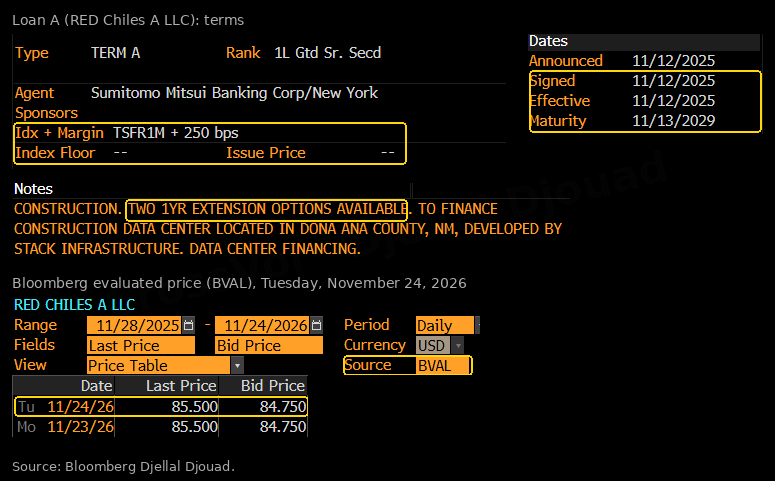
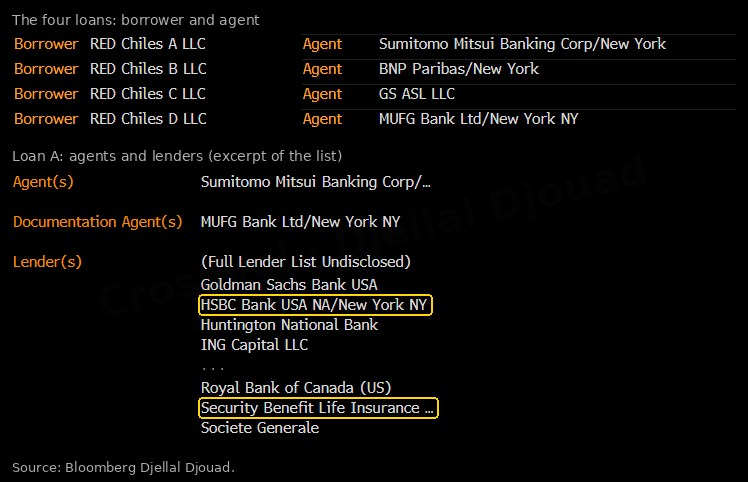
The deal, from the terminal. Four loans, one per building, $18.01 billion, signed on November 12, 2025: one-month term SOFR plus 250 basis points, no floor, maturity November 13, 2029, with two one-year extensions. The agents are SMBC, BNP Paribas, Goldman Sachs and MUFG; loan A's lenders include HSBC and an insurer, Security Benefit Life. The campus is about 1 gigawatt of data center capacity; the 2.45 gigawatts often quoted is the capacity of its fuel cells.
The price, taken apart. At 85 the loans yield about 13% a year to 2029, a discount margin of about 855 basis points over SOFR, and the same math reproduces Bloomberg's own margins within half a basis point. Oracle's five-year credit default swap explains 339 of them. The other 516 or so is the price of completion risk and of holding a loan no dealer quotes on screen.
The permit has no date. The "November 23" deadline some reports still gave on November 6 no longer applies: the developer's entity waived it on November 5, and the December 7 hearing was cancelled on November 6, with no new date.
Credit did not buy the rally. On Monday, November 23, Oracle's stock rose 12.3% and its five-year credit default swap fell 1.8 basis points, to 339, within 2 basis points of its one-year high.
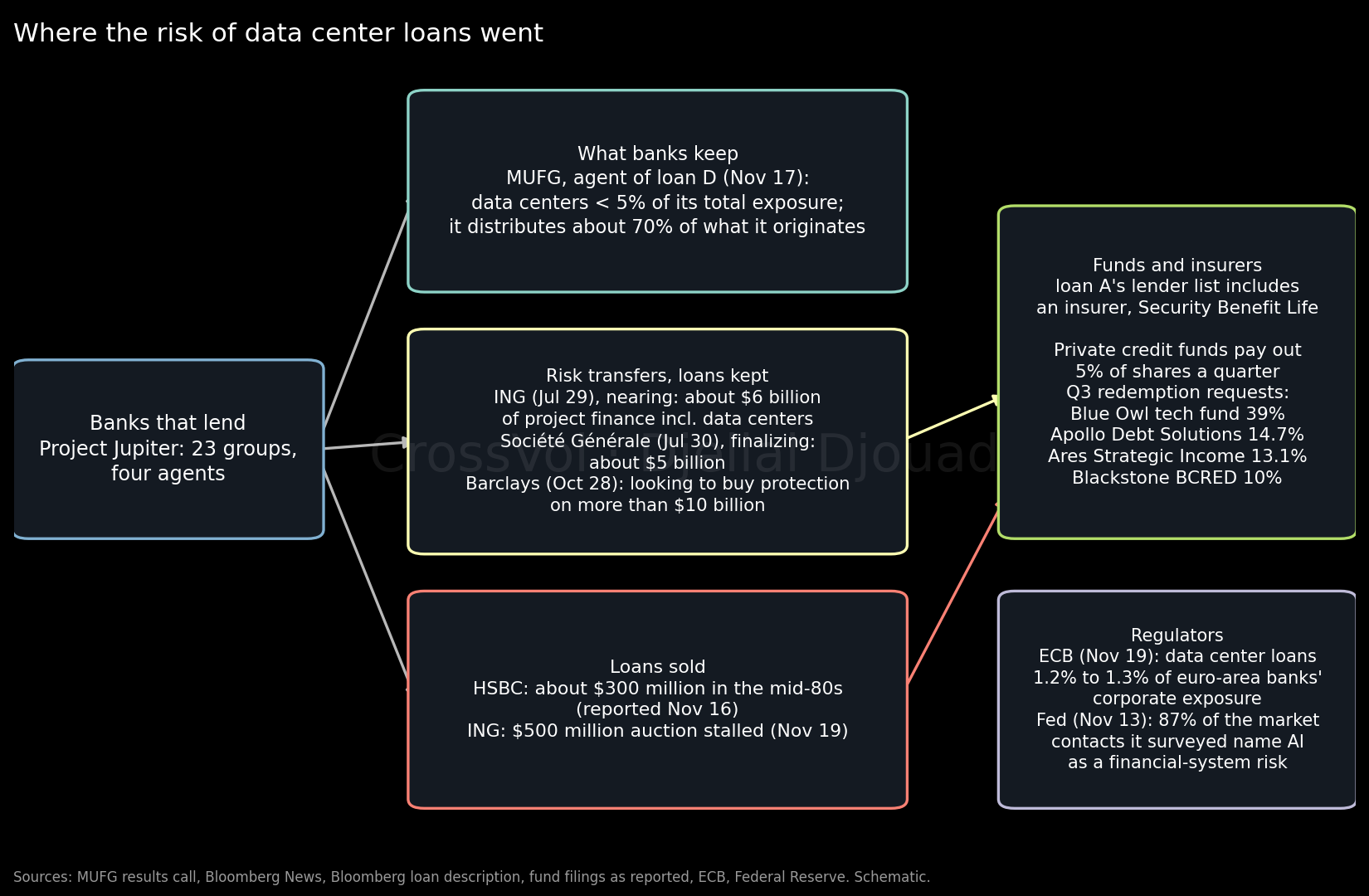
The risk is leaving bank balance sheets. MUFG, agent of loan D, says data centers are under 5% of its total exposure and that it distributes about 70% of what it originates. In July, ING and Société Générale were finalizing significant risk transfers on about $6 billion and $5 billion of project finance loans, data centers included. Loan A's lender list already includes an insurer.
The deal
Project Jupiter is a Stargate campus in Doña Ana County, developed by STACK Infrastructure, a Blue Owl company, with BorderPlex Digital Assets; Blue Owl's funds put in the equity. Oracle describes its large sites, New Mexico among them, as "around a gigawatt a piece" (earnings call, September 10). The 2.45 gigawatts often attached to the campus measures something else: "up to 2.45 GW of installed Bloom fuel cell capacity", the on-site power plant announced by Oracle and BorderPlex on April 27.
The financing is called Project Miner, and Bloomberg News reported it on November 7, 2025, with about 20 banks lending. The signed loan descriptions give the rest: four term loans, one per building and each run by one agent, first-lien and secured, unrated, with 23 bank groups at signing.
The dated story
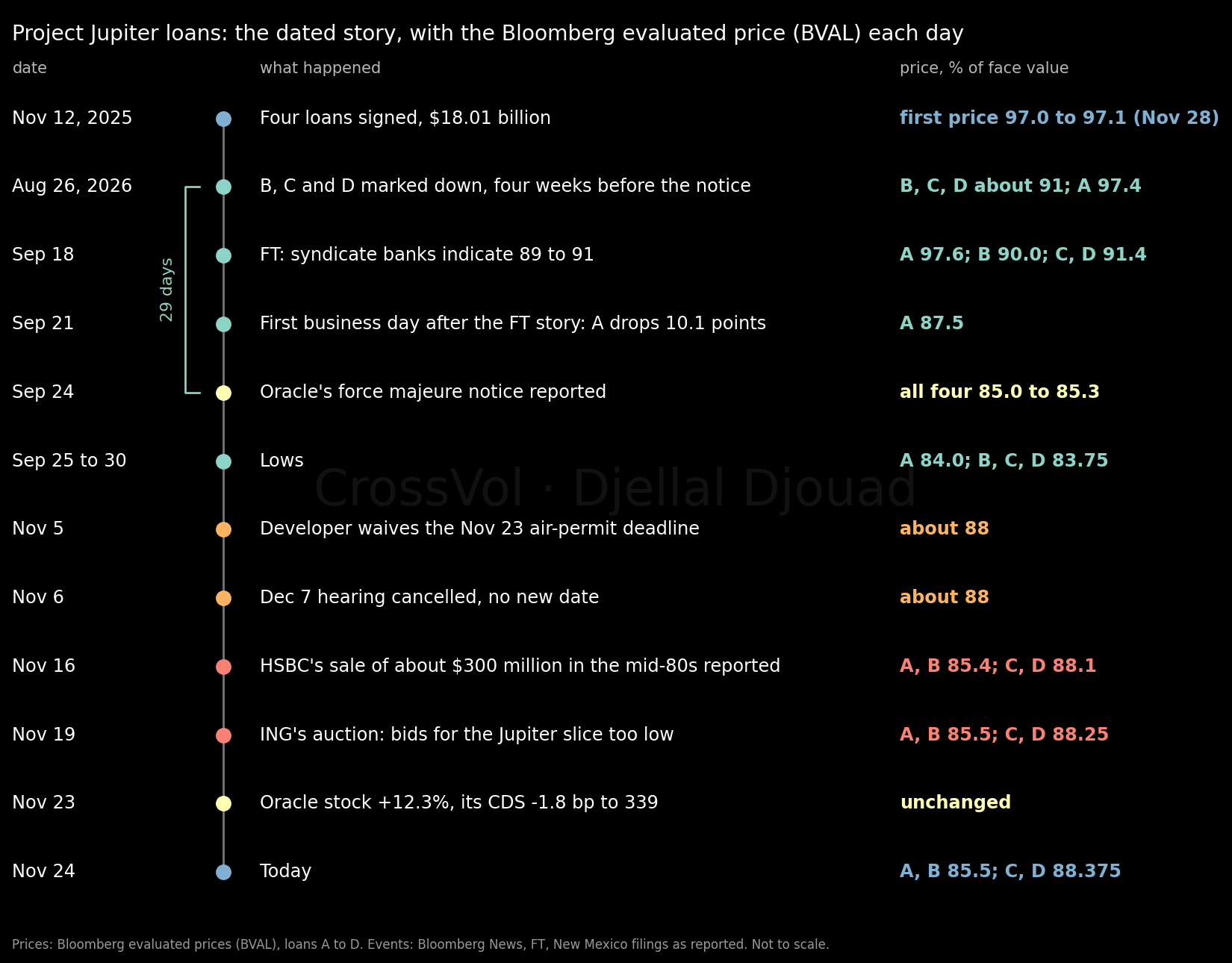
These loans do not trade on an exchange. Their prices are Bloomberg's evaluated prices (BVAL), a daily estimate built from the market information Bloomberg collects. BVAL is the only source pricing them on the terminal, and no dealer quoted loan A in the previous 24 hours. Bloomberg also scores the information behind each evaluated price from 1 to 10: the score is 7 for loans A and B and 1 for C and D. So I read the level and the dates, and I build nothing on the gap between buildings.
The first price, on November 28, 2025, was 97 to 97.1. Loan B lost nearly three points on August 6, then B, C and D were marked down to about 91 on Wednesday, August 26. When the FT reported on September 18 that syndicate banks indicated the loans at 89 to 91 cents, that matched the evaluated prices of B, C and D; loan A fell only on the following Monday. By September 24, the day Bloomberg reported Oracle's notice, all four stood between 85.31 and 85. The low came on September 30, at 83.75 for B, C and D.
HSBC sold "a roughly $300 million piece" of the package "at prices in the mid-80s", "shortly after Oracle sent a notice to the project's developer citing force majeure", Bloomberg News reported on November 16. ING offered about $500 million of data center loans, including a $25 million slice of the New Mexico financing, with bids due on Thursday, November 19. The bid window "closed without drawing the type of interest needed to clear the debt", and bids for the Jupiter piece "came in too low" (Bloomberg News, November 20). ING moved to one-on-one sales.
Oracle's Vantage campuses in Texas and Wisconsin are financed by $22.75 billion and $15.25 billion of construction loans at the same margin. The FT reported the Frontier and Lighthouse loans quoted above 90 cents. I could not check it: on Bloomberg the two Vantage loans, which I take to be the FT's, have no price source at all.
What 85 means
A floating-rate loan strips the question down to credit. The coupon resets every month at one-month term SOFR plus 2.5 percentage points, so a one-point rise in rates moves loan A by less than a fifth of a point, when Oracle's fixed-rate 7.45% bond of November 2031 would lose about 4 points. What moves the loan is its discount margin, the spread over SOFR that discounts its cash flows back to the price: 100 basis points of margin are worth about 2.2 points for loans A and B. A mark of 85 is a statement about completion and credit.
Assume one-month term SOFR averages 4.5%, the three-year SOFR swap rate on November 23, and repayment at par. Yields are quoted like the coupon, compounded monthly over a 360-day year. The evaluated prices then mean:
At 85: 13.05% a year and a discount margin of 855 basis points to November 2029; 10.88% and 638 basis points to November 2031 if both extensions are used.
At 85.5, loans A and B: 12.83% and 833 basis points to 2029; 10.74% and 624 to 2031.
At 88.375, loans C and D: 11.59% and 709 basis points to 2029; 9.94% and 544 to 2031.
On Bloomberg's screen the margins are 866 basis points at the 84.75 bid for A and B and 730 at the 87.875 bid for C and D. Ours, to November 2029, are within half a basis point of both, so Bloomberg computes them to the first maturity, and so do I below.
Now Oracle's own credit. Its five-year credit default swap, the annual cost of insuring its debt, closed at 339 basis points on November 23. At a margin of 339, the cost of Oracle's credit alone, the loan would be worth about 97.6, close to where it started a year ago. Oracle's 7.45% bond of November 2031, sold three weeks ago, yields 7.72%; loans A and B yield 10.74% to the same month at 85.5. The market asks over three points a year more for a first-lien claim on the buildings than for Oracle's unsecured promise.
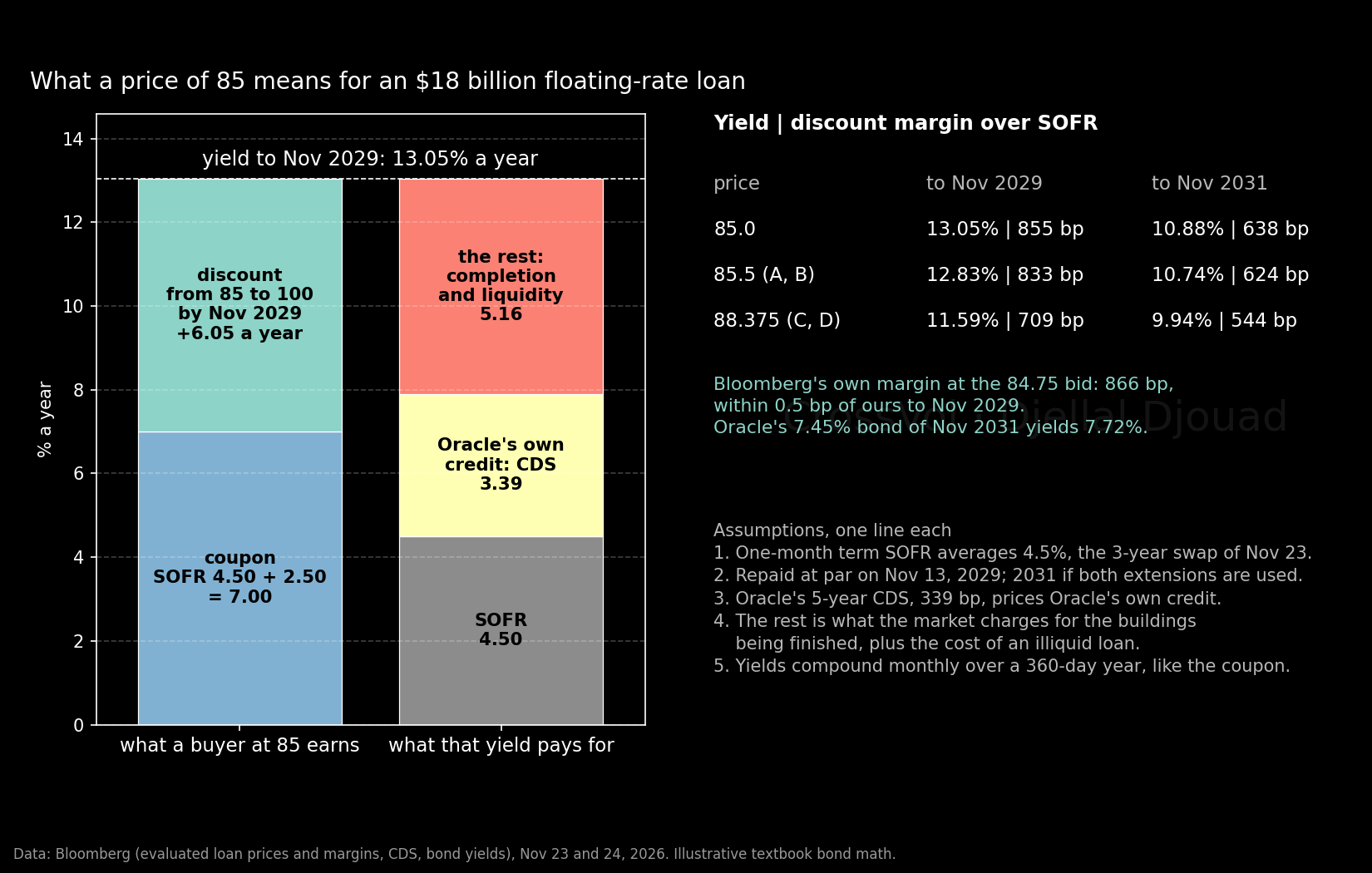
At 85, then, 339 of the 855 basis points pay for Oracle's credit and about 516 pay for the rest: the risk that the buildings are never finished, plus the cost of holding a loan that dealers do not quote on screen.
An illustrative implied loss. In the textbook credit triangle, a spread is about the annual probability of default times the loss given default. Read the 516 basis points as completion risk alone. If lenders lose 30% of face value when a project fails, they are paid for a 17% annual probability of failure, 40% over the three years to 2029. If they lose half, 10% a year and 26% over three years. If they lose 70%, 7% a year and 20%. These are risk-neutral odds that include a liquidity premium, so they probably overstate what lenders really expect.
Three scenarios, illustrative. I discount every cash flow at SOFR plus Oracle's 339 basis points, so Oracle's credit is already paid for, and I start from 85.5:
On time. The lease starts in 2028 as planned and the loan is repaid at par in November 2029. Worth about 97.6 today; a holder from 85.5 earns 12.8% a year.
A year late. Oracle's carry cost pays the interest meanwhile, the first extension is used and the loan is repaid at par in November 2030. Worth about 96.9; a holder from 85.5 earns 11.5% a year.
Never finished. The interest is paid until November 2029, then lenders recover 40, 50 or 60 cents from the site. Worth about 50, 58 or 66; a holder from 85.5 loses 13%, 7% or 2% a year.
The breakeven, illustrative. A year of delay costs less than a point of value while Oracle pays the carry cost. What sets the price is the chance that the buildings are never finished. At 85.5 that chance is priced at about 26% if lenders would recover 40 cents, 31% at 50 cents and 38% at 60 cents. Below those odds 85.5 is cheap: at 10%, with 50 cents of recovery, the loan would be worth about 93.7. Above them it is expensive. For loans C and D at 88.375 the same reading gives about 20% to 29%. This is a reading of the price. It is not a trade and not a recommendation.
What credit says against equities
On Monday, November 23, after Nvidia's board brought back Jensen Huang, Nvidia rose 31%, CoreWeave 22.3% and Oracle 12.3% to $113.68. CoreWeave's credit default swap fell 113 basis points. Oracle's fell 1.8, to 339, within 2 basis points of its one-year high of Friday. On November 18 Oracle had closed at $113.89, almost Monday's price, with its swap at 317: same share price, 22 basis points more to insure the debt. Its 45 dollar-denominated bonds maturing in 2031 or later barely moved, their spread over Treasuries narrowing by about 1 basis point on average. Oracle's swap has doubled since June 30, and S&P cut Oracle on July 9 to BBB-, "one notch above a junk rating".
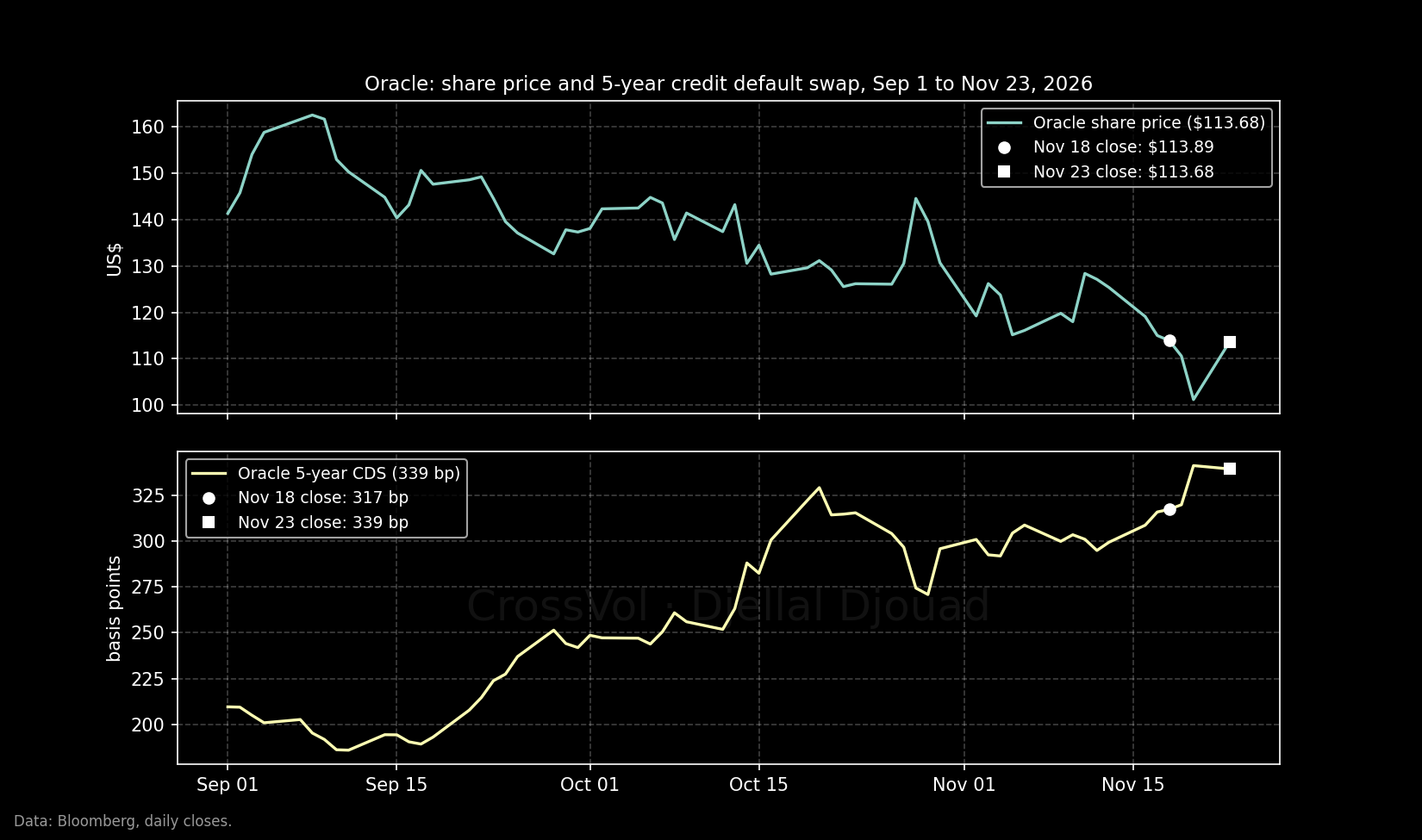
Why would Oracle's credit ignore a 12% rally? A year ago Morgan Stanley argued that construction loans on Oracle-leased sites would become a major source of demand for Oracle credit default swaps, as banks stuck with the loans hedge them. The FT adds that confidentiality clauses in some data center loans stop lenders from using swaps and synthetic risk transfers that require sharing loan information. A bank that can neither sell nor directly hedge such a loan buys protection on the tenant, whatever Nvidia does. I cannot prove it without public volumes, yet it fits the facts, and Bank of America's equity derivatives strategists described the same split this month in a note titled "The AI credit-equity disagreement": hyperscalers' bond spreads and credit default swaps at their widest in at least five years, while their price-earnings multiples and implied volatility barely moved.
On November 21, in Stock Market Next Week: Can Stocks and the Euro Fall Further?, I wrote: "Credit now feeds equity." The high yield spread had widened 51 basis points in a week to 367, a one-year high; on Monday it came back only 11, to 356. My call in the same article, another 10% off the Nasdaq 100 in the coming weeks, has not worked so far. As I wrote on Monday in Nasdaq 100 Rebound: The Huang Effect Lit the Vanna Rally, "The rebound came first, and it came hard." Oracle's credit and the high yield market barely joined it.
Why a safe tenant does not make a safe loan
The notice. If a force majeure event tied to electricity is established, Oracle "could win a three-year delay on rent" on a campus planned to start in 2028, Bloomberg reported on September 24, and the notice "does not constitute an event of default". According to the FT, if Jupiter is not ready, Oracle owes a "carry cost" in lieu of rent for up to three years, enough to cover the interest on the debt in full. The coupon is covered. The open question is when the rent starts, and whether it starts at all.
The permit. The fuel cells need an air permit. On November 5 the developer's entity, Yucca Growth Infrastructure, waived its right to a decision by November 23. On November 6 the public hearing set for December 7 was cancelled, with no new date until the New Mexico Environment Department recommends approving or denying the permit. The gas pipeline for the site had already been pushed back to February 1, 2027.
The guarantee. Goldman Sachs described the general mechanism on November 11. Guarantees that make a weaker tenant's lease look investment grade work "provided the developer builds and delivers the facility on time, because these wrappers only become effective upon completion". And: "Developers typically have a 180-day grace period for late delivery, but if a project misses that outside date, the tenant has a termination option that allows them to walk away." Jupiter's own lease terms are not public.
On November 5, in The AI Depreciation Bomb: The Chips Last Three Years, the Loans Last Ten, I wrote that for a data center loan "The collateral is the tenant." New Mexico adds a condition: the tenant becomes the collateral once the building is delivered, and before that the lender carries a construction project. The same article noted that "BNP Paribas is one of the four administrative agents" on this loan; the loan descriptions now show it runs loan B.
How much sits before delivery? Oracle's 10-Q to August 31 reports "$288 billion of additional lease commitments, substantially all related to data center arrangements", which its balance sheet does not show, and Meta reports about $356 billion of leases not yet started. The Fed's Financial Stability Report of November 13 and Governor Barr put the leases not yet started, take-or-pay contracts and guarantees of seven companies "above $3 trillion".
Where the risk went
MUFG, the agent of loan D, said on November 17: "Data centers account for less than 5% of our total exposure." It distributes "approximately 70% of the financing we originate to investors". In July, ING and Société Générale were finalizing significant risk transfers on project finance books that include data centers, about $6 billion and $5 billion (Bloomberg, July 29 and 30), and Barclays was "looking to buy default protection on more than $10 billion of debt" (Bloomberg, October 28). Data center loans are only 1.2% to 1.3% of euro area banks' corporate exposures, the ECB said on November 19. What is under strain is the machine that turns a bank loan into a fund's asset: "Senior risk officers at many financial institutions have basically indicated that those portfolios need to be reduced," Nuveen's Don Dimitrievich told the FT this month.
The buyers ration their own exits. In the third quarter, investors asked to redeem 39% of the shares of Blue Owl's non-traded technology fund, 14.7% at Apollo Debt Solutions, 13.1% at Ares Strategic Income Fund and 10% at Blackstone Private Credit Fund, and these funds pay out 5% a quarter. Fitch puts the US private credit default rate at 6.3% over the twelve months to the third quarter. Blue Owl is also the equity sponsor of Jupiter.
On July 3, in The AI Debt Trojan: Why the US IG Index Just Got Prettier and More Fragile, I wrote, reading the IMF: "The risk is the structure of the debt." The list that followed ended with "insurance company sidecars, and private credit funds." Five months later, one of the four Jupiter loans has an insurer in its lender list, and banks of its syndicate are selling pieces and moving to transfer part of the risk of their data center books.
What to watch, and what would prove me wrong
The air permit. A decision date, or a recommendation from the Environment Department.
The delivery schedule. Oracle's results, expected on Thursday, December 10, and the pipeline date of February 1, 2027.
The refinancing wall. The construction loans mature in November 2029 for New Mexico, April 2030 for Texas and July 2030 for Wisconsin, each with two one-year extensions, and are meant to be refinanced into long-term debt once the leases run. That market is already crowded: Goldman Sachs expects, for 2027 alone, $545 billion of AI project finance and $440 billion of direct hyperscaler issuance.
Bank sales. ING's one-on-one sales, new risk transfers, and the review of bank data center lending that the ECB is considering (Bloomberg, November 6).
The counter-signals. A market index of rental prices for Nvidia's B200 chips rose 23.5% between September 1 and November 19, to $6.94 an hour. Microsoft borrowed $25 billion on October 29, its ten-year bond at 0.65 point over Treasuries. Oracle said on November 20 that it was "the first hyperscaler fully funded for this investment cycle".
I will change my mind if ING sells its New Mexico slice near 90, if New Mexico issues the air permit and the pipeline arrives on time, if Oracle's swap falls back under 300 basis points, or if CoreWeave places its next investment grade loan of at least $4 billion at the 7% to 7.5% yield Bloomberg reported it could achieve. New Mexico would then be a local permit story with a bad price. If none of that happens, the next sale below the mid-80s will tell us the patient has company.
About the author. Djellal Djouad is a derivatives trader with 17 years on equity, FX and fixed income derivatives desks and the co-founder of CrossVol Research, the research desk of CrossVol (crossvol.com), an options analytics platform for derivatives traders.
This article is for educational purposes only. It is not investment advice and not a recommendation to buy or sell anything. Loans, bonds, credit default swaps and stocks carry a high risk of loss. Evaluated loan prices are estimates and can differ from the price at which a loan actually trades. The scenarios and implied probabilities above are illustrative calculations under stated assumptions.


Comments
Log in or sign up to join the conversation.