

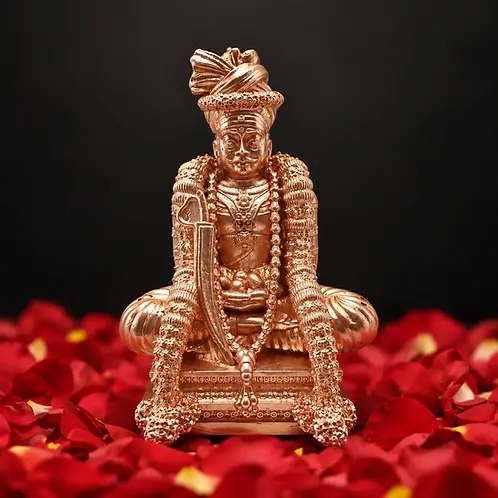
Madurai Pandi Muneeswarar is one of Tamil Nadu's most formidable guardian deities, a fierce protector whose legend is inseparable from the city of Madurai itself. Devotees drawn to his story often choose to bring home a bronze Pandi Muneeswarar idol as a way of inviting his protective presence into their space, connecting everyday worship to a centuries-old tradition of justice, penance and divine guardianship.
Unlike the gentler, ornamental forms of temple deities, Pandi Muneeswarar belongs to the older, more visceral layer of Tamil devotion — the grama devatas, or village guardian gods, who stand watch at boundaries, crossroads and burial grounds, weapons drawn, ready to defend their people. His story links a Pandyan king, a great Tamil epic of betrayal, and a buried idol unearthed by two ordinary villagers, making him one of the most narratively rich guardian figures in South Indian tradition. At Idol Bronze, this legacy is captured in bronze for those who wish to keep a fierce protector close to home.
Who Is Madurai Pandi Muneeswarar?
A Guardian Among the Ashta Muneeswaras
Pandi Muneeswarar is counted among the Ashta Muneeswaras — eight fierce forms said to have sprung from Lord Shiva's fury when he destroyed Daksha's yagna. Where Veerabhadra is remembered as the terrifying force born of that same rage in the Puranic mainstream, Tamil folk tradition preserves eight parallel manifestations, each entrusted to guard a different region, and each carrying a distinct local legend. Pandi Muneeswarar is the guardian assigned to Madurai, and his story is the one most deeply intertwined with the city's own history.
The Pandyan King Reborn
What sets Pandi Muneeswarar apart from the other seven Muneeswara forms is his human backstory. He is widely believed to be the Pandyan king Nedunchezhiyan reborn as a Muneeswarar — a guardian spirit who takes on divine ferocity as an act of atonement. This is not a deity descended purely from myth; he is remembered as a ruler who once sat on Madurai's throne, and whose later form as a temple guardian is understood as the continuation of that same soul's journey.
Not a Classical Temple Deity
Unlike Vishnu, Shiva or the Devi in their classical Puranic forms, Muneeswarar deities are not part of the pan-Indian pantheon with elaborate cosmic genealogies. They belong to Tamil Nadu's folk-guardian tradition, alongside figures like Ayyanar, Karuppasamy and Madurai Veeran — deities who are worshipped at village boundaries and temple peripheries rather than in the main sanctum. Pandi Muneeswarar's fame, however, has grown well beyond a single boundary shrine, making him one of the most widely recognised guardian forms in and around Madurai.
Iconography and Symbolism of Pandi Muneeswarar
Weapons of a Warrior-Protector
Pandi Muneeswarar is almost always depicted bearing a trishula (trident) and a sword, the twin emblems of a deity whose role is defense rather than blessing alone. The trident marks his descent from Shiva's own fury, while the sword signals a guardian who acts decisively against wrongdoing — a visual reminder that his grace comes paired with the power to punish.
The Horse as Vahana
His mount, a horse, reinforces this image of constant vigilance. Where many deities ride vahanas associated with calm or celestial travel, the horse is a vahana of readiness — swift, alert and always prepared to ride out and confront a threat. For a guardian deity tasked with protecting a city and its people, this symbolism of instant response is central to his identity.
Simple Yet Powerful Attire
Despite his ferocity, Pandi Muneeswarar's traditional form is strikingly unadorned. He is typically shown in a simple dhoti, without the elaborate jewellery or crowns seen on classical temple deities. This simplicity is deliberate: it reflects his folk origins and keeps the focus on his weapons, his stance and his fierce, watchful expression rather than on ornamentation.
Fierce and Peaceful Forms
Like several Tamil guardian deities, Pandi Muneeswarar is worshipped in both an ugra (fierce) and a shanta (peaceful) form. The fierce form, with bared weapons and a wide-eyed, intense gaze, is invoked for protection against evil forces and injustice. The peaceful form, calmer in posture and expression, represents the same guardian in a state of grace — a reminder that his ferocity exists to serve, not to terrorize, the devotees under his care.
The Legend of Madurai Pandi Muneeswarar
Born From Shiva's Fury
The story begins, as with all eight Muneeswaras, at the destruction of Daksha's sacrifice. Shiva's rage at the humiliation of Sati took form as fierce guardian spirits who scattered across the Tamil land, each settling where they were needed most. One such spirit made his home in and around Madurai — the city that would later give him his most famous identity.
The Injustice to Kovalan
The legend takes a decisive turn with the Pandyan king Nedunchezhiyan, a ruler remembered in the great Tamil epic Silappathikaram. In that story, the merchant Kovalan is wrongly accused of stealing the queen's anklet and is executed on the king's orders without a fair hearing. When his wife Kannagi proves his innocence by shattering an anklet before the court to reveal it was filled with gems, not pearls like the queen's, the king is struck by the weight of the injustice he has caused. Kannagi's fury famously sets the city ablaze in the epic's climax — a moment that remains one of Tamil literature's most powerful reckonings with unjust rule.
A King's Penance
Tradition holds that Nedunchezhiyan, consumed by remorse for the death he had wrongly ordered, did not simply pass into history as a fallen king. Instead, his soul is believed to have taken on the form of a Muneeswarar — a guardian spirit whose fierce vigilance against injustice becomes his eternal penance. Where he once failed to protect an innocent man, he is now bound to protect all who come to him, standing guard against exactly the kind of wrongdoing that once marked his reign.
Unearthed by Valliammal and Periyasamy
The final chapter of the legend is set centuries later, near Mattuthavani in Madurai. According to local tradition, the deity's idol lay buried nearly eight feet underground until it was discovered by two ordinary villagers, Valliammal and Periyasamy. Their unearthing of the idol is remembered as the moment Pandi Muneeswarar re-entered the living memory of Madurai, transforming a buried relic into an active site of worship and giving rise to the shrine that stands today.
Pandi Kovil: The Shrine at Melamadai
The principal shrine of Madurai Pandi Muneeswarar, popularly known as Pandi Kovil, stands in the Melamadai area of Madurai. Built around the site associated with the idol's discovery, the temple has grown into an important centre of devotion for those seeking protection, justice and relief from disputes or wrongful treatment. Worship here retains the character of folk devotion — direct, intense and deeply personal — rather than the elaborate ritual calendar of a major Agamic temple, and devotees often approach the deity with very specific pleas for protection or resolution.
Spiritual Significance of Madurai Pandi Muneeswarar
Protector against evil and harm — as a fierce guardian, Pandi Muneeswarar is invoked to ward off malevolent forces, black magic and ill fortune.
Dispenser of justice — rooted in the Kovalan legend, he is approached by those who feel wronged or are seeking a fair resolution to disputes.
Guardian of boundaries — in keeping with grama devata tradition, he is seen as a protector of homes, villages and sacred spaces from outside harm.
A deity of the wronged and the humble — his own legend as a repentant king gives him a particular association with correcting injustice done to ordinary people, echoing Kovalan's fate.
Why Is Madurai Pandi Muneeswarar Different from Other Guardian Deity Forms
Unlike Ayyanar or Karuppasamy, whose legends are largely mythic in origin, Pandi Muneeswarar's story is anchored to a named historical Pandyan king and a specific literary epic.
Where most Ashta Muneeswara forms are known mainly in scholarly or ritual circles, Pandi Muneeswarar has grown into one of the most widely recognised guardian deities in Madurai's living devotional landscape.
His dual fierce-and-peaceful form gives devotees two distinct ways to approach him — a contrast that is less pronounced in many other village guardian deities.
Unlike classical temple deities defined chiefly through cosmic mythology, his significance is inseparable from real human themes: injustice, remorse and atonement, making his worship feel intensely relatable.
Conclusion
Madurai Pandi Muneeswarar's story moves from the fury of Shiva to the fall of a Pandyan king, and finally to a buried idol brought back into the light by two ordinary villagers. Every part of that journey feeds into what he represents today: a fierce, ever-watchful guardian who protects the innocent and answers the pleas of those seeking justice. For devotees who want that protective, watchful energy present in their own home or pooja space, a bronze Pandi Muneeswarar idol offers a tangible link to this powerful Madurai tradition.
Comments
Log in or sign up to join the conversation.