

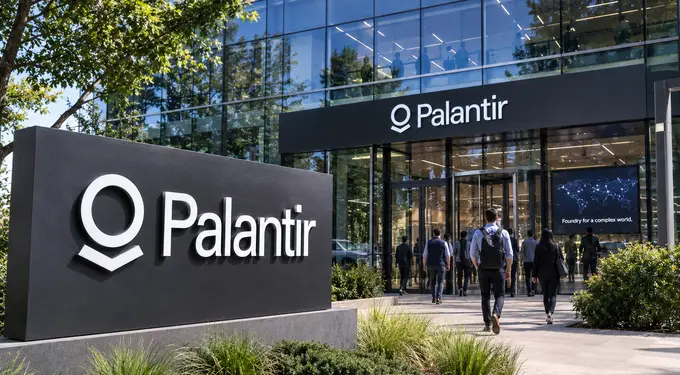
Palantir Technologies (PLTR) shares fell 3% on Wednesday as investors rotated out of software stocks and back into semiconductor and networking companies following another round of strong earnings that reinforced confidence in artificial intelligence infrastructure spending.
The decline came as software stocks broadly underperformed.
Microsoft (MSFT), Salesforce (CRM), ServiceNow (NOW) and Workday (WDAY) also traded lower, while chipmakers and optical networking companies rallied on signs that demand for AI infrastructure remains robust.
The move reflects a familiar pattern in recent months, with investors alternating between AI hardware companies and software names depending on where they see the strongest opportunities.
Software stocks lag as investors return to AI infrastructure
The latest rotation follows earnings reports from chip and networking companies that signaled continued strength in AI-related demand.
Chips remain central to powering large language models, while rapid data center expansion has fueled demand for optical networking equipment.
At the same time, investors remain cautious about software companies because advances in AI coding tools could disrupt existing software products.
Despite Wednesday's decline, Palantir and Microsoft have significantly outperformed in recent months.
Palantir shares have gained roughly 35% over the past three months.
Analysts remain divided despite record quarterly performance
Palantir recently reported one of the strongest quarters in its history, with revenue growing 93% year over year, the fastest pace the company has ever reported.
The results pushed the stock more than 20% higher following the earnings release.
However, Jefferies maintained its Underperform rating while raising its price target to $80 from $70.
"We are fundamental fans of PLTR, but valuation leaves little room for a normalization in growth or execution slippage," analyst Brent Thill wrote.
RBC Capital Markets also maintained an Underperform rating with a $90 price target, citing slowing international revenue growth despite stronger-than-expected commercial and government results.
Morgan Stanley analyst Sanjit Singh highlighted Palantir's sustained execution, noting the company has accelerated revenue growth every quarter for the past three years while expanding operating margins from 25% to 60%.
Hargreaves Lansdown analyst Matt Britzman described the latest quarter as evidence that the company is in a genuine expansion phase, while also acknowledging that the valuation remains elevated.
Strong operating metrics support higher guidance
Palantir's US business accounted for more than 81% of total revenue during the quarter and expanded 115% year over year.
US commercial revenue grew 149%, while US government revenue increased 90%.
The company closed a record 220 deals worth at least $1 million and generated $1.22 billion in adjusted free cash flow, representing a 63% margin.
Net dollar retention reached 157%, indicating existing customers increased spending by 57% over the past year.
Following the strong results, Palantir raised its full-year revenue guidance to a midpoint of $8.154 billion, representing annual growth of approximately 82% and marking the company's largest-ever increase to full-year guidance.
Despite the strong operating performance, valuation remains the central debate surrounding the stock.
According to Barchart data, 21 of the 29 analysts covering Palantir rate the stock a Strong Buy, while six recommend Hold, one recommends Moderate Sell and one recommends Strong Sell.


Comments
Log in or sign up to join the conversation.