

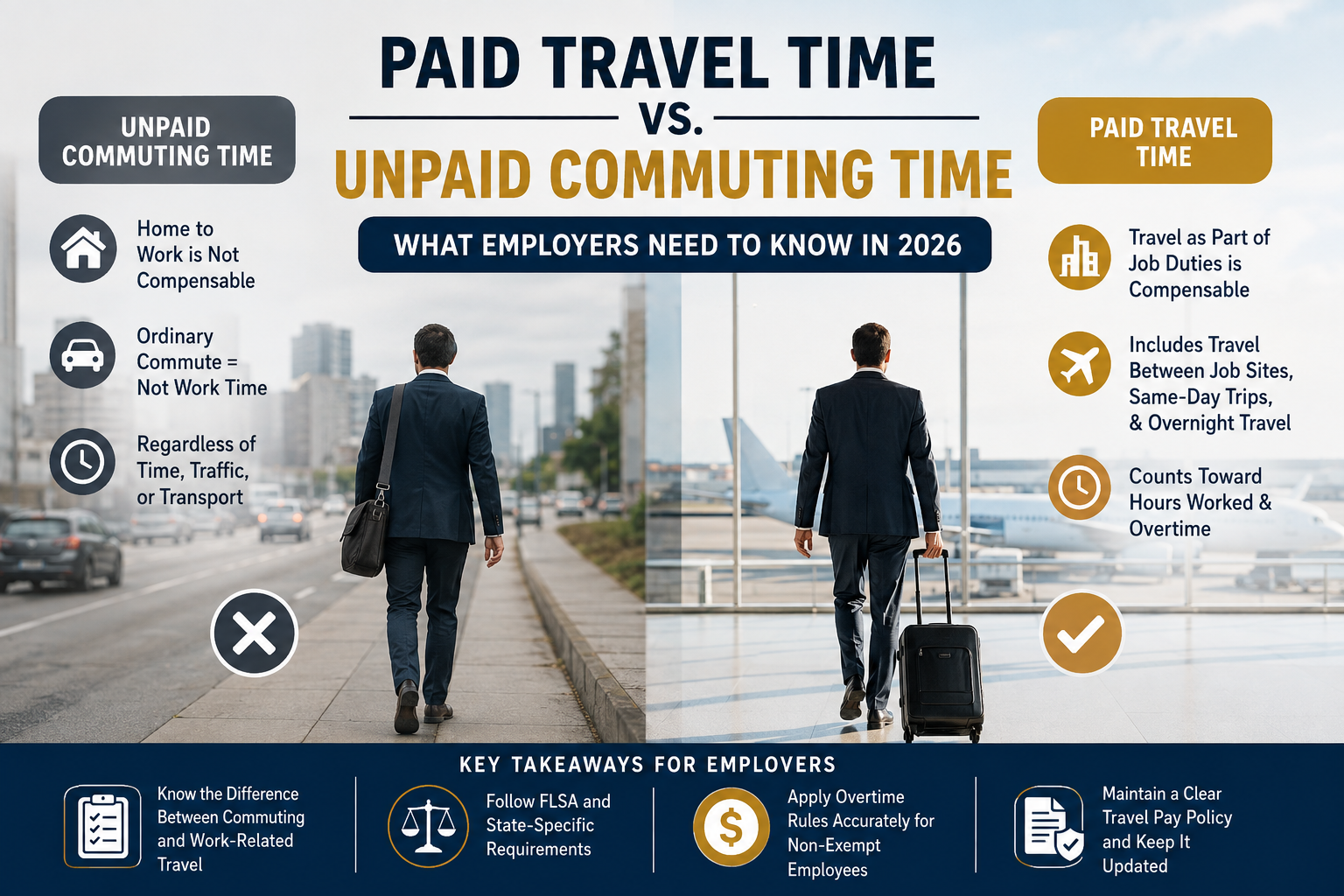
Few payroll questions cause as much confusion as figuring out when travel pay is owed. Employers often assume that any time an employee spends away from the office should be compensated, while others mistakenly believe all travel falls outside of paid work hours. Neither assumption is safe. The Fair Labor Standards Act (FLSA) draws a clear, though sometimes tricky, line between an employee's ordinary commute and business-related travel that must be paid. Getting this distinction wrong can trigger wage claims, overtime miscalculations, and costly compliance headaches.
Why the Distinction Matters
Travel pay rules sit at the intersection of federal wage and hour law, state-specific requirements, and IRS guidance on reimbursements. A payroll department that treats every mile the same way risks either overpaying unnecessarily or underpaying in a way that invites a Department of Labor audit. Since travel time can also affect overtime calculations, the stakes go beyond a single paycheck line item and touch broader payroll compliance.
Ordinary Commuting Time Is Not Compensable
Under the FLSA's Portal-to-Portal Act, the daily commute between an employee's home and their regular worksite is not considered work time, regardless of how long the drive takes or how much traffic is involved. This rule applies whether the employee drives their own car, takes public transit, or is dropped off. Commuting time is treated as ordinary home-to-work travel, and employers are not required to compensate it, even if the employee is checking work email or taking a business call along the way, as long as the activity is minimal.
When Travel Time Becomes Paid Work Time
The picture changes once an employee is asked to travel as part of their job duties. Several common scenarios typically require payment:
Travel between job sites during the workday, such as moving from one client location to another
Same-day out-of-town trips for meetings, training, or special assignments
Overnight travel that cuts into an employee's normal working hours, even if the travel happens on a weekend
Travel required because a manager sends the employee somewhere other than the usual reporting location
For non-exempt employees, this travel time typically counts toward hours worked and must be factored into overtime calculations if it pushes the workweek total past 40 hours. Exempt employees are generally paid a fixed salary regardless of travel, but employers should still track this time for recordkeeping and scheduling purposes.
Special Circumstances Payroll Teams Should Watch
A few situations tend to trip up even experienced payroll professionals:
Overnight travel is one of the trickiest areas. If an employee travels overnight and the trip includes hours that fall within their regular work schedule, that portion is generally compensable, even on a non-workday. Time spent as a passenger outside normal working hours, however, is often not compensable unless the employee is actually performing work.
Multi-state travel adds another layer of complexity. When employees travel across state lines, employers must apply the more generous standard between federal and state law, and some states have travel pay rules that go beyond FLSA minimums. This makes it essential for payroll departments to stay current on where employees are physically working, not just where the company is headquartered.
Reimbursements and IRS Rules
Travel pay isn't only a wage and hour issue. The IRS also has specific rules about when travel-related payments count as taxable wages versus non-taxable reimbursements. Employers using an accountable plan, where expenses are substantiated and excess reimbursements are returned, can generally exclude those payments from taxable income. Per diem arrangements and nonaccountable plans carry different tax treatment, so payroll and finance teams need to coordinate closely to avoid misclassifying these payments.
Building a Compliant Travel Pay Policy
A written travel pay policy helps set clear expectations and reduces the risk of disputes. At minimum, the policy should define what counts as the regular worksite, explain how overnight and multi-day travel will be handled, and clarify how travel time interacts with overtime rules. Because wage and hour laws vary by state and continue to evolve, periodic review of the policy against current federal and state requirements is a smart practice for any payroll or HR department.
Frequently Asked Questions
Q1.Does travel pay apply to remote employees who occasionally visit the office?
If a remote employee's home is considered their regular worksite, occasional office visits may be treated differently than a typical commute, depending on state rules and company policy, so this should be addressed explicitly in writing.
Q2.Is meal and rest break time during travel compensable?
Generally, bona fide meal breaks during travel are not paid, but short rest breaks are typically treated the same way they would be during a normal workday.
Q3.Can an employer require unpaid travel for non-exempt staff?
No. If travel time meets the criteria for compensable work under the FLSA or applicable state law, it must be paid, and attempting to classify it as unpaid can expose the employer to wage claims.
Q4.How should travel pay be recorded for payroll purposes?
Employers should track travel start and end times separately from regular work hours so the total can be accurately included in weekly hours worked and any overtime calculations.
Comments
Log in or sign up to join the conversation.