

Measuring economic activity using astronomical and other scientific tools is a relatively recent development that has come into its own during the 21st century.
One of the neater tools are telescopes and cameras mounted on Earth-orbiting satellites that take pictures of the night-darkened surfaces of the world. NASA's Black Marble project uses those images to tracks how the nighttime lights spread across entire regions change in brightness over time, with fully processed imagery now covering the years from 2014 through 2022.
We haven't gotten too far into the data behind the images yet, but what we see in how nighttime lights have changed the years between 2014 and 2022 appears to correspond with how carbon dioxide emissions have changed in those regions. Nighttime lights in Asia, and especially in China and India have become significantly brighter during a period in which those nation's emissions of carbon dioxide have risen. By contrast, regions that have seen falling levels of CO₂ emissions such as the eastern portion of the U.S. and western Europe have seen the brightness of their nighttime lights grow dimmer.
That introduction brings us to the latest measurements of the concentration of carbon dioxide in the Earth's atmosphere, which is measured at the remote Mauna Loa Observatory. The latest data indicates the pace at which carbon dioxide is being emitted into the Earth's atmosphere is continuing to decline, which indicates the world's economic activity is falling.
The following chart reveals how the trailing twelve month average of the year-over-year change in the rate at which the concentration of carbon dioxide in the Earth's air is changing has changed from January 2000 through July 2026.
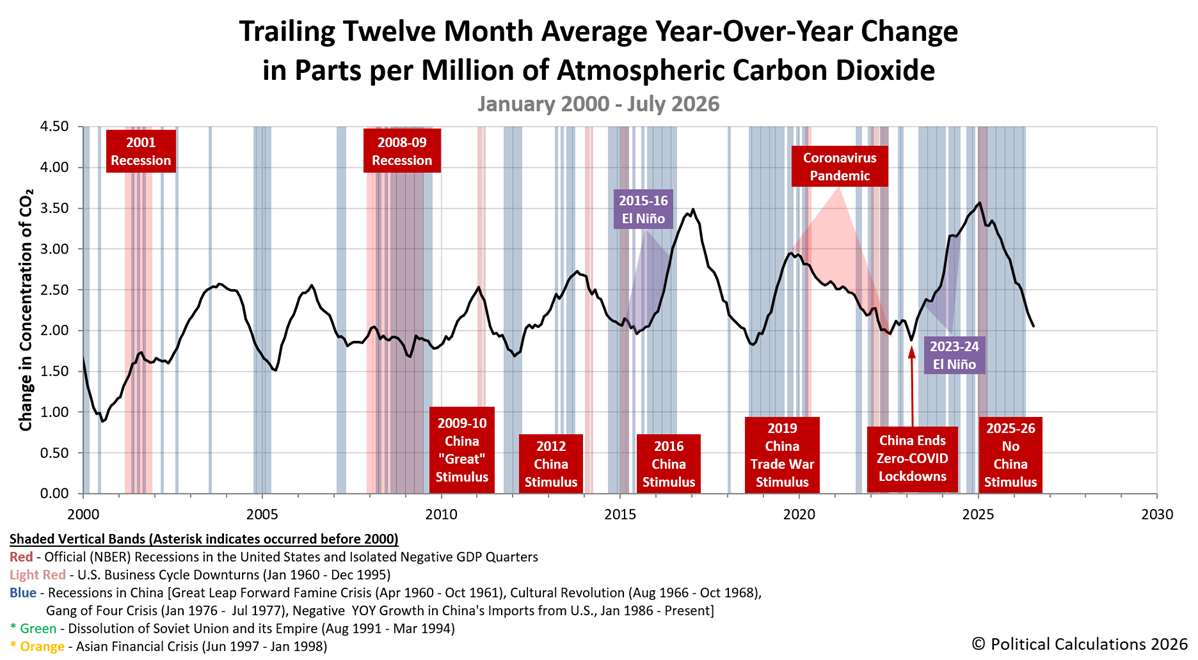
The rate at which CO₂ is increasing in the atmosphere is nearing levels where it has bottomed during periods of global recessions, or rather, significant regional recessions, in the 21st century.
References
National Oceanographic and Atmospheric Administration. Earth System Research Laboratory. Mauna Loa Observatory CO2 Data. [Online Data]. Updated 5 August 2026.

Comments
Log in or sign up to join the conversation.