

Market Overview
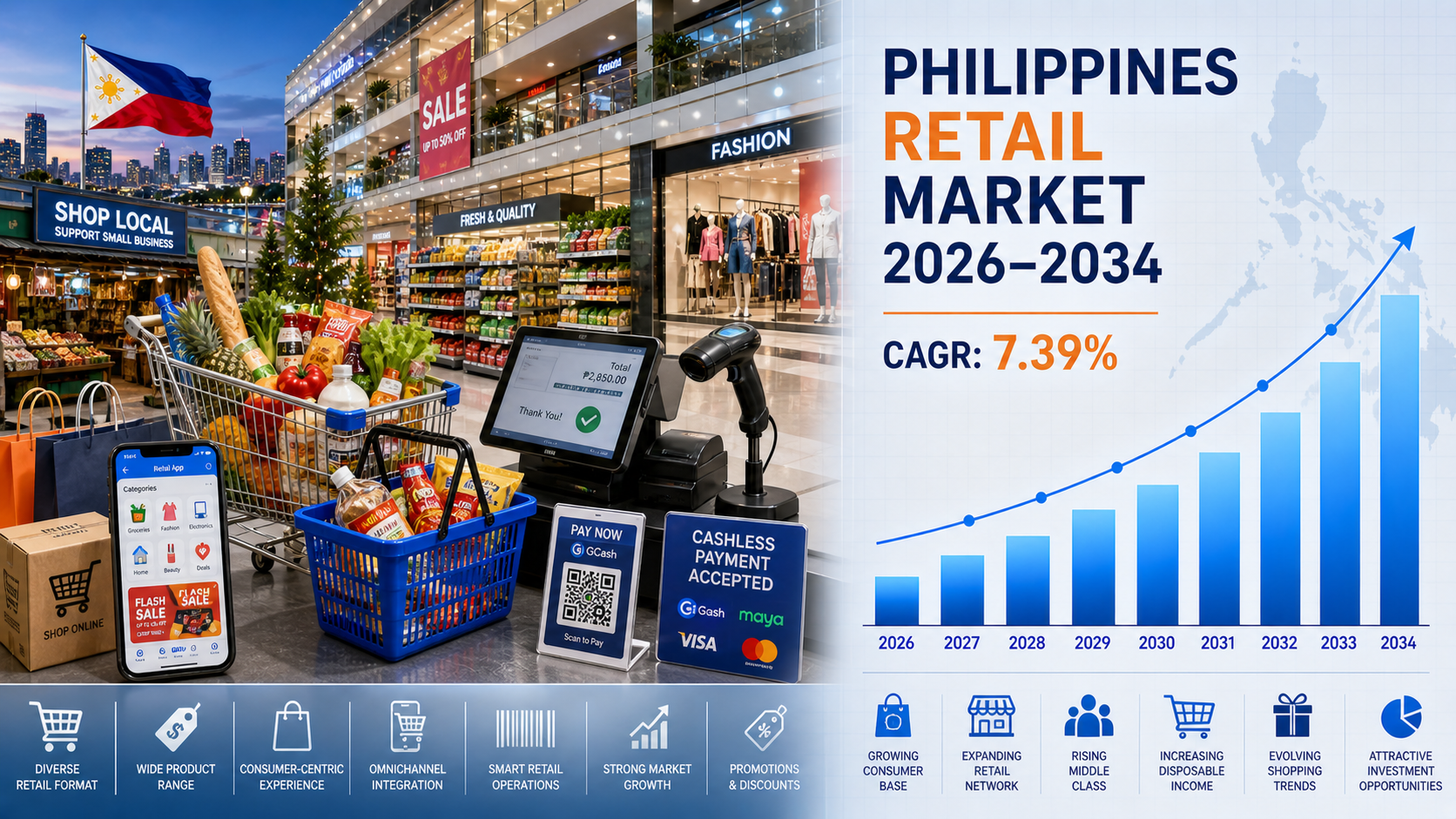
The Philippines retail market is composed of growth, driven by increasing consumer spending, expansion of modern retail formats, and e-commerce, with key players like SM Retail and Puregold leading the way, despite challenges from inflation and counterfeit products. The market size reached USD 74.8 Billion in 2025 and is projected to reach USD 144.8 Billion by 2034, growing at a compound annual growth rate (CAGR) of 7.39% from 2026 to 2034.
The market is strategically important to the Philippines' economy as it supports employment, drives consumer spending, enables product distribution across the archipelago, and contributes significantly to GDP.
Request a Sample Report for In-Depth Market Insights: https://www.imarcgroup.com/philippines-retail-market/requestsample
Philippines Retail Market Summary
The Philippines retail market encompasses a system where products (food and beverages, personal and household care, apparel, footwear and accessories, furniture, toys and hobby, electronic and household appliances, and others) are sold through distribution channels (supermarkets and hypermarkets, convenience stores and department stores, specialty stores, online stores, and others) across the archipelago.
These retail services are valued for their role in providing consumers with access to a wide range of products, enabling convenience, supporting local brands and entrepreneurship, and facilitating economic activity.
The ecosystem includes retail chains (SM Retail, Puregold), supermarkets, hypermarkets, convenience stores, department stores, specialty stores, online platforms, local entrepreneurs, suppliers, and consumers across Luzon, Visayas, and Mindanao.
Major segments identified in the market include product (food and beverages, personal and household care, apparel, footwear and accessories, furniture, toys and hobby, electronic and household appliances, others), distribution channel (supermarkets and hypermarkets, convenience stores and department stores, specialty stores, online stores, others), and region (Luzon, Visayas, Mindanao).
The market is benefiting from rising demand for packaged and ready-to-eat (RTE) food (convenience for time-starved consumers and working women), increase in demand for branded goods (rising purchasing power of middle-income group, growth of luxury and premium brands), urban growth and retail experience transformation (lifestyle centers, mixed-use properties), e-commerce integration and omni-channel innovation, and local entrepreneurship and lifestyle-based retail niches.
PORTER'S FIVE FORCES ANALYSIS — PHILIPPINES RETAIL MARKET
Bargaining Power of Suppliers — Moderate
Retail suppliers include product manufacturers, distributors, and local producers. The rising demand for branded goods has increased the purchasing power of the middle-income group, giving large retail chains leverage over suppliers.
Retailers are expanding their offerings of packaged and ready-to-eat food items, specialty products, and local artisanal goods, diversifying their supplier base.
However, large retail chains like SM Retail and Puregold have significant volume purchasing power, giving them bargaining leverage over individual suppliers.
Bargaining Power of Buyers — Moderate to High
Buyers include individual consumers across all income segments. The growing middle class and increased exposure to global food trends have influenced Filipino consumers' inclination towards branded and packaged goods.
The rise of e-commerce and social commerce has given buyers access to a wider range of products, price comparison, and customer reviews, increasing buyer power.
Price sensitivity remains high, particularly in lower-income and provincial markets, forcing retailers to balance product variety and quality with competitive pricing.
Threat of New Entrants — Moderate
The retail market has moderate barriers to entry. New entrants can enter through e-commerce platforms, specialty stores, or lifestyle-based retail niches. Local entrepreneurship is fueling the growth of small and indigenous brands in wellness, beauty, and gourmet food categories.
Collaborative retail hubs and micro-market ecosystems are reducing overhead for emerging brands, making entry more accessible.
However, established retailers have significant brand recognition, distribution networks, and real estate assets, creating barriers for unestablished entrants.
Threat of Substitutes — Moderate
Traditional street-side vendors, sari-sari stores, and mobile kiosks remain cornerstones of Philippine commerce, especially in rural areas and residential neighborhoods, providing convenience, low prices, and flexible payment arrangements.
Informal retail competition creates a challenge for formal retailers striving for scale and sustainable margins, as many Filipino shoppers prioritize affordability over curated selection or premium ambiance.
However, modern retail formats are increasingly offering value-added services (in-store cafes, interactive digital signage, loyalty programs) that informal substitutes cannot replicate.
Competitive Rivalry — High
The Philippines retail market features intense competition among established retail chains (SM Retail, Puregold), e-commerce platforms, specialty stores, and informal retailers.
Differentiation occurs through product assortment, store experience (lifestyle centers, experiential retail), omnichannel capabilities, pricing, and loyalty programs.
Retailers are investing in omnichannel innovation, social commerce, and local brand partnerships to differentiate themselves in a crowded market.
MARKET GROWTH DRIVERS
Rising Demand for Packaged and Ready-to-Eat (RTE) Food
Increased demand for convenience food items is one of the key drivers of the Philippines' strong growth in the retail market. These foods, requiring little preparation, have become increasingly popular, especially among time-starved consumers and the rising number of working women, who prefer to opt for such foods as processed meats and poultry over traditional home-cooked foods. The increasing urbanization and changing lifestyles in the Philippines have contributed to the growing demand for packaged and ready-to-eat food items.
Consumers are seeking products that offer convenience, quality, and variety to cater to their fast-paced lives. This trend has led to an increase in the sales of packaged snacks, frozen meals, and other convenience food items across various retail channels in the country. Major retailers are expanding their offerings in this segment to meet the evolving consumer preferences and capitalize on the lucrative growth opportunities.
Increase in Demand for Branded Goods
The Philippines retail market share is particularly experiencing a significant rise and key participants are now seizing the optimistic growth rates in various retail categories. Also, the Philippines has the potential to surpass other Southeast Asian neighbors in the retail e-commerce segment. Regarding the retail trade increase, it could be attributed to the improvement in the supply and distribution of the different products and services that are to be devoured by the consumers.
The rising purchasing power of the middle-income group and the population's enhancement of its buying power for branded products due to higher income can be attributed to the increase in consumption of branded products in apparel, cosmetics, footwear, watches, drinks, and food products. The middle and the upper-middle class in the Philippines have grown rapidly over the years with an increasing number of consumers considered to be rich making the market a promising one for brands considered to be luxurious and premium. Retailers are thus planning several full-fledged branded products to this new upper-class segment and improve their status through multi-format outlets and flagship stores.
Urban Growth and Retail Experience Transformation
Metro Manila, Cebu, and Davao's fast-paced urban growth is further fueling the Philippines retail sector market. Expanding middle-class communities, mall saturation, and mixed-use properties are transforming the way Filipinos shop. Retail venues are no longer mere transactional centers—they are turning into lifestyle centers, with dining, entertainment, and community activities coexisting alongside retail experiences.
From pop-up shops that highlight local designers to experiential brand experiences woven in the context of mall promenades, consumers seek more sensory indulgences as they shop. Retailers are answering back with the incorporation of in-store cafes, interactive digital signage, and hybrid areas where customers can shop products alongside cultural events and food festivals. This convergence away from simple convenience toward shared and edited experiences is driving foot traffic, extending dwell time, and building more enduring brand loyalty.
E-Commerce Integration and Omni-Channel Innovation
Leveraging the Philippines' increasing digital connectivity, retail companies are effectively combining online and offline experiences to reach more tech-savvy customers. Retailers are infusing the shopper experience with frictionless omnichannel capabilities, where customers can order online and pick up in stores, shop digital catalogs in stores to validate availability, or even make purchases through messenger apps.
Social commerce and live-stream shopping events have created rapid brand discovery among Filipino shoppers, particularly those looking for boutique or artisanal products not available in mainstream stores. Furthermore, regional vendors can reach urban markets through e-commerce platforms while city-based brands can penetrate provincial areas without physical presence. Retailers support this by offering localized payment options, from cash-on-delivery to mobile wallets, and by leveraging social media to promote flash sales or new product drops.
Local Entrepreneurship and Lifestyle-Based Retail Niches
The vibrant Philippines retail market demand is also being fueled by an explosion of local entrepreneurship and lifestyle-driven store concepts. Small and indigenous brands, particularly in wellness, beauty, and gourmet food categories, are leveraging carefully crafted pop-up stores, concept stores, and kiosks at malls to catch on through storytelling, community affiliation, and local authenticity.
Such themes as "coffee lover's nook," Filipino craftsmanship, or "sustainable living" feature curated offerings that speak to cultural identity and values-driven lifestyles. Marketplace and collaboration hub formats foster local brand partnerships, where one may sell handcrafted skin care in tandem with organic candles or heritage snacks, which is driving experiential discovery and cross-promotion. In-store workshops or interactive events, e.g., latte art classes, craft demonstrations, or plant care clinics, are also common among many brands, forging emotional connections and encouraging repeat visits.
PHILIPPINES RETAIL MARKET SEGMENTATION
Product Insights:
Food and Beverages
Personal and Household Care
Apparel, Footwear and Accessories
Furniture, Toys and Hobby
Electronic and Household Appliances
Others
Distribution Channel Insights:
Supermarkets and Hypermarkets
Convenience Stores and Department Stores
Specialty Stores
Online Stores
Others
Regional Insights:
Luzon
Visayas
Mindanao
COMPETITIVE LANDSCAPE
The Philippines retail market features intense competition among established retail chains, e-commerce platforms, specialty stores, and informal retailers. Leading players differentiate through product assortment, store experience, omnichannel capabilities, pricing, and loyalty programs. Retailers are investing in omni-channel innovation, social commerce, and local brand partnerships to differentiate themselves.
Key players mentioned in the report include:
SM Retail
Puregold
REGIONAL ANALYSIS
Luzon: As the region containing Metro Manila and other major urban centers, Luzon represents the largest retail market in the Philippines. The region benefits from high population density, concentration of supermarkets, hypermarkets, department stores, and specialty stores. Metro Manila, Cebu, and Davao's fast-paced urban growth is transforming retail into lifestyle centers with dining, entertainment, and community activities.
Visayas: The Visayas region, including major cities like Cebu, represents a growing retail market driven by urbanization, tourism, and expanding middle-class communities. Cebu is a key retail hub with a mix of modern retail formats and local specialty stores. Retail venues are turning into lifestyle centers, with pop-up shops highlighting local designers.
Mindanao: Mindanao represents an emerging retail market with growth potential driven by increasing urbanization in Davao and other cities, rising middle-class population, and infrastructure development. Coastal and provincial expansion presents opportunities for contemporary retail formats like suburban malls and lifestyle centers. Local specialty stores featuring regional products are gaining traction.
RECENT INDUSTRY DEVELOPMENTS
June 2026: The Philippine Statistics Authority (PSA) reported that the country's digital economy generated PHP 2.74 trillion in gross value added (GVA) in 2025, accounting for 9.8% of GDP, reflecting the increasing integration of digital channels into the retail sector and supporting omnichannel retail growth.
May 2026: Retail industry groups reported continued expansion of modern trade formats, convenience stores, and supermarket chains across the Philippines. Strong consumer spending and urbanization trends supported the growth of organized retail and shopping center developments nationwide.
April 2026: The Philippine economy grew by 5.4% year-over-year in the first quarter of 2026, supported by robust household consumption. Consumer spending, which accounts for roughly three-fourths of the country's economic output, remained a key driver of retail sales growth.
March 2026: E-commerce platforms reported that the combined Gross Merchandise Value (GMV) of Shopee, Lazada, and TikTok Shop reached approximately USD 22 billion in 2025, a 15% increase from the previous year, highlighting the growing convergence between online and offline retail channels.
February 2026: The Philippines maintained its position as the fourth-largest e-commerce market in Southeast Asia, with the broader retail sector benefiting from increasing digital payment adoption, expanding logistics infrastructure, and rising internet penetration among consumers.
January 2026: The Philippine retail sector entered 2026 with strong momentum following sustained consumer demand. Inflation eased to around 2.9% in December 2025, improving household purchasing power and supporting retail expenditure across food, apparel, electronics, and discretionary categories.
January 2026: Mobile-wallet penetration exceeded 65% among Filipino consumers, accelerating cashless transactions across physical stores and online retail platforms. The trend continued to reshape payment preferences and customer engagement strategies in the retail industry.
Note: If you need any specific information that is not currently covered within the scope of the report, we will provide the same as a part of customization.
Speak to an analyst: https://www.imarcgroup.com/request?type=report&id=28821&flag=C
About Us
IMARC Group is a global management consulting firm that helps the world's most ambitious change makers to create a lasting impact. The company provides a comprehensive suite of market entry and expansion services. IMARC offerings include thorough market assessment, feasibility studies, company incorporation assistance, factory setup support, regulatory approvals and licensing navigation, branding, marketing and sales strategies, competitive landscape and benchmarking analysis, pricing and cost research, and procurement research.
Contact Us
IMARC Group
134 N 4th St., Brooklyn, NY 11249, USA
Email: [email protected]
Tel. No.: (D) +91 120 433 0800
United States: +1-201-971-6302
Comments
Log in or sign up to join the conversation.