

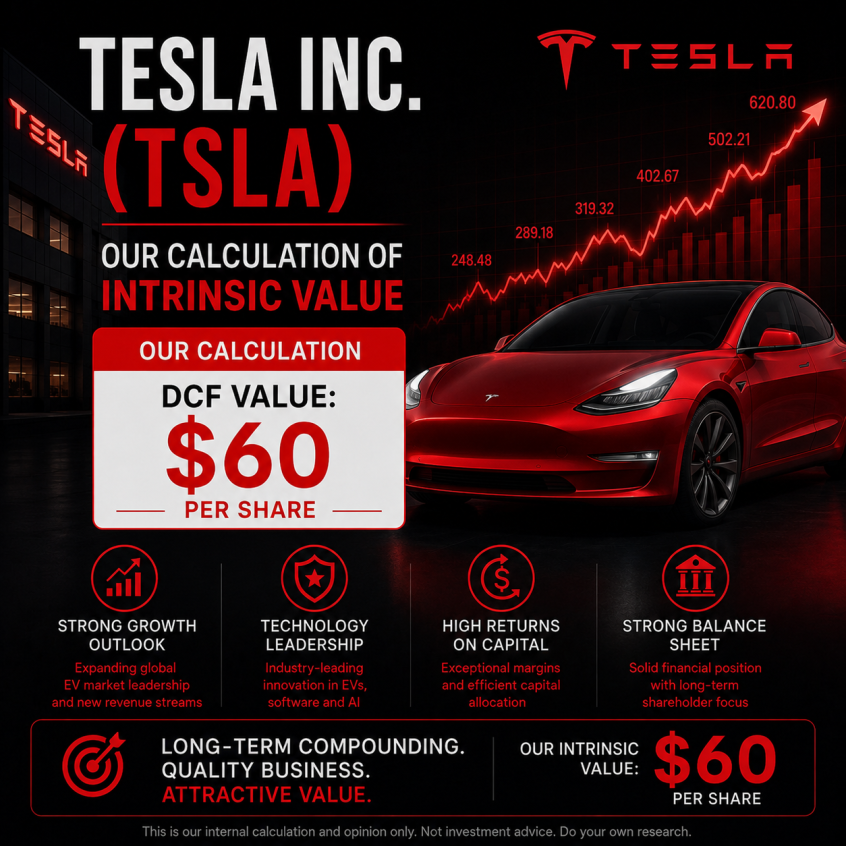
Each week, we run a DCF (Discounted Cash Flow) model on a company from our watchlist. This week’s pick: Tesla, Inc. (TSLA).
Profile
Tesla is one of the largest electric vehicle and clean energy companies, designing and manufacturing electric vehicles, energy storage systems, solar products, and related technologies.
What began primarily as an electric vehicle manufacturer has evolved into a diversified technology and energy company with operations spanning automotive manufacturing, battery storage, charging infrastructure, artificial intelligence, and autonomous driving technology.
Tesla’s business model is driven by:
• Sales and leasing of electric vehicles
• Automotive regulatory credit revenue
• Energy generation and storage products
• Services, charging, insurance, and other automotive revenue
• Potential long-term opportunities from autonomous driving, robotics, and artificial intelligence
Tesla’s competitive advantages include:
• One of the most recognized brands in the electric vehicle industry
• Significant manufacturing scale and vertical integration
• A large and expanding global charging network
• Strong balance sheet with substantial cash reserves
• Growing energy storage operations
The business also benefits from long-term structural tailwinds including increasing electric vehicle adoption, growing demand for battery storage, investment in artificial intelligence, and the potential development of autonomous transportation.
DCF Analysis
Inputs:
Discount Rate: 9%
Terminal Growth Rate: 3%
WACC: 9%
Forecasted Free Cash Flows (in billions USD)
2026: $8.1 → PV: $7.4B
2027: $9.3 → PV: $7.8B
2028: $10.6 → PV: $8.2B
2029: $12.2 → PV: $8.6B
2030: $14.0 → PV: $9.1B
Total Present Value of FCFs = ~$41.1B
Terminal Value Calculation
Using the perpetuity growth model with 2030 FCF of $14.0B:
TV = (14.0 × 1.03) ÷ (0.09 − 0.03)
Terminal Value ≈ $240B
Present Value of Terminal Value ≈ $156B
Enterprise Value
Enterprise Value = $41.1B + $156B
Enterprise Value ≈ $197B
Net Cash Position
Cash & Equivalents: ~$44.1B
Total Debt: ~$14.7B
Net Cash ≈ $29.4B
Equity Value & Per-Share Value
Equity Value = $197B + $29.4B
Equity Value ≈ $226B
Shares Outstanding: ~3.75B
Intrinsic Value per Share ≈ $60
Conclusion
DCF Value: ~$60
Current Price: ~$395
Margin of Safety: ~-85%
Tesla remains one of the most innovative and closely followed companies in the market. The company maintains a strong balance sheet, substantial liquidity, global manufacturing capacity, and growing operations beyond its core automotive business.
Tesla’s energy storage business represents an increasingly important growth opportunity, while management continues investing heavily in artificial intelligence, autonomous driving, and robotics. If these initiatives develop into highly profitable businesses, Tesla’s long-term earnings potential could extend significantly beyond traditional vehicle manufacturing.
However, the current valuation presents a major challenge for conventional discounted cash flow analysis. Even assuming free cash flow grows at approximately 15% annually over the next five years, a conservative DCF model produces an intrinsic value substantially below the current share price.
The difference between Tesla’s estimated DCF value and its market price highlights the significant expectations already embedded in the stock. Investors appear to be pricing in substantial future value from autonomous vehicles, robotaxis, artificial intelligence, robotics, and other businesses that are not yet generating meaningful free cash flow.
For long-term investors, Tesla remains a unique business with significant growth opportunities. However, from a traditional valuation perspective, the current market price offers little margin of safety under conservative assumptions and requires substantial future growth beyond the company’s existing cash-generating operations to justify its valuation.



Comments
Log in or sign up to join the conversation.