


More quickish hits today.
First, more on the DYMIX mutual fund that we looked at yesterday. The fund has done well performance-wise but has been very volatile. It has about the same level of volatility as the S&P 500 but is only 50% equities. The mix of equities and macro has meant the fund has taken a very different path to a similar result as SPY.
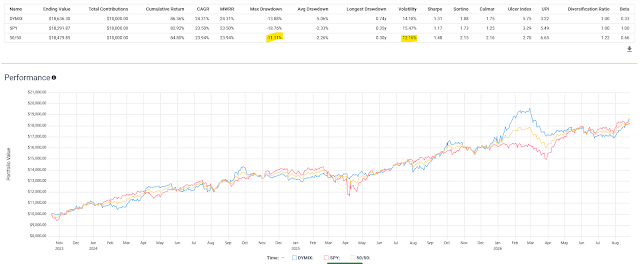
A 50/50 blend of the two brings the volatility down noticeably, improves the Sharpe Ratio, and has a meaningful impact on max drawdowns and average drawdowns. I have no idea if this can carry forward or not, as it probably relies on DYMIX continuing to make good decisions, but it is a good and simple example of blending two very volatile things to get a result with less volatility. This is why BTAL has worked as a way to hedge portfolios, but 50% to BTAL is absolutely the wrong weighting; that should be much smaller.
Yesterday, I said that the FOXY ETF from Simplify might turn out to be a useful fund for adding currency exposure; it is a variation on the carry trade. We've also looked at a couple of stinkers from Simplify too. I think we were early to realize that its Tail Risk fund, which had the symbol CYA, wouldn't work because of the way it relied on going long volatility via the VIX, and sure enough the fund went down a ton and closed.
We've been curious but skeptical of the Simplify Multi QIS Alternative ETF (QIS). QIS stands for quantitative investment strategies.
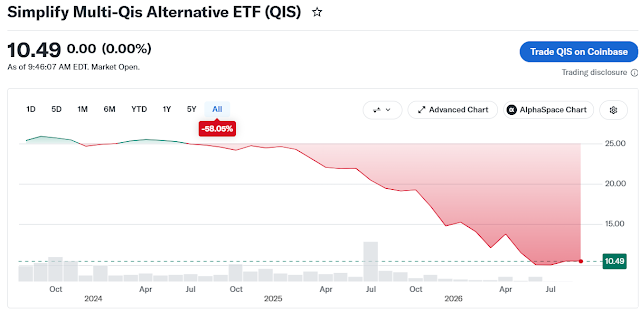
Stinker. It's more difficult to look through QIS' holdings to understand what the story is compared to CYA, but Copilot thinks that QIS has also been hurt by going long volatility. Ouch.
Very quickly on autocallables, ProShares posted a glossary of terms that might be useful if you're trying to learn about them.
ETF provider Kurv just listed a capital-efficient fund along the lines of WisdomTree (WT) or ReturnStacked with the Kurv US Large Cap Tax Optimized ETF (LCTO). The prospectus allows it to be 100% S&P 500/100% fixed income, which will usually be municipal bond ETFs. Currently, though, it is only 58% in munis, so for now the weighting is similar to NTSX from WisdomTree, but that fund owns AGG-like exposure instead of just munis, and it allocates 90% to equities, not 100%.
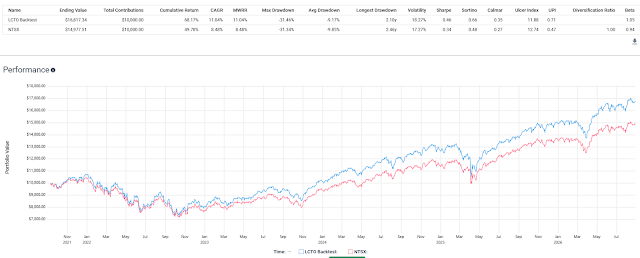
LCTO is actively managed, so this backtest doesn't give it credit for any good decisions related to shortening duration it might have made if it had existed. LCTO has done noticeably better, but it has more S&P 500 exposure. Just peeling out the muni bond ETFs, that sleeve compounded at 1.01% for the same period versus -0.23% for AGG.
You can listen to this podcast from Kurv to learn more about what they have in mind.
LCTO was discussed in the podcast as a portable alpha strategy. I'm not a huge fan of implementing portable alpha this way.

If an investor puts 67% into NTSX or LCTO, they have 33% left over to either add yield like T-bills or add alternatives to better diversify the 67% they put into the levered fund. That sounds good in theory, but how difficult would it be to have 2/3 of your account down 30%, as was the case in 2022? Salvaging 2022 would have required really dialing in the exact alts to mitigate that decline. Having to get that right seems much more difficult than avoiding the leverage and diversifying your diversifiers.


Comments
Log in or sign up to join the conversation.