

Efficient storage is one of the most important factors in maintaining an organized warehouse, stockroom, workshop, or commercial facility. Businesses need storage solutions that make products easy to identify, access, arrange, and relocate when operational requirements change.
Open shelves provide a practical way to organize a wide variety of materials while maintaining direct access to stored items. Unlike enclosed cabinets, open shelving keeps products visible and easily reachable, making it suitable for facilities where materials are handled frequently.
From spare parts and tools to cartons, documents, packaged products, and general inventory, open shelving can support many everyday storage requirements.
What Are Open Shelves?
Open shelves are storage structures designed without enclosed doors or cabinets. They normally consist of vertical frames or uprights combined with horizontal shelf levels where materials can be placed.
Their straightforward design makes open shelf racks useful in environments where quick access and clear product visibility are important.
Depending on the facility and stored materials, businesses may use:
Open storage shelves
Metal open shelves
Adjustable open shelves
Industrial open shelves
Open storage racks
Heavy-duty open shelves
Commercial open shelving
The configuration can be selected according to available floor space, storage height, product dimensions, and operational requirements.
Why Open Shelving Works Well in Warehouses
Warehouse storage is not simply about creating additional space. An effective storage layout should also help employees locate, handle, and replenish materials efficiently.
Well-arranged warehouse open shelves can provide designated locations for different products while keeping the stored inventory visible from the aisle.
This can be especially useful for warehouses handling smaller products, maintenance items, tools, packaged goods, spare parts, and frequently accessed materials.
Better Visibility of Stored Products
One of the main advantages of open storage shelves is product visibility.
With enclosed storage cabinets, workers may need to open multiple doors or drawers to locate a particular item. Open shelving allows products to remain visible, which can simplify identification and retrieval.
Labels, bins, cartons, or different product categories can also be arranged across clearly defined shelf levels.
Better visibility can support:
Faster product identification
Easier stock checking
Better inventory organization
More convenient replenishment
Reduced unnecessary searching
For operations where employees regularly pick and return materials, this accessibility can be particularly valuable.
Making Better Use of Vertical Storage Space
Warehouse floor space is valuable. Expanding horizontally is not always practical, especially when a facility has limited available area.
Open shelving units allow businesses to organize products vertically by creating multiple storage levels within the same floor footprint.
Instead of placing cartons, tools, or materials directly on the floor, businesses can arrange them across different shelf levels. This creates a cleaner storage layout while improving the use of available height.
A properly planned shelving layout can also help keep aisles and working areas more organized.
Common Applications of Open Shelf Storage
The flexibility and simple design of open shelf storage make it suitable for a wide range of environments where quick access, visibility, and organized storage are important. From industrial warehouses to offices, open shelving helps businesses arrange materials efficiently while making stored items easier to identify and retrieve.
Warehouses
Warehouses often handle large quantities of products, spare parts, tools, and packaged materials that require organized storage. Open shelving provides a practical solution for keeping cartons, maintenance items, inventory boxes, and components arranged in specific locations.
Because the shelves remain open, workers can quickly identify stored items without searching through closed cabinets. This improves picking efficiency, stock checking, and daily warehouse operations.
Common warehouse applications include:
Spare parts storage
Packaging materials
Small components
Maintenance supplies
Inventory bins and cartons
Frequently accessed products
Workshops
Workshops require storage solutions that keep tools, equipment, and small components close to working areas. Open shelf storage allows technicians and operators to arrange frequently used items in an accessible manner.
Tools and materials can be categorized according to usage, making the workplace more organized and reducing time spent searching for required items.
Typical workshop uses include:
Hand tools and equipment
Machine spare parts
Consumables
Maintenance materials
Small assemblies and components
Stockrooms
Stockrooms are designed to store products before they are moved to production areas, retail spaces, or customer locations. Open storage racks help maintain visibility and organization by providing dedicated spaces for different categories of inventory.
With proper labeling, businesses can create an efficient stock management system where employees can quickly locate, check, and replenish stored items.
Benefits in stockrooms include:
Better product identification
Improved inventory control
Easier stock counting
Organized storage zones
Faster material retrieval
Retail Storage Areas
Retail businesses often require additional storage behind sales areas to manage reserve inventory. Commercial open shelving provides an effective way to organize extra products, cartons, and supplies while keeping them easily accessible for employees.
Open shelves allow staff to quickly locate additional stock when products need to be replenished on display areas.
Common retail applications include:
Backroom inventory storage
Product cartons
Display support materials
Seasonal stock
Packaging supplies
Offices
Offices also benefit from organized shelving systems for storing documents, files, stationery, and general supplies. Open shelves provide a simple and accessible storage option where frequently used materials can be arranged neatly.
They are commonly used for:
Document storage
Archive files
Office stationery
Reference materials
Equipment and supplies
By using properly planned open shelving units, offices can maintain cleaner workspaces while ensuring important materials remain easy to access.
Industrial Facilities
Industrial environments often require organized storage solutions for a wide range of materials used in daily operations. Industrial open shelves provide a practical way to arrange maintenance components, production supplies, tools, and general materials while keeping them easily accessible.
In manufacturing plants, workshops, and industrial units, employees frequently need quick access to spare parts, machine accessories, consumables, and maintenance items. Open shelving allows these materials to be stored in clearly defined locations, reducing search time and improving workplace efficiency.
Metal Open Shelves for Commercial Environments
Storage equipment used in warehouses and industrial facilities should be selected according to the operating environment and expected loading conditions.
Metal open shelves are widely suited to commercial and industrial applications because they provide a structured framework for organizing different materials.
Their open construction also makes routine inspection and cleaning more convenient because the contents remain visible and accessible.
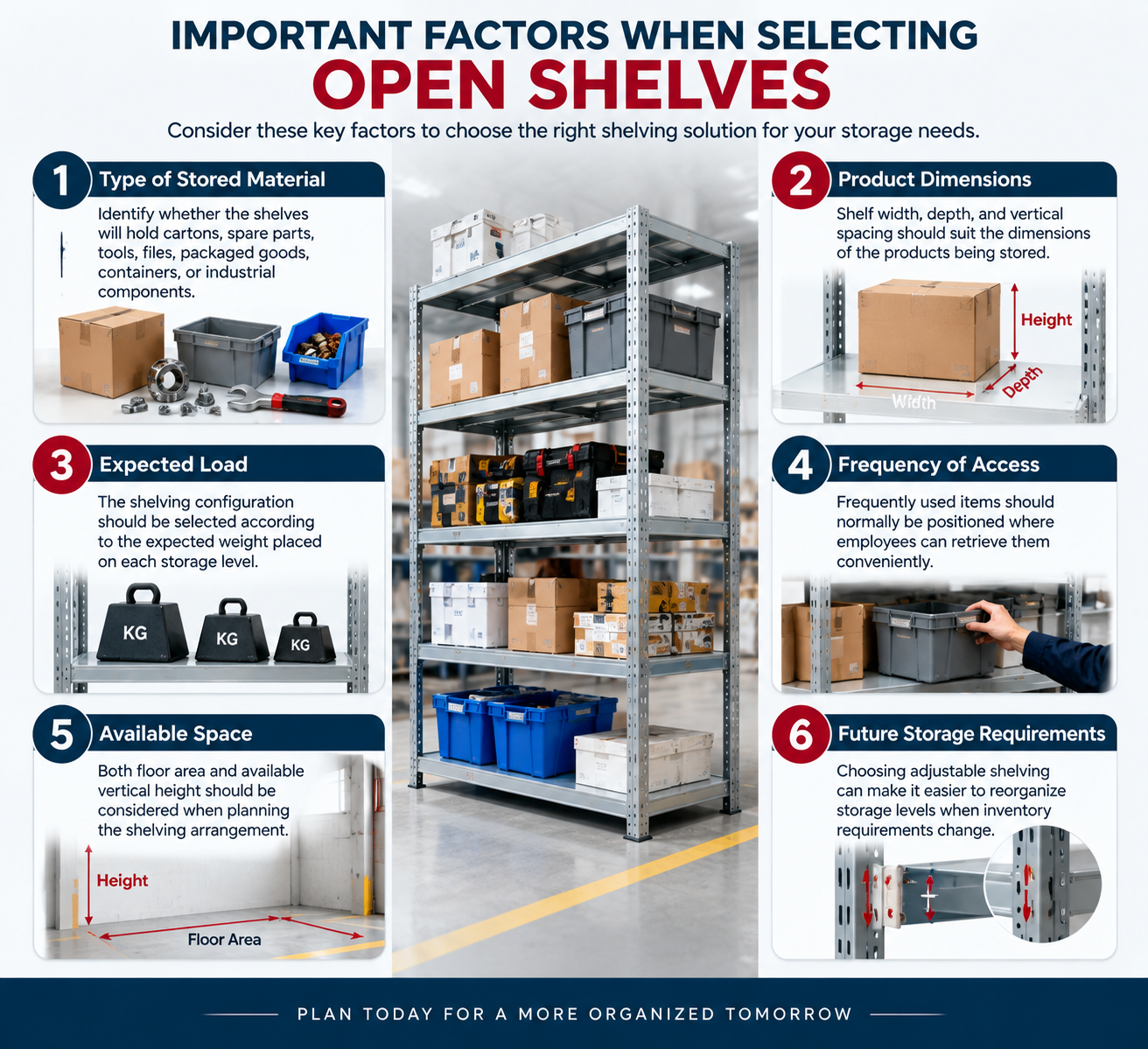
When planning metal storage shelves, businesses should consider shelf dimensions, material weight, aisle requirements, frequency of access, and overall warehouse layout.
Adjustable Shelving for Changing Storage Requirements
Inventory requirements rarely remain exactly the same.
Product sizes may change, new stock categories may be introduced, or the quantity of stored materials may increase. For this reason, flexibility is an important consideration when selecting storage equipment.
An adjustable open shelving system allows shelf positions to be configured according to different storage requirements.
For example, smaller spacing may be suitable for compact products, while larger vertical clearances may be needed for taller cartons or components.
This adaptability makes adjustable open shelves useful for facilities where storage requirements change over time.
Creating a More Organized Storage Layout
Installing shelving alone does not guarantee an efficient warehouse. The overall organization of the storage area is equally important.
Businesses can improve shelf utilization by assigning specific locations to different product groups. Frequently accessed products can be positioned at convenient working heights, while less frequently handled materials can occupy other available levels.
Clear identification labels can also be added to shelf positions, bins, or product categories.
A structured open shelf storage layout can therefore support a more systematic flow from receiving and storage to picking, packing, and dispatch.
Open Shelves vs Enclosed Storage
Both open and enclosed storage systems have suitable applications.
Enclosed cabinets may be preferred when materials require additional protection, controlled access, or concealment. However, where visibility and frequent access are priorities, open shelving units provide a straightforward alternative.
Open shelves are particularly suitable when businesses require:
Direct access to stored products
Easy visual identification
Flexible shelf configurations
Organized small and medium-size inventory
Efficient use of vertical space
Simple stock monitoring
The correct choice ultimately depends on the products, operating environment, and storage process.
Supporting Efficient Warehouse Operations
Storage systems form an important part of overall warehouse planning.
Well-positioned industrial open shelves can help create defined storage areas, reduce floor-level clutter, and improve access to commonly used materials. When combined with clear labeling and an organized inventory system, shelving can contribute to a more structured working environment.
Businesses should therefore evaluate storage requirements carefully rather than selecting shelves based only on available space.
Conclusion
Open shelves provide a flexible and practical approach to organizing warehouses, stockrooms, workshops, offices, and commercial facilities.From open shelf racks and metal open shelves to adjustable and heavy-duty configurations, businesses can select shelving according to product dimensions, loading requirements, available space, and frequency of access.A properly planned shelving arrangement can improve product visibility, make better use of vertical space, and create a more organized storage environment.For businesses looking to improve everyday storage and accessibility, open shelving remains a versatile solution for both commercial and industrial applications.
#OpenShelves #WarehouseOpenShelves #OpenShelfRacks #OpenStorageShelves #OpenShelvingUnits #IndustrialOpenShelves #MetalOpenShelves #WarehouseStorage #CommercialOpenShelving #StorageShelves #OpenStorageRacks
Comments
Log in or sign up to join the conversation.