

Last week’s Bloomberg radio segment followed on my latest New York Society of Security Analysts’ seminar in which the dichotomy between the message of the fixed income (credit) markets and that of the equity markets cannot remain in place indefinitely1. The radio interview also featured what was for me a rather direct and forceful criticism of central banker “monetary activism”, which describes a move far beyond the core central banker mandates and, in the process, a failure to force other public policy decision-makers to act. The candid nevertheless disgraceful quote by Jean-Claude Juncker, President of the European Commission noted two-weeks ago personifies this ugly situation: “We all know what to do; we just don't know how to get re-elected after we’ve done it!”.
All of the above – and more – was brought to bear on the remarkable situation of an overvalued US stock market that can only be described as highly risky. Leaving little room for error, the potential for gain appears to be very small compared to the potential for loss, which appears to be quite substantial. All that is needed is a trigger mechanism – a Lehman moment, if you will – and the game is up. But for now, with the music playing and the performance record of most investment professionals as dismal as it has and still is, the need to dance (plus the alpha male belief that one can find a chair or the exit before or as the music stops) is strong.
Toward the interview there was one moment when I ever so briefly mentioned that there was one way out of the bearish view I espoused and it is that one-way factor that I would like to go into here.
The one way out is if earnings growth in the coming 18 months starts to accelerate and that earnings growth comes from not from the increasing dry well of cost cutting and operational efficiency improvements but, preferably, via top line (sales) growth. Here is some data on the recent history of sales growth versus bottom line growth.
The following table is from data provided by my good friend Sam Stovall at S&P Capital IQ and has been modified to illustrate the growth in earnings per share on a sales versus operating and as reported earnings basis since 2010.
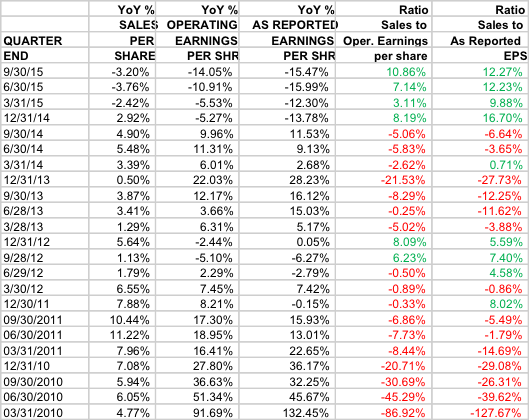
What you see is something that has been widely known but not, to my knowledge, been shown quite this clearly: the growth in both operating earnings and on an as reported basis is a product of cost cutting and operating improvements, much of which is due to technology, globalization, and management changes2. What, in effect, this means is that unless there is more blood to squeeze from the corporate stone, top line has to drive the bottom line.
Investment Strategy Implications
US stocks are not cheap. Therefore, with interest rates at rock bottom, their justification for high levels in the future rest in companies growing the top line at something remotely resembling their cost of capital3. For that to happen, a whole lot of things must not wrong while a whole lot of things must go right. And that’s a lot to ask for when stocks are so expensive.
***
1 See last Thursday posting for the audio reply of the interview
2 Most notable of which is the corporate global operating system.
3 11% historically, 6 to 8% recently.



Comments
Log in or sign up to join the conversation.