
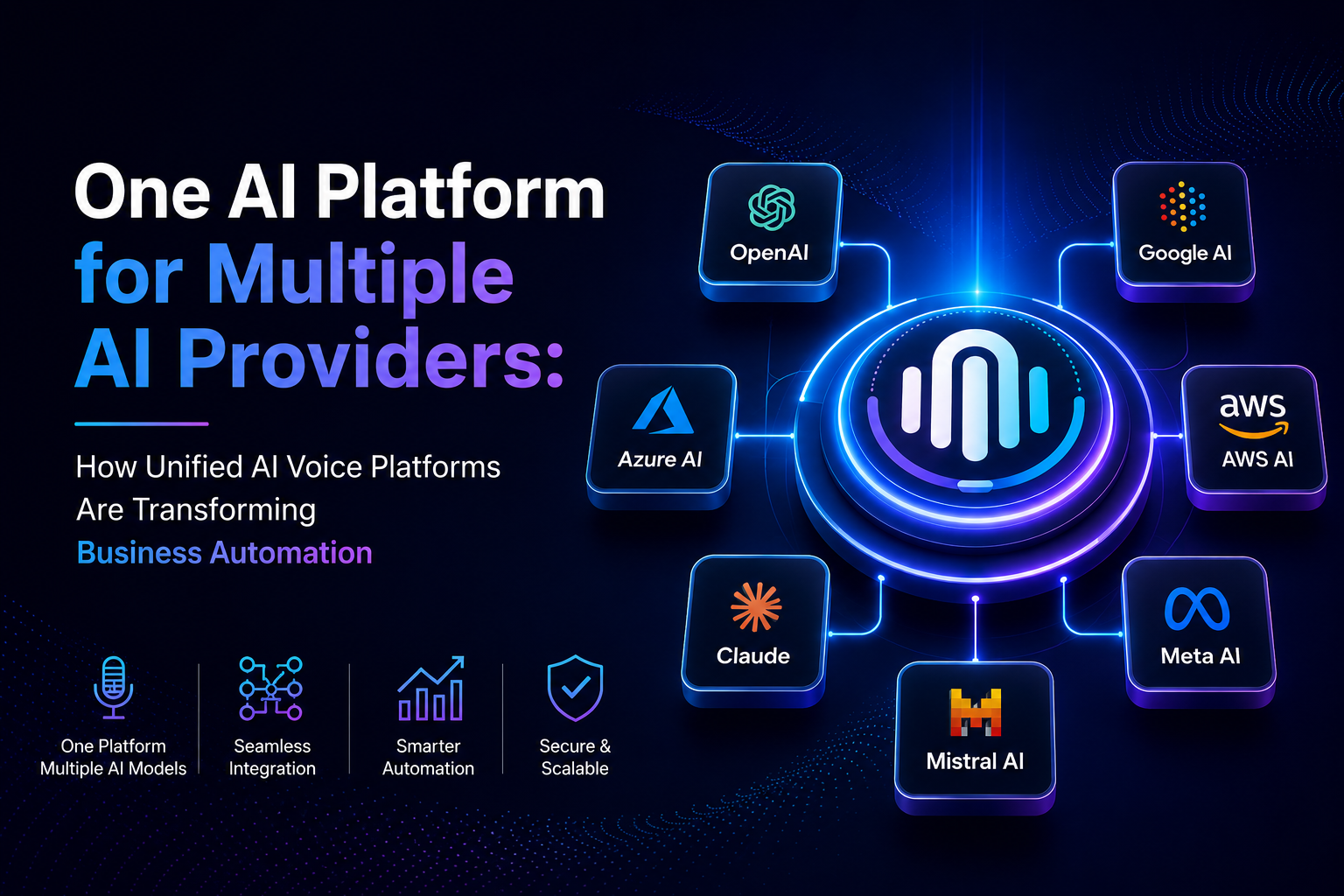
Artificial intelligence has become an essential technology for businesses looking to improve communication, automate repetitive operations, and enhance customer experiences. As AI adoption increases, organizations are exploring multiple AI capabilities for different business requirements, including voice automation, customer interactions, workflow management, and intelligent assistance.
However, managing multiple AI solutions separately can create complexity, increase operational efforts, and make scalability more challenging.
A unified AI voice platform provides a structured solution by bringing different AI capabilities together within a single environment. Instead of handling separate systems for voice processing, conversation intelligence, automation, and AI model management, businesses can manage their complete voice automation workflow through one centralized platform.
Understanding Unified AI Voice Platforms
A unified AI voice platform is an integrated system that combines multiple artificial intelligence technologies to create advanced voice-based interactions. These platforms allow businesses to build intelligent voice agents capable of understanding customer requests, processing conversations, and performing specific actions based on business requirements.
The purpose of a unified platform is to simplify AI adoption by reducing dependency on multiple disconnected solutions. Businesses can manage voice interactions, automate communication processes, and improve customer engagement through a single framework that supports flexibility and scalability.
With the advancement of AI technologies, organizations require systems that can adapt to different communication needs. A unified approach allows businesses to utilize suitable AI capabilities for different workflows while maintaining better control over their automation processes.
Why Businesses Are Moving Toward Unified AI Platforms
The increasing demand for faster and more efficient communication has encouraged businesses to adopt AI-powered voice solutions. Customers expect quick responses, accurate information, and seamless interactions across different communication channels. Traditional communication systems often struggle to provide this level of availability and personalization.
Managing separate AI tools for different functions can increase technical complexity and require additional resources. A unified AI voice platform simplifies this process by providing a centralized environment where businesses can manage automation, monitor performance, and improve customer interactions more effectively.
These platforms also help organizations optimize their technology investments by providing better control over AI usage and reducing the challenges associated with multiple independent systems.
Role of AI Integration in Voice Automation
Voice automation depends on several AI capabilities working together. Speech recognition, language understanding, response generation, and workflow execution are important components that determine the effectiveness of an AI voice system.
A unified AI voice platform connects these capabilities to create smoother and more intelligent conversations. Businesses can use such platforms for handling customer inquiries, managing appointments, qualifying leads, collecting information, and supporting daily communication activities. The ability to combine different AI functionalities within one platform allows organizations to create customized voice experiences based on their specific operational requirements.
How Vomyra Supports Unified AI Voice Experiences
Modern businesses require voice solutions that can manage real conversations while maintaining accuracy, consistency, and efficiency. AI voice agents need to understand customer intent, provide relevant responses, and complete business-related actions without unnecessary complexity.
Vomyra helps businesses create AI-powered voice experiences by providing a platform designed for intelligent communication automation. The solution enables organizations to manage voice interactions more efficiently while supporting different business workflows and customer engagement requirements.
A unified approach allows businesses to simplify their AI operations and create scalable communication systems that can adapt as their needs grow.
How Vomyra Stacks Up Against Other Voice AI Options
Voice AI solutions differ based on their flexibility, automation capabilities, and ability to support business-specific workflows. Basic voice automation systems generally depend on fixed responses and predefined conversation paths, which may limit their ability to handle complex customer interactions.
A unified AI voice platform provides a more advanced approach by combining multiple AI capabilities into a single system. This enables businesses to create flexible voice experiences that can adapt to different situations and customer requirements.
Compared with traditional voice solutions, unified platforms provide greater control over conversation management, easier workflow customization, and improved scalability. Businesses can enhance their communication processes without managing multiple disconnected technologies.
vomyra ai voice agent follows this unified approach by helping organizations build voice automation systems that support efficient communication and smoother customer interactions.
Benefits of Using One Platform for Multiple AI Capabilities
A single AI platform reduces the complexity of managing different technologies separately. Businesses can save time by controlling their AI workflows from one place and avoid unnecessary operational challenges.
Unified platforms also improve testing and optimization because organizations can evaluate different AI capabilities within the same environment. This allows businesses to make better decisions regarding their automation strategies and improve overall performance.
Cost management is another important advantage. A centralized platform provides better visibility into AI usage and helps businesses maintain better control over their technology expenses.
Future of Unified AI Voice Platforms
The future of business communication is moving toward intelligent systems that can understand conversations, automate processes, and provide personalized customer experiences. One AI Platform for Multiple AI Providers is becoming an important approach in this transformation, allowing businesses to access advanced AI capabilities through a unified and manageable voice automation system.
As businesses continue adopting automation, the demand for flexible and scalable voice solutions will continue to increase. Organizations that implement unified AI platforms can improve operational efficiency while creating better communication experiences for customers.
Vomyra represents the growing shift toward unified AI voice automation by helping businesses use advanced voice technology in a simplified and scalable way. The combination of multiple AI capabilities within one platform allows organizations to improve productivity, enhance customer engagement, and prepare for the future of automated communication.
Frequently Asked Questions (FAQs)
What is a unified AI voice platform?
A unified AI voice platform is a system that combines multiple AI technologies into one environment to help businesses create and manage intelligent voice interactions.
How does a unified AI voice platform improve business operations?
It improves business operations by automating repetitive communication tasks, reducing response time, and helping teams manage customer interactions more efficiently.
Can AI voice platforms handle customer support activities?
Yes, AI voice platforms can assist with customer inquiries, appointment management, lead interactions, and other communication-based tasks.
Why are businesses adopting unified AI solutions?
Businesses are adopting unified AI solutions because they simplify technology management, improve automation efficiency, and provide scalable communication capabilities.
How are unified AI voice platforms different from traditional voice systems?
Unified AI voice platforms provide more flexible and intelligent conversations compared with traditional systems that often rely on fixed scripts and limited responses.
Comments
Log in or sign up to join the conversation.