

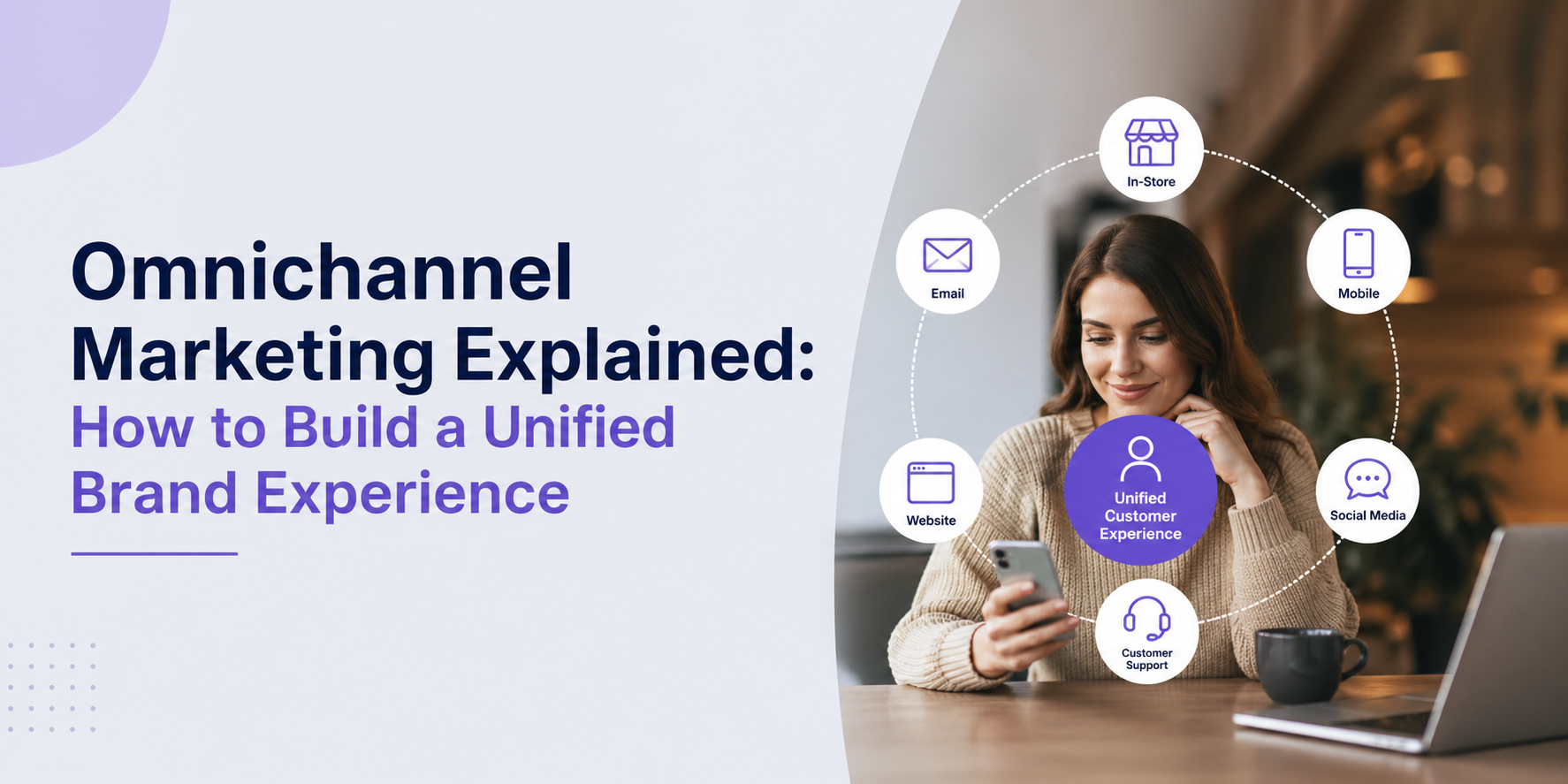
Your customer discovered your brand on Instagram. They clicked through to the website, browsed for ten minutes, and left without buying. Three days later, they received a generic promotional email that had no memory of what they looked at. They walked into your physical store and the staff had no idea they'd already been close to purchasing online. They called customer support with a question and had to explain the entire context from scratch. By the time they finally bought — if they bought at all — they'd experienced four completely disconnected versions of the same brand. And you counted it as one conversion, never knowing how close you came to losing it at each handoff.
This is the omnichannel gap — and it's costing brands far more than they realize. Not just in lost conversions, but in the accumulated friction that makes customers feel like they're dealing with a company that doesn't know them, doesn't remember them, and doesn't particularly care about the continuity of their experience. In a market where switching costs are low and alternatives are abundant, that friction is a churn accelerant. Research consistently shows that customers who experience a seamless, connected brand journey across multiple channels have significantly higher lifetime value, higher retention rates, and higher likelihood of referral than those who experience siloed, disconnected interactions.
In this post, you'll learn what omnichannel marketing actually means beyond the buzzword definition, why it's architecturally different from multichannel marketing and why that distinction matters, and how to build a genuinely unified brand experience across every touchpoint your customer encounters. Whether you're constructing this capability internally or partnering with a digital marketing company in India that operates at this level of strategic integration, this is the framework that connects the dots between channels, data, and customer experience.
Omnichannel vs Multichannel: The Distinction That Changes Everything
Most businesses that believe they're doing omnichannel marketing are actually doing multichannel marketing — and the difference between the two is not semantic. It's architectural, and it determines whether your marketing compounds or fragments.
Multichannel marketing means being present on multiple channels. You have a website, an Instagram account, a Google Ads campaign, an email list, and perhaps a physical store or a WhatsApp business account. Each channel operates with its own strategy, its own team, and its own metrics. The brand is present everywhere — but the channels don't talk to each other, don't share data, and don't create a coherent customer journey across the full experience. The customer exists in each channel as a separate identity. The brand shows up differently in each one.
Omnichannel marketing means building a single, unified customer experience that is consistent across every channel and continuous across every interaction — regardless of where the customer enters the journey, where they move through it, and where they eventually convert. The channels are not independent strategies. They are synchronized touchpoints in a single, customer-centric system. The data from one channel informs the experience in every other. The message in each channel reflects the customer's current position in the journey, not the channel's default communication.
The structural difference is where the system is organized around: the channel or the customer. Multichannel organizations build strategies channel by channel. Omnichannel organizations build strategies customer journey by customer journey — and then determine which channels best serve each stage of that journey.
This is not just a philosophical distinction. It has direct, measurable impact. A study by the Aberdeen Group found that companies with strong omnichannel customer engagement retain on average 89% of their customers, compared to 33% for companies with weak omnichannel engagement. That retention gap compounds into a lifetime value gap, a revenue gap, and ultimately a market share gap that is very difficult to close once it opens.
The Customer Journey Is Not Linear — and Your Channels Need to Reflect That
One of the most persistent errors in channel strategy is mapping the customer journey as a straight line — awareness to consideration to purchase — and assigning channels to stages in a neat sequence. Awareness = social. Consideration = email. Conversion = paid search. Retention = push notifications. The logic is tidy. The reality is messier and more interesting.
Real customer journeys are non-linear. A customer might discover the brand through word-of-mouth, research it on Google, follow it on Instagram for two months without purchasing, receive an email that finally triggers a website visit, get distracted and return three days later via a retargeting ad, and complete the purchase through a WhatsApp conversation with a sales representative. That's six touchpoints across six channels — none of which, in isolation, could claim full credit for the conversion, and none of which, in isolation, would have been sufficient to produce it.
Building a unified brand experience for a non-linear journey requires two capabilities most multichannel organizations lack.
The first is cross-channel identity resolution — the technical ability to recognize that the same person who clicked your Instagram ad is also the email subscriber who opened your last three campaigns and the website visitor who spent eight minutes on your pricing page. Without this, every channel treats the customer as a stranger and communicates accordingly. With it, every channel can communicate in context — acknowledging where the customer has been, responding to what they've engaged with, and advancing the relationship rather than resetting it.
The second is journey orchestration — the operational capability to trigger the right communication, in the right channel, at the right moment in the customer's journey, based on their actual behavior rather than a predetermined campaign schedule. This requires both the technical infrastructure (a Customer Data Platform or marketing automation system capable of real-time behavioral triggering) and the strategic design of the journeys those triggers activate.
The Data Foundation: Why Omnichannel Starts with First-Party Data
Omnichannel marketing is, at its core, a data strategy. Without a unified, accurate, real-time view of your customer — their behavior, their preferences, their purchase history, their channel interactions — building a connected experience is impossible. You can have the right message and the wrong timing, or the right channel and the wrong message, and the experience fragments. The data is what makes it coherent.
The primary data asset in an omnichannel system is first-party data — data collected directly from your customers through their interactions with your brand. Website behavior, purchase history, email engagement, in-app activity, customer service interactions, and point-of-sale data from physical touchpoints are all first-party data sources. This data is more accurate than third-party data, more durable in a privacy-constrained advertising environment, and more strategically valuable because it reflects your specific customer's relationship with your specific brand.
Building a first-party data strategy means creating deliberate mechanisms to collect, unify, and activate this data across every channel. The collection mechanisms include: progressive profiling through on-site forms and quizzes, loyalty program enrollment, email subscription with preference capture, account creation incentives, and post-purchase surveys. Each of these creates a data record that, when unified across channels, builds a progressively richer customer profile.
The unification layer is typically a Customer Data Platform (CDP) — a system that ingests data from every channel, resolves it to a single customer identity, and makes it available in real time to every downstream channel and tool in the stack. A CDP is the technical spine of an omnichannel system. Without it, the data sits in channel-specific silos — the email platform knows the email behavior, the e-commerce platform knows the purchase history, the CRM knows the sales interactions — and the customer experience remains fragmented even if the data nominally exists.
For any business evaluating how to build this infrastructure, working with a digital marketing company in India that has genuine CDP implementation experience — not just channel management — is the difference between a connected system and a sophisticated multichannel operation that still treats its customers as channel-specific audiences.
Building Consistent Brand Experience Across Every Touchpoint
Data and infrastructure create the conditions for a unified experience. But the experience itself — the tone, the visual language, the messaging, the emotional character of every interaction — must be consistent enough across channels to feel like a single, coherent brand, while being adapted enough to each channel's native format to feel natural within it.
This distinction — consistent but adapted — is where omnichannel creative strategy lives. It is not the same as running identical content across every channel. An Instagram Story, a WhatsApp message, a Google Search ad, an in-store digital display, and a post-purchase email are different formats with different native conventions and different audience expectations. The brand that runs the same copy in all five feels tone-deaf in most of them. But the brand that creates five completely different creative approaches without a unifying strategic and visual thread loses coherence and starts to feel like five different brands.
The solution is a brand experience framework — a documented set of principles that defines what stays consistent across every channel (brand voice, visual codes, positioning, emotional character) and what adapts to each channel (format, length, tone register, call to action type). This framework is the creative infrastructure that enables every team, every agency, and every channel manager to produce channel-appropriate content that is simultaneously brand-coherent.
Specific elements that must remain consistent regardless of channel:
The brand's core narrative and the value proposition it is built around
The visual identity codes — primary color, typography, logo usage, photography style
The emotional register — whether the brand is warm or authoritative, playful or precise
The language patterns that define brand voice — the words it uses, the words it avoids, the sentence structure and rhythm that make it recognizably itself
Specific elements that should adapt by channel:
Message length and format density
Degree of formality in tone
The specific call to action relevant to that channel's role in the journey
The content type that performs best natively — video on YouTube, carousel on Instagram, long-form on LinkedIn, concise on Twitter/X
Omnichannel in Practice: Mapping the Connected Customer Journey
Theory is useful. A worked example is more useful. Here is what a genuinely connected omnichannel customer journey looks like for a mid-size D2C skincare brand operating across digital and physical channels.
Day 1 — Discovery: A prospect sees a short-form video ad on Instagram Reels featuring a customer transformation story. She watches 85% of the video and clicks through to the brand website. She browses the hero product page for four minutes and reads three reviews before leaving without purchasing. The CDP records: Instagram ad engagement, website visit, specific product page view, review engagement, exit without conversion.
Day 2 — Consideration nurturing: Based on her product page behavior, the retargeting system serves her a Meta ad featuring the specific product she viewed — not a generic brand ad — with a "Read why 2,000 customers switched" message aligned to her review-reading behavior. Simultaneously, because she didn't provide an email, the brand's on-site pop-up triggers on her return visit with a 10% first-purchase offer in exchange for email signup.
Day 4 — Email consideration sequence: She signs up. The welcome email sequence begins — not a generic "thanks for subscribing" sequence, but one personalized to her entry behavior: "You were looking at [Product Name]. Here's what makes it different." The sequence delivers three emails over seven days, each answering one dimension of the consideration-stage question.
Day 8 — In-store visit: She visits a physical retail location. The POS system, integrated with the CDP, recognizes her loyalty account (created at email signup) and surfaces her browsing history to the store associate. The associate can acknowledge her interest in the specific product, offer a sample, and complete the sale with full context of the digital journey that preceded it.
Day 9 — Post-purchase retention: The purchase triggers a post-purchase email sequence — product onboarding, usage tips, and a cross-sell recommendation based on her purchase. The Instagram retargeting campaign is suppressed for 30 days to avoid advertising a product she just bought. The loyalty program triggers a points notification.
Day 45 — Repurchase window: Based on the product's typical usage cycle, the system triggers a replenishment email at the predicted moment of depletion — with a one-click reorder option. The experience is seamless, the timing is precise, and the customer feels understood rather than marketed to.
This is omnichannel in operation. Every touchpoint informed by the last. Every channel contributing to a single, continuous relationship. Every communication relevant because the system knows where the customer is in their journey.
The Technology Stack: What You Actually Need to Build This
Omnichannel marketing has a reputation for requiring enterprise-level technology budgets. The reality in 2026 is more accessible — the tools exist at multiple price points, and the architecture matters more than the specific vendor.
The essential components of an omnichannel technology stack are:
Customer Data Platform (CDP): The identity resolution and data unification layer. Segment, Klaviyo CDP, and Adobe Experience Platform serve different market segments. The right choice depends on data volume, integration complexity, and budget — but some form of unified customer data layer is non-negotiable.
Marketing Automation Platform: The orchestration layer that triggers communications based on behavioral signals. Klaviyo for e-commerce, HubSpot for B2B, Salesforce Marketing Cloud for enterprise — all capable of journey orchestration when connected to a unified data source.
CRM: The relationship management system that connects sales, customer service, and marketing data for a complete customer view. Critical for ensuring that a customer service interaction informs the next marketing touchpoint and vice versa.
Analytics and Attribution Platform: Google Analytics 4, combined with platform-native attribution tools and ideally a third-party multi-touch attribution solution, for understanding how channels contribute across the journey rather than in isolation.
Channel-Specific Tools: The ad platforms, email service providers, social media management tools, and CMS systems that execute within each channel — all connected to the CDP for data input and behavioral triggering.
The integration between these systems — the data flows, the API connections, the event taxonomy that defines how behavioral signals are named and passed between tools — is where most omnichannel implementations succeed or fail. The tools themselves are usually adequate. The implementation of the connections between them is where specialist expertise is essential.
The Organizational Challenge: Why Technology Alone Can't Build Omnichannel
Here is the uncomfortable truth about omnichannel marketing that most technology vendors won't tell you: the biggest barrier to building a unified brand experience is not the technology. It's the organizational structure.
Most marketing organizations are built around channels. There is a social media team, a paid media team, an email team, a content team, and perhaps a brand team. Each team has its own objectives, its own budget, its own metrics, and — critically — its own incentives. The email team is measured on email engagement. The paid media team is measured on ROAS. The social team is measured on reach and follower growth. None of them are measured on the customer's holistic experience across all of them.
This structure produces multichannel marketing by default. Each channel optimizes for its own metric, which means each channel optimizes for itself — not for the customer journey that crosses all of them. The email team sends at the cadence that maximizes open rates, regardless of whether the customer has already purchased based on a retargeting campaign that morning. The paid media team retargets recent purchasers because they're the highest-converting audience, regardless of whether those customers need to be sold to or nurtured toward repurchase.
Building genuine omnichannel capability requires either reorganizing around customer journey ownership rather than channel ownership — creating journey managers who are accountable for the full experience across channels — or creating strong cross-channel governance mechanisms that enforce coordination between channel teams. Neither is easy. Both are necessary. And both require leadership commitment that goes beyond approving a CDP implementation and calling it an omnichannel strategy.
Measuring Omnichannel: Metrics That Reflect the Whole Journey
The measurement framework for omnichannel marketing must be as integrated as the strategy itself. Channel-specific metrics, measured in isolation, will always tell a partial story and drive partial optimization decisions.
The metrics that matter in a genuinely omnichannel system are:
Customer Lifetime Value (LTV) by acquisition channel and journey path: Which channels and journey sequences produce the highest-value customers over time? This reveals which combinations of touchpoints are most worth investing in — a question that channel-specific ROAS cannot answer.
Cross-channel journey completion rates: What proportion of customers who enter the journey at the top of funnel complete a purchase, and what is the drop-off rate at each stage and each channel handoff? This identifies where the unified experience is breaking down.
Retention rate by omnichannel engagement score: Customers who engage across more channels consistently have higher retention rates. Tracking this correlation validates the investment in omnichannel infrastructure and identifies the engagement patterns most predictive of long-term retention.
Net Promoter Score correlated with journey experience: Customers who experienced a seamless, connected journey are more likely to recommend the brand. Tracking NPS alongside journey data connects experience quality to advocacy behavior.
Share of wallet over time: In categories where customers purchase from multiple brands, tracking the proportion of total category spend captured by your brand over the customer's lifetime measures loyalty at the most meaningful level.
Conclusion:
Every brand talks about customer experience. The ones that actually deliver it have built the infrastructure, the organizational alignment, and the measurement systems to make it real across every touchpoint, every channel, and every moment in the customer journey.
Omnichannel marketing is not a campaign you run. It is a capability you build — and it builds slowly, through the progressive integration of data systems, the gradual alignment of channel teams around journey objectives, and the sustained discipline of designing every customer interaction as part of a continuous relationship rather than an isolated transaction.
The brands that make this investment consistently outperform those that don't — on retention, on lifetime value, on referral rates, and ultimately on revenue growth. Because the customers who feel genuinely understood by a brand don't just buy from it. They stay, they spend more, and they bring others with them.
Build the unified experience. The metrics will follow.
Comments
Log in or sign up to join the conversation.