

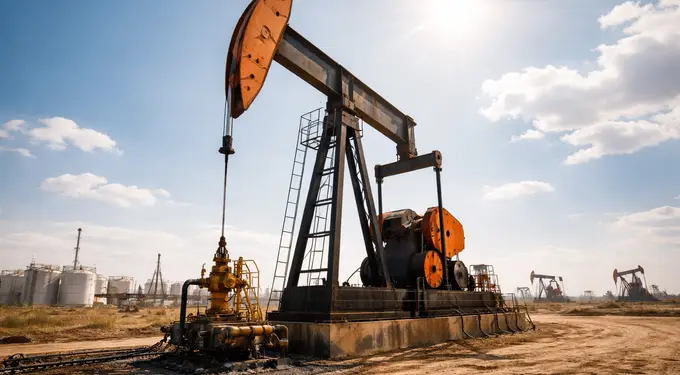
Oil climbed for a second consecutive session on Thursday after US President Donald Trump, in a prime-time April 1 address, warned that Washington would continue to strike Iran “extremely hard” over the next two to three weeks, reviving supply-side fears and reversing earlier optimism around a near-term de-escalation.
Prices and market reaction
West Texas Intermediate for May delivery rose 4.1% to $104.21 a barrel on the New York Mercantile Exchange, just above the 27 August contract high of $104.
The international benchmark Brent for June delivery climbed 5% to $106.42 a barrel.
Futures had already rallied on Wednesday as continued strikes on Iranian energy infrastructure and persistent disruption to shipping through the Strait of Hormuz heightened fears of prolonged supply losses in global oil markets.
Trump's remarks and competing signals
In his address to the American people, Trump said the US would continue striking Iran “extremely hard” over the next two to three weeks, while emphasising that discussions with Tehran were still ongoing and stopping short of confirming any final decision on the endgame.
Iran's government denied requesting a ceasefire, with spokesman Fars agency stating that the Strait of Hormuz "will not open under the management of the Americans or the Israelis," a direct rebuttal of Trump's claim on Truth Social that Tehran had sought a truce.
Strait of Hormuz and supply risk
The Strait of Hormuz, the critical chokepoint through which roughly 20% of the world's daily oil trade passes — including the entirety of Iran's crude exports — has seen little or no tanker traffic since hostilities between the US-Israel alliance and Iran began on 28 February.
Some cargo has nonetheless moved through the waterway: the Liberia-flagged tanker Shenlong, a 315,532-deadweight-tonne vessel, arrived at Mumbai port on 11 March after navigating the corridor.
Disruptions to shipping flows across key Middle Eastern routes, particularly around the Strait of Hormuz, continued to constrain available supply, though intermittent cargo movement helped cap the extent of price gains.
What to watch
Price direction will hinge on three variables: the trajectory of ceasefire talks, any resumption of tanker traffic through Hormuz, and the durability of the current disruption to regional oil flows, which has repeatedly pushed Brent above and below the $100-a-barrel threshold.
Even a limited reopening of the strait to oil shipments could exert significant downward pressure on futures; any escalation, conversely, risks a sharp move higher.
Comments
Log in or sign up to join the conversation.