

Energy markets have been known for being unstable but now they have officially gone rogue. The tensions boiled over when Iran closed off the Strait of Hormuz nearly completely in response to U.S. and Israeli attacks on Iranian nuclear facilities. The Strait of Hormuz is a narrow waterway that sees about 20% of all oil transport move through it. However, with Iran threatening missile attacks and shipping companies like Maersk (AMKBY) and Trafigura refusing to send their ships through the strait due to Iran’s aggressive stance, it looks like oil is about to take a nose dive. Oil is already plunging and many experts are predicting $100 oil. But one interesting point that many people may be missing is this could signal the acceleration of de-dollarization.
The Crisis Level
As Day 5 of this America-Israel-Iran conflict continues, Iran has surpassed 1,000 killed. Iranian drones have struck the U.S. consulate in Dubai, a cargo ship in Fujairah, and Turkey used NATO radar to shoot down an Iranian missile targeting their airspace. Iran’s Islamic Revolutionary Guard Corps Corps spokesman declared that Iranian ships will not allow oil exports from the region. “Iranian oil will not flow freely from the Persian Gulf region,” said IRGC spokesman Ramezan Sharif. Iran can easily produce thousands of inexpensive drones at the cost of $30,000 a piece, which decimates the expensive and limited U.S./Israeli defense tech that costs up to $1 million a shot. So far, four ships have been damaged from Iranian attacks and GPS signals are being jammed throughout the Strait making it dangerous to traverse.
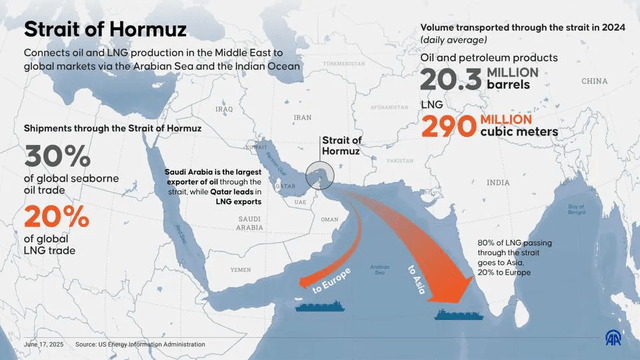
Strait of Hormuz Connects oil and LNG production in the Middle East to global markets (Forbes)
Approximately 20-21 million barrels of oil and 290 million cubic meters of LNG are at risk of not shipping. Qatar’s exports are stuck, Saudi sites are on edge, and shipping companies are rushing to find new routes—only to watch costs shoot up. Over in Europe, natural gas prices just soared by more than 20%. It’s a sharp reminder: our energy networks are tangled together, and when one thread snaps, everyone feels it.
Iran's Leverage in Hormuz
So, what gives Iran so much power in the region? Why does shutting down the Strait of Hormuz hit so hard? People wonder if we can just go around, but the math isn’t on our side.
This strait carries about 18.6 million barrels daily, which is much more than any other alternatives. In fact, no root comes even close:
The Suez Canal is handling a volume of approximately 4. 6 million barrels a day.
The Bab al, Mandab Strait records a figure of 3. 1 million barrels a day, however, the Houthi disruptions have already impacted it.
Saudi Arabia's East, West Pipeline may provide some assistance; however, it operates on land and cannot accommodate a large, scale global rerouting.
As for Iran's Jask Terminal, it is not even functioning yet.
Even taking the Suez and Bab al, Mandab together, they would just be able to supply about 7. 7 million barrels, which is only around 41% of the required amount. Pipelines have a capacity to partly compensate, but they cannot be a quick solution to maritime transport.
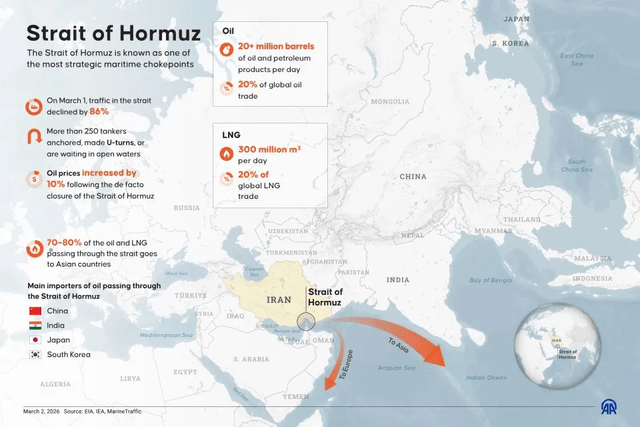
Strait of Hormuz The Strait of Hormuz is known as one of the most strategic maritime chokepoints (Anadolu Ajansı)
Going around Africa's Cape of Good Hope will increase the time of voyages by several weeks and will cost millions of dollars in additional charges, resulting in freight rates reaching the highest levels for several months.
Asian economies will suffer the most from such a turn of events. China, which imports 73% of its oil via the Strait of Hormuz, appears to have secured from Iran through silent negotiations a promise of continued access, possibly at very low prices. On the other hand, countries like Japan, South Korea, and India are in a very difficult situation as they face either seeing their stocks depleted or having to buy from intermediaries at exorbitant prices. China's formal demands for freedom of navigation on the seas are just a facade for what, in all probability, is very intense secret negotiations aimed at protecting the supply of Qatari LNG and averting a much larger escalation.
Strategic Changes in Energy Landscape Thanks to China
Of course, the whole, very serious situation, has resulted in some people talking about the dawn of "a new era in global energy, " with China playing one of the leading roles. By giving Iran a dependable market outside the reach of the sanctions. since China takes 90% of Iran's total exports of 1.7 million barrels daily, the trades being in yuan most of the time Tehran is guaranteed a lifeline.
As a result, China is forcing its neighboring countries to choose between paying high prices for the limited supplies if they get any at all or going to the considerable expense of finding other sources, probably quite far away. Indeed, this whole set of circumstances is effectively eliminating the traditional groups like OPEC from the picture, while an Iran - China alliance is gaining stature by becoming the main player in the region.
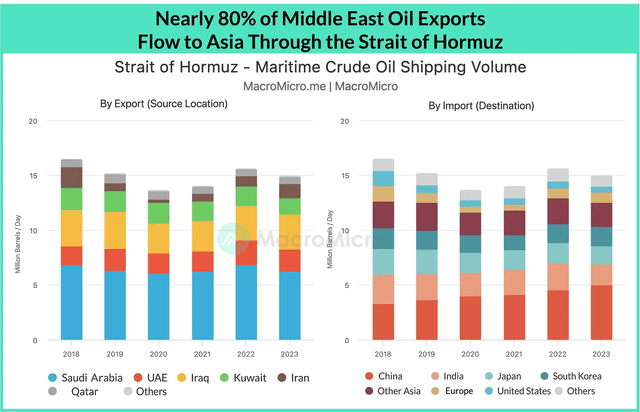
Nearly 80% of Middle East Oil Exports Flow to Asia Through the Strait of Hormuz (Macro Micro)
The United States is in a predicament with no winning option: one would be to use military force to open the strait, in which case China could very well get involved because of the ship escorts it provides; the other would be to accept a situation in which a majority of the flow of resources at least is controlled by Beijing. Each of these two possible routes would have very serious costs attached to it, in human lives, financial resources, and capacity of exerting influence.
Petrodollar System is Under Threat - Indications of a Larger Change
Back in the 1970s, the U.S. made agreements with Saudi Arabia, leading to oil being mostly priced and traded in dollars since then. This move significantly enhanced the U.S.'s financial dominance globally as it facilitated the recycling of surpluses into Treasury securities and allowed the U.S. to carry on with deficits. However, the global scenario has become so fragmented today that this arrangement is getting weaker due to the de, dollarization programs, reshuffling of alliances, and the move towards renewable energy, all of which have been greatly highlighted by the February 2026 conflict outbreak.
Consider the numbers:
The IMFs quarterly report on currency composition of official foreign exchange reserves (COFER) for Q3 2025 indicates the Americans dollar's share has fallen to 56.9% of the total global reserves, a considerable decline from the 71% record that the currency set in the past, as countries are diversifying their holdings via other currencies.
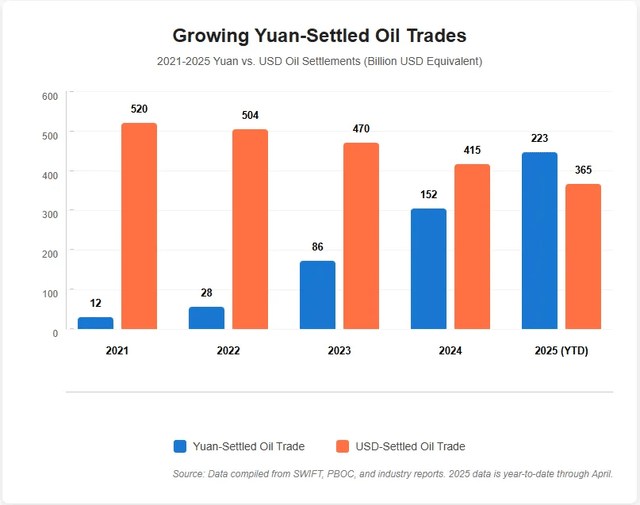
Growing Yuan-Settled Oil Trades (Reuters)
It is true that 80% of the world's oil transactions still involve the dollar, however, there is a shift in the pattern, China buys Iranian (and to some extent Saudi) oil in yuan, Iran is using barter transactions to escape sanctions, and a lot of Russian, Indian trades take place in rupees. The BRICS group, which besides Brazil, Russia, India, China, and South Africa now also includes Saudi Arabia and Iran, is actively encouraging more exchanges in their respective currencies, although results have been patchy so far.
The current turmoil in the Gulf has induced immediate spikes in oil prices, with Brent and WTI rising on concerns over supply. This rush to buy the dollar as a safe haven has only been temporary. However, if this situation continues, it may reverse the effects: reduced reinvestment in U.S. bonds, increased interest rates domestically, and inflation owing to more expensive imports.
A significant switchlike 20, 30% of oil trades being conducted in yuan or barter, especially if the conflict leads the supply more toward China may change the balance permanently away from the dollar. Nobody is ready to declare that the dollar will be completely replaced only yetthe yuan isnt fully convertible, cryptocurrencies are too volatile, and gold is quite limitedbut the movement is there and gaining momentum.
The conflict at the Hormuz exposes vividly to what extent the dollar's dominance in the oil market has weakened, and it would be a good idea for investors to monitor carefully the appearance of these cracks.
Oil Price Forecasts Point Towards $100
The experts at Goldman Sachs have upped their estimate for the price of Brent to $76 a barrel in Q2 2026, a $10 raise as a result of the strait incident and stockpiles running out. However, if the strait remains closed for five weeks with no relief from OPEC+ or strategic releases, a $100 price is what we would face. A month's disruption can mean $15 more, and extended disorder can push it to $120, $150 due to market frenzy.
WTI is on the same level, targeting $71 for the period. Be ready for many fluctuations as news is coming in.
Investment Strategies to Survive and Thrive
Times of severe crisis and tension naturally call for carefully rethinking one's portfolios. It is without a doubt that such periods carry immense risks, though at the same time they unpredictability may largely be transformed into quite some potential gains, if one knows how to play their cards right.
Momentum play remains in Energy sector. One of the approaches can be based on ETFs such as USO offering almost one, to, one exposure to oil or XLE for the whole energy sector stocks.
Safe Havens. Investor may also want to keep some reserves in more stable financial instruments which are perceived as going against the dollar. This can include Gold, with ETFs like GLD and SLV.
To start with, always take into account the matter of liquidity, although the U. S. strategic reserve is around 700 million barrels which may limit price surges, the much less substantial stocks of Asia (e. g. Japan and Korea) could even aggravate the supply problems. Thinking further down the road, consider if de-dollarization can become a reality along with the alternatives currencies as well as the related assets .
This is more than just a flare-up in the Persian Gulf region since it goes to highlight the petrodollar system. Geopolitics is what currently occupies and moves the markets. Therefore, rational thinking combined with a diversification done properly is going to be necessary while the unfolding events will certainly make the Strait the center of the world again.

Comments
Log in or sign up to join the conversation.