

The U.S. energy resurgence has been one of the bright spots of the economic recovery since the Financial Crisis of 2008. Many of the shale plays in Texas financed their growth with cheap debt. Now that oil has fallen from above $100 to sub-$50 many oil drillers are finding it difficult to service that debt. Through mid-December, there were 41 oil and gas bankruptcies with collective debt exceeding $16 billion.
Are Bankers Looking To Save Themselves?
Banks have feasted on fees and interest income from energy loans since the crisis. Now that drillers and oilfield services firms are finding it difficult to service that debt banks want out in order to save themselves. If they can't sell the paper at cents on the dollar, banks have been willing to fob off their exposure onto shareholders of the underlying credits.
In early March, oil and gas companies had announced plans to raise as much as $9.2 billion in new equity:
U.S. oil and gas companies from Marathon Oil Corp. MRO to Weatherford International WFT have announced plans to raise about $9.2 billion in new equity, the most year-to-date since at least 1999... Until only a few weeks ago, bankers, executives and investors had assumed the capital markets were closed to the energy sector, which is laboring under oil prices that have fallen almost 70 percent from the summer of 2014. Then, in early January, a handful of companies with assets in the prized Permian Basin in Texas successfully tested the waters. Now "the window is clearly open" for almost everybody, Tudor, Pickering, Holt & Co. said.
I had originally thought the equity capital would be used to help the indebted firms stave off the downturn in the oil market. However, in many instances, the additional equity was used to repay debt to bankers who wanted out before the companies collapsed.
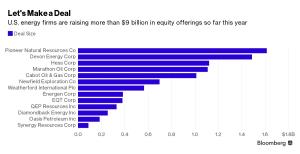
Pioneer PXD, Diamondback FANG, Synergy SYRG, Cabot COG, Energen EGN, Weatherford International, Devon Energy DVN and Newfield NFX were expected to use the funds to pare debt, and in some cases, secured revolving debt.
Oil And Gas Debt - The Next Moral Hazard
The country goes through periods of economic expansions and contractions. The recession of 2008 was a recession on steroids due to wanton speculation by investment banks like Bear Stearns, Goldman Sachs, Morgan Stanley and Lehman. These banks had proprietary trading portfolios that included investments in financial assets - real estate, mortgage-backed securities ("MBS") - totaling $1 trillion and created a moral hazard that triggered the Financial Crisis.
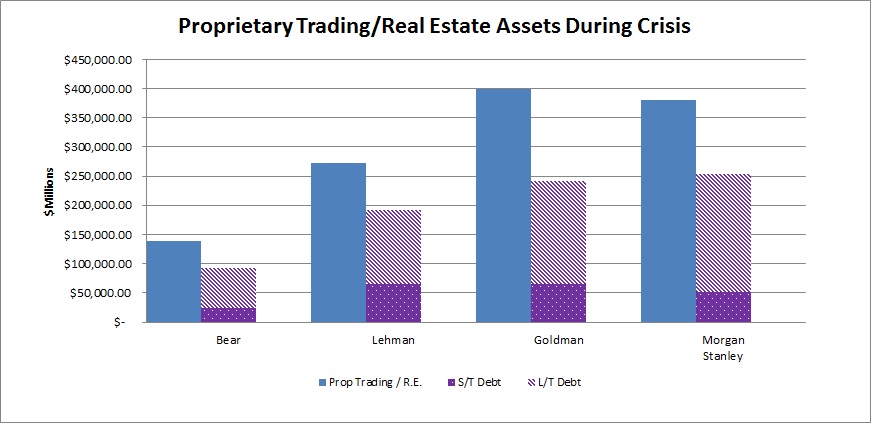
These firms funded their financial assets with cheap commercial paper and kept the spread between the rate on the financial assets and their funding costs. Each one either suffered a run on the bank or was bailed out.
Bear Stearns
At its fiscal year ended November 2007, Bear Stearns had $138 billion in financial instruments, including about $45 billion of MBS. Home sales began to decline from 2006-2007 and the subprime sector of the housing market totally cratered in 2007. Depressed housing prices from foreclosures and rising rates spread to the prime market in the second half of 2007. In response, Wall Street slashed the value of their mortgage portfolios, further driving down prices. Bear suffered a "run on the bank" in Q1 2008 and sold to JPMorgan JPM for $2 within a period of months.
Lehman
Bear's collapse put Lehman in the cross hairs of short-sellers betting that it too would run out of cash. According to its May 2008 report, Lehman's Capital Markets division was stung by nearly $3 billion in losses on principal transactions related to residential and commercial real estate investments. Shortly after pre-releasing its Q3 2008 earnings, which reflected billions of write-downs on real estate holdings, the run on the bank began. Lehman filed for bankruptcy shortly thereafter.
Goldman
By August 2008, Goldman had experienced billions in write-offs on residential and commercial mortgages. Its leverage of 26x made it vulnerable to a run on the bank. The situation was averted when it received about $10 billion in TARP and was allowed to convert to a bank holding company. Of note is that it had $14 billion in collateral calls under credit default swaps with AIG AIG that led to AIG's bailout. That bailout ultimately inured to the benefit of Goldman and other AIG counterparties made whole from the collateral calls.
Morgan Stanley
The subprime debacle negatively impacted Morgan Stanley's lending business and mortgage portfolio. For the nine months ended August 31, 2008, it had lost over $5 billion in losses on loans, mortgages and exposures to monoline insurers and derivative contracts. It avoided Lehman's fate after receiving a $9 billion investment from Mitsubishi UFJ Financial and $10 billion in TARP funds.
The Next Financial Crisis?
The Financial Crisis led to $450 billion in TARP and $8 trillion in zero interest loans and other forms of stimulus that could have been allocated to other sectors of the economy. Today, major banks have stated that their energy loan portfolios are under control. The fact that energy firms are willing to sell equity in order to repay revolving credit facilities makes me look askance on banks' energy loans. First of all, revolvers are often highly secured and the first in line to be repaid in case a firm collapses. Secondly, the revolvers renew each year and banks can either reduce the credit limit or pull their debt altogether. This gives lenders under these facilities a lot of leverage. It begs the questions, "Are these equity raises to repay short-term lenders really voluntary? Will $2.5 trillion in energy debt trigger the next financial crisis?"
According to the Bank of International Settlements, oil and gas debt increased from $1 trillion in 2008 to $2.5 trillion in 2014; about $1.6 trillion represented syndicated loans. Lower oil prices have already led to shale bankruptcies and caused a retrenchment by some drillers. If oil prices remain lower for longer, the subsequent reduction in capex by drillers could tamp down total capital spending and GDP growth.
There could also be a residual effect. Banks could cut lending to other sectors due to losses on their energy loan portfolios; that can't be good for economic growth. The bigger question is, "Who do banks take down with them in the process?" We saw from the last crisis how AIG was upended after it insured bad mortgages from Goldman and others. If the government has to step in to prop up banks again, that could portend another misallocation of capital that could otherwise go to the populace who would spend it immediately to spur growth, or potentially find a better use for it.
Specifically, investors should avoid JPMorgan and Morgan Stanley. The combined percentage of energy and mining within JPM's loan portfolio is in the high single digits; however, they represented the lion's share of JPM's increase in provision for credit losses last quarter. 40% of the credits in Morgan Stanley's energy-related portfolio (11% of total loans) are junk-related. If the global economy remains in the doldrums, those junk credits could worsen.



Comments
Log in or sign up to join the conversation.