


We last blew the dust off the North American Smaller Companies sector this time year. Looking for a topical hook that would chime with a younger demographic, I noted that US small caps last outperformed when Ronnie Corbett last walked amongst us. The last full year that the Russell 2000 beat the Russell 1000 was 2016, when the nimbler of the Two Ronnies departed this vale of tears.
That record has still to be broken, with 2026 barely half over. However, the Russell 2000 has been on something of a tear so far. Over the 12 months to 21 July 2026, the large-cap Russell 1000 is up 19.9%, while the small- and mid-cap (Smid) Russell 2000 rose 35.6%. Translated into fund sector performance, over the 12 months to June 2026, the IA North America sector rose 22.8% while North American Smaller Companies almost doubled this, at 41.4%. However, over three years, the large-cap sector is ahead by almost four percentage points, and over five years it has delivered 69%, while North American Smaller Companies returned 41.3%.
Sell, sell, sell…
US small caps have been under relentless selling pressure for years. Even in 2025, when US investors were at their most negative on equities generally, and US equities in particular, US small cap redemptions were more than four times higher than for Equity US (the Lipper classification with the second worst outflows for the period). This has persisted even into the period of US small cap outperformance this year.
UK investors have yet to pick up on the rebound in US small cap performance. From June 2024 to June 2025, the IA North American Smaller Companies sector attracted £2.4bn despite the persistent underperformance. Over the following 12 months, to June 2026, the sector took a measly £52m. Over the same period the IA North America sector shed £9.42bn.
The fundamental case for US Smid has strengthened. While the earnings outlook for US large caps was revised up over Q2, the Russell 2000 Growth saw the largest valuation expansion, according to FTSE Russell analysis. The rotation into small caps and broadening of the US equity rally has developed over the year so far. In particular, the Russell 2000 index has been lifted by second-order beneficiaries of AI capex, such as the makers of chip manufacturing and testing equipment, providers of networking, and connectivity to data centres. Nevertheless, US Smid’s performance was more broad-based than just in Tech. The index saw significant contributions from Industrials, Pharma & Biotech and Banks, over the period.
Fund survivors
Top of our table is the Alquity SICAV-VAM US Micro Cap Growth fund. It’s a new entrant to the table, and has ridden the AI wave most successfully, with a tech weight of 43%, and a semiconductor and semiconductor equipment exposure of 27%: the highest in the sector for both figures.
Five funds on this month’s table are survivors from the previous year: Driehaus US Micro Cap Equity, Artemis US Smaller Companies, CT US Smaller Companies, Goldman Sachs US Small Cap CORE Equity, New Capital US Small Cap Growth,and the State Street SPDR MSCI USA Small Cap Value Weighted UCITS ETF—the latter being the only tracker on the list.
There are, however, risks to this US Smid ascent. Not least, the new regime at the Federal Reserve. Rather than this be the “cut no matter what” many had feared, we have seen a shift in market expectations, from cuts towards more tightening. As a result, forecast earnings growth has been revised down for the Russell 2000, indicating the possible pricing in of headwinds from higher rates for US small caps. Large caps with healthier balance sheets tend to fare better under tighter financial conditions. Investors must therefore balance the palpable broadening out of the US equity rally from its previous base among a small group of mega caps further down the cap scale, with the potential for unfavourable economic conditions for smaller companies.
The US Smid revival was largely unanticipated, and all the more noteworthy for that. It remains to be seen whether the run can continue, or whether I can roll out my creaky Ronnie Corbett comparison for another year.
Table 1: Top-Performing IA North American Smaller Companies Sector Funds Over Three Years (with a minimum five-year history)
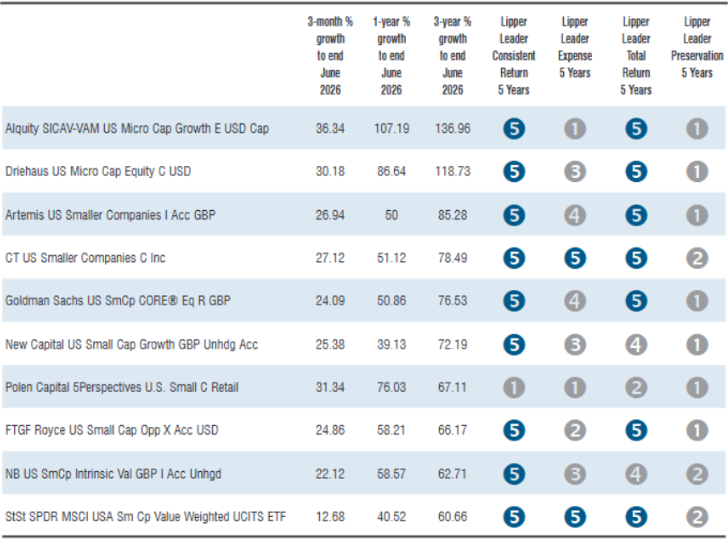
All data as of June 30, 2026; Calculations in GBP
Source: LSEG Lipper



Comments
Log in or sign up to join the conversation.