

The Empire State Manufacturing Survey index modestly improved and remains in expansion. The key internals were mixed with backlog falling significantly.
Analyst Opinion of Empire State Manufacturing Survey
Because of the movement down of backlog, and improving for new orders - it is hard to say that this report was better than last month.
Econintersect reminds you that this is a survey (a quantification of opinion). Please see caveats at the end of this post. However, sometimes it is better not to look to deeply into the details of a noisy survey as just the overview is all you need to know
- Expectations from Econoday were for a reading between 17.0 to 21.4 (consensus 19.3) versus the 21.1 reported. Any value above zero shows expansion for the New York area manufacturers.
- New orders subindex of the Empire State Manufacturing declined but remains in expansion, whilst the unfilled orders sub-index improved and remains in expansion.
- This noisy index has moved from 30.2 (October 2017), 19.4 (November), 18.0 (December), 17.7 (January 2018), 13.1 (February), 22.5 (March), 15.8 (April), 20.1 (May), 25.0 (June), 22.6 (July), 25.6 (August), 19.0 (September) - and now 21.1.
From the report:
Business activity continued to grow strongly in New York State, according to firms responding to the October 2018 Empire State Manufacturing Survey. The headline general business conditions index rose two points to 21.1, pointing to a slightly faster pace of growth than in September. New orders and shipments both picked up noticeably. Delivery times continued to lengthen, while inventories held steady. Labor market indicators pointed to a modest increase in employment levels and no change in hours worked. Price indexes edged down but remained elevated, suggesting ongoing significant increases in both input prices and selling prices. Looking ahead, firms generally remained optimistic about the six-month outlook.

z empire1.PNG
The above graphic shows that when the index is in negative territory that it is not a signal of a recession - of 10 times in negative territory (since the Great Recession) - no recession occurred. Conversely, a positive number is likely to be indicating economic expansion. Historically, when it does make a correct negative prediction it can be timely - this index was only two months late in going negative after what was eventually determined to be the start of the 2007 recession.
This survey has a lot extra bells and whistles which take attention away from the core questions: (1) are orders and (2) are unfilled orders (backlog) improving? - and the answer is that the key internals moved in different directions.

Unfilled order contraction can be a signal for a recession.
Summary of all Federal Reserve Districts Manufacturing:
Richmond Fed (hyperlink to reports):

Kansas Fed (hyperlink to reports):

Dallas Fed (hyperlink to reports):

Philly Fed (hyperlink to reports):

New York Fed (hyperlink to reports):

Federal Reserve Industrial Production - Actual Data (hyperlink to report):
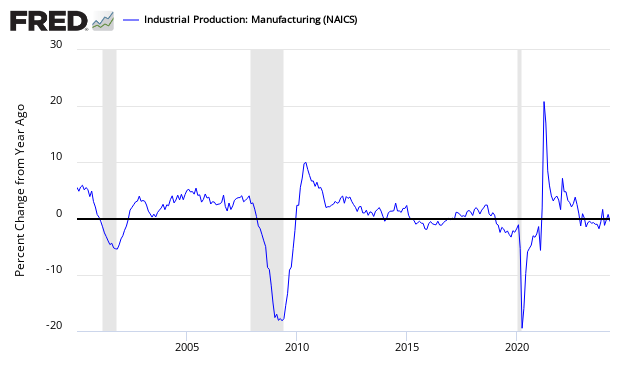
Holding this and other survey's Econintersect follows accountable for their predictions, the following graph compares the hard data from Industrial Products manufacturing subindex (dark blue bar) and US Census manufacturing shipments (lighter blue bar) to the Dallas Fed survey (light blue bar).

In the above graphic, hard data is the long bars, and surveys are the short bars. The arrows on the left side are the key to growth or contraction.
Caveats on the use of Empire State Manufacturing Survey:
This is a survey, a quantification of opinion - not facts and data. Surveys lead hard data by weeks to months and can provide early insight into changing conditions. Econintersect finds they do not necessarily end up being consistent compared to hard economic data that comes later, and can miss economic turning points.
According to Econoday:
The New York Fed conducts this monthly survey of manufacturers in New York State. Participants from across the state represent a variety of industries. On the first of each month, the same pool of roughly 175 manufacturing executives (usually the CEO or the president) is sent a questionnaire to report the change in an assortment of indicators from the previous month. Respondents also give their views about the likely direction of these same indicators six months ahead.
This Empire State Survey is very noisy - and has shown recessionary conditions throughout the second half of 2011 - and no recession resulted. Overall, since the end of the 2007 recession - this index has indicated two false recession warnings.
No survey is accurate in projecting employment - and the Empire State Manufacturing Survey is no exception. Although there are some general correlation in trends, month-to-month movements have not correlated with the BLS Service Sector Employment data.
Over time, there is a general correlation with real manufacturing data - but month-to-month conflicts are frequent.


Comments
Log in or sign up to join the conversation.