

Markets have a clean way of arguing about Nvidia (NVDA) after a print like the one on 17 November 2026: fiscal third-quarter revenue of 115.8 billion dollars, up 103 percent year on year, a guide of about 130 billion dollars for the next quarter, and an outlook for roughly 75 percent growth in the following fiscal year. If the multiple looks stretched, the boom must be late. I understand that instinct. I think it is incomplete.
The year 2000 is the wrong map. Then, capital built capacity for demand that had not arrived. Now, land, power and chips are lagging demand already written into contracts. Alphabet (GOOGL), Amazon (AMZN), Microsoft (MSFT) and Meta (META) are spending 720 to 740 billion dollars this year, roughly 78 percent more than a year earlier. The market is looking for about 935 billion dollars in 2027. Gartner (IT) puts global AI spending at 2.75 trillion dollars in 2026 and 4.05 trillion in 2027, with nearly 59 percent of the 2027 total going to infrastructure. Those forecasts point to substantial investment, although they remain uncertain.
The slope changes because software is moving from answers to tasks. An agent plans, executes, checks and retries. One instruction becomes dozens of compute steps. Gartner expects 40 percent of enterprise applications to include such agents by the end of 2026, up from less than 5 percent in 2025. Google is processing more than 3.2 quadrillion tokens a month. Growth is in work per user, not in the number of people who have opened a chat window.
I have spent more than 15 years working with data, so I try to treat one earnings print as a data point, not as a full cycle. The more interesting slope is what happens when software stops answering questions and starts completing jobs. That is already visible in enterprise budgets, and it is a different risk than a classic end-of-cycle fade in a single chip name.
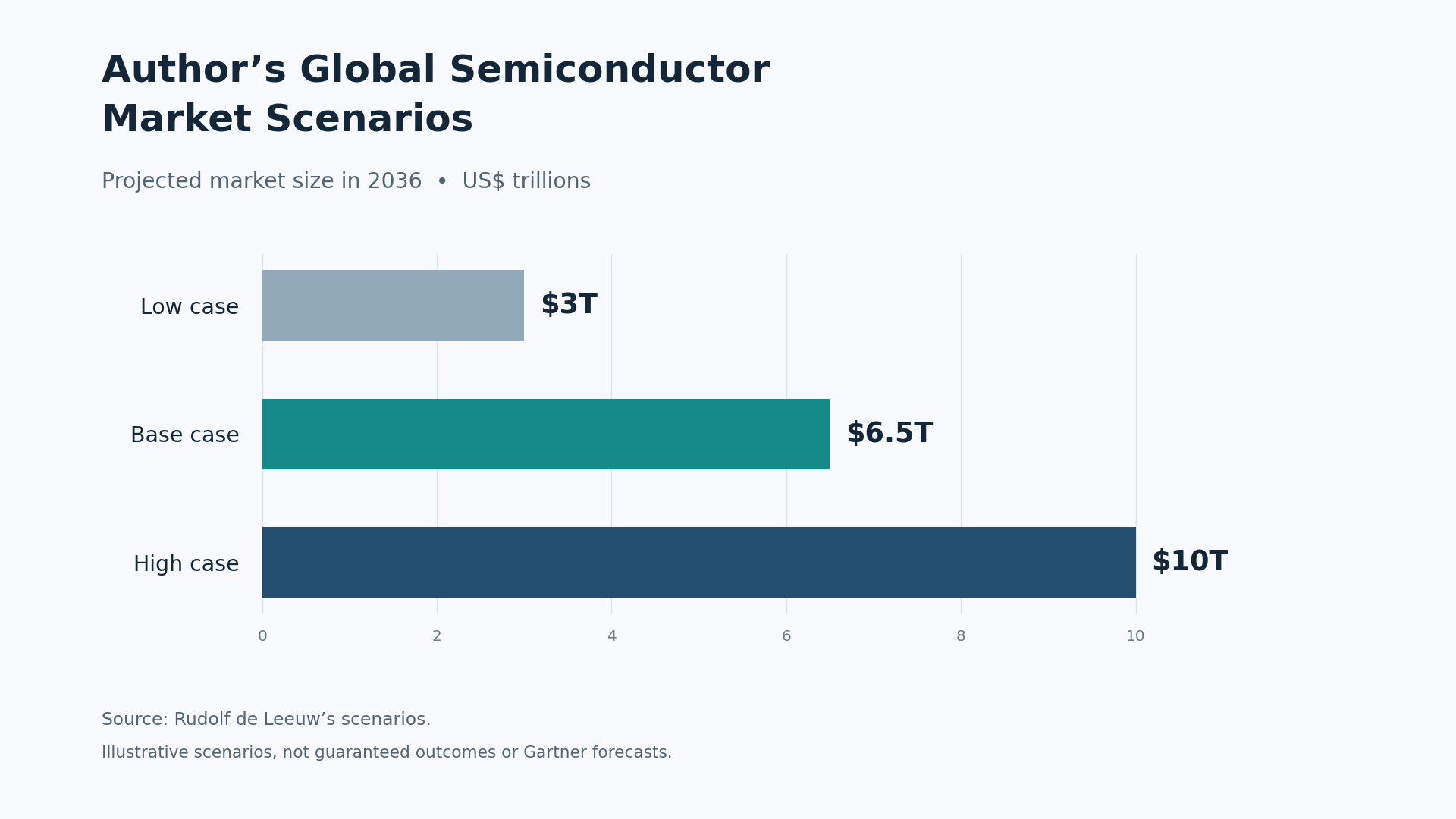
I run three paths for the global chip market, about 1.55 trillion dollars this year on Gartner's figures. My base case is 3.5 trillion in 2031 and 6.5 trillion in 2036, around 15 percent a year against a historical average near 9 percent, according to McKinsey. The low case is 3 trillion by 2036; the high case is 10 trillion. Even my low case implies long-term growth, though it does not rule out sharp downturns along the way. Leaner models will not automatically cap demand. Cheaper tasks become new tasks.
I invest in chip companies and semiconductor ETFs, and I say so. This is not a recommendation on NVDA or any other name, and it is not investment advice. It is a warning against reading a structural shift in work as a single-stock story. If AI becomes a co-worker, the constraint is compute and power. You can price that risk, or keep arguing about last quarter's multiple while the work migrates.
Sources:
Comments
Log in or sign up to join the conversation.