

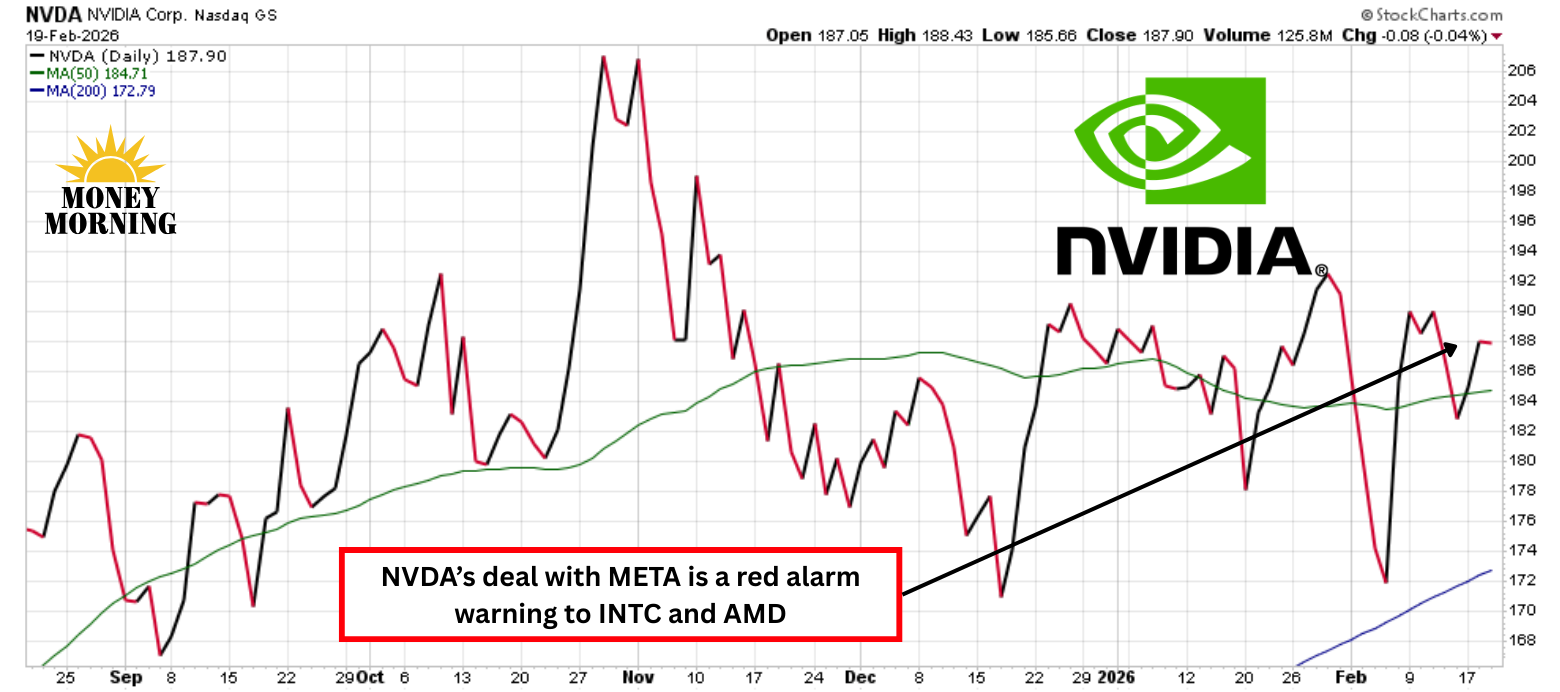
Nvidia (NVDA) and Meta Platforms (META) recently announced an expanded partnership aimed at bolstering Meta's artificial intelligence infrastructure across on-premises setups, cloud environments, and expansive data centers. Meta seeks to achieve superior performance and energy efficiency, addressing the growing computational needs of its platforms like Facebook, Instagram, and WhatsApp.
The deal underscores Nvidia's deepening role in the AI ecosystem, where its GPUs already dominate. However, the finer details reveal why competitors Intel (INTC) and Advanced Micro Devices (AMD) should be on high alert: Nvidia isn't just supplying accelerators but is positioning itself as a comprehensive provider, potentially eroding the market shares of these CPU giants in data centers and beyond.
This shift could accelerate Nvidia's transformation from a graphics specialist into a full-stack AI powerhouse, raising competitive pressures in an industry already strained by supply constraints and rapid innovation.
Expanding Nvidia's Hardware Footprint
At the heart of the Nvidia-Meta partnership is the deployment of millions of Nvidia's next-generation GPUs, including the Blackwell and upcoming Rubin architectures. These GPUs are designed for unprecedented AI workloads, offering massive parallel processing capabilities that outpace current offerings. But the agreement goes further, incorporating Nvidia's Grace CPUs and Spectrum-X networking technology.
Grace, an Arm Holdings (ARM)-based CPU, provides high-performance computing tailored for AI and data center applications, while Spectrum-X enhances interconnectivity with low-latency, high-bandwidth Ethernet solutions optimized for AI clusters.
This bundle allows Meta to create tightly integrated systems where GPUs, CPUs, and networking fabric work seamlessly together, minimizing bottlenecks and maximizing throughput. For Meta, this means faster iteration on large language models and more efficient inference for real-time AI features.
Nvidia's ability to supply these components under one roof simplifies procurement and integration for customers like Meta, who face escalating demands from AI-driven services. Historically, data center builds have relied on mixing and matching vendors, but Nvidia's approach could streamline operations, reducing costs and deployment times.
Competitive Threats to Intel and AMD
The risks to Intel are particularly acute. It has long dominated data center CPUs, enjoying a near-monopoly and powering the majority of servers worldwide. However, a severe capacity crunch amid surging AI demand finds it struggling to ramp up production of its Xeon processors to meet demand.
AMD has capitalized on this, aggressively stealing market share with its EPYC CPUs, which offer competitive performance and better power efficiency in some scenarios. Yet, Nvidia's entry with Grace CPUs threatens both. By bundling CPUs with its market-leading GPUs, Nvidia could become a one-stop shop for AI infrastructure, appealing to hyperscalers who prioritize ecosystem compatibility over multi-vendor complexity. This is especially worrisome as AI workloads increasingly favor integrated solutions.
Adding to the pressure, Nvidia is gearing up to launch its own laptop chip—an Arm-based System-on-Chip (SoC) for Windows on Arm (WoA) notebooks. This move directly challenges Intel and AMD's x86 processors in the consumer PC market, while also taking aim at Apple (AAPL)'s custom silicon in premium devices. With Arm's efficiency advantages, Nvidia could disrupt the laptop segment, where AI features like on-device processing are becoming standard.
Bottom Line
The expanding scale of Nvidia's offerings – from GPUs and CPUs to networking – should be setting off alarm bells at Intel and AMD. While a complete win in these new arenas isn't guaranteed, given the entrenched positions of x86 architectures and ongoing manufacturing challenges for Nvidia, there's no reason to think the company can't make serious inroads either.



Comments
Log in or sign up to join the conversation.