

Nvidia (Nasdaq: NVDA) recently reported earnings. At face value, they looked fine, but underlying, we like to look at the two-year run rates and they slowed for key metrics: revenues, datacenter, and gaming. Prospects look strong, but I expected more when compared to what it said at recent conferences.
Quick History Of Our Nvidia Calls
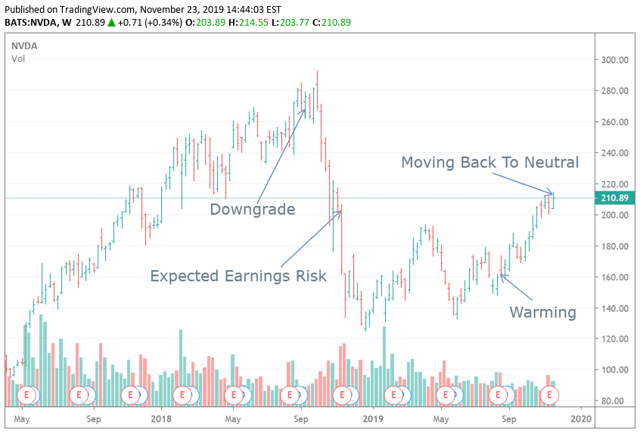
September 13, 2018: Downgraded Nvidia ahead of a big drop.
November 12, 2018: We were out cautious ahead of earnings Nov 15th that saw a 19% drop in the stock price. We were cautious then when we saw revenue growth slowing ahead of that.
August 27, 2019: We were out that we were "warming up" thinking growth rates could start to re-accelerate.
First, What We Look For In Tech
We're earnings and momentum focused. In tech, that's so critical. When a tech stock is showing accelerating trends, that's when you want to be there. But when trends are slowing, you want to check and recheck your work because something's not quite right.
The main driver to earnings is of course revenue growth. If revenue growth is getting better (accelerating), that gives large institutional investors visibility that the story has legs. When revenue growth slows, then look out because people start making valuation calls, but then there are those surprise earnings misses killing a stock 15-20%.
I don't like value in tech. I like momentum. So when things slow down, no matter how good the story is I watch out.
I like the Nvidia story, but that's not enough for me. I need to see it in the numbers. Nvidia isn't showing it to me in the numbers.
Something Much Different Than What The Company Said At Citi's Tech Conference
Nvidia spoke at Citi's tech conference back in early September. I was pumped when it expected "broad-based growth from Q2 to Q3."
Given positive news out of Micron (Nasdaq: MU) and AMD (Nasdaq: AMD) about cloud growth, I thought this quarter should have been great. Nvidia depends on cloud customers.
It ended up with sequential growth (Q3 versus Q2) of 16.9%. That's good growth, but about normal seasonality except for last year which was impacted by crypto and inventory challenges.
But a look at the underlying growth rates shows us something.
Focus On The Two-Year Performance
While the numbers were pretty good, you can see a lot what's going on "under the hood" when you start looking at two-year growth rates.
The two-year growth rates take this year's growth rate plus last year's growth rate. Then you compare that number to the recent quarters.
The two-year growth rates end up smoothing out for one-timers. Sometimes companies have an easy year-ago number or a one-time event making this year's numbers look better or worse. But when you take the two years combined, you start to notice an underlying trend.
My subscribers have come to learn that even the companies tend to use the two-year growth rates and you can see it in their guidance. Their guide many times implies the same two-year run-rate as a just-reported quarter.
So when you see changes in that two-year (faster or slower) numbers, you know the company's paying attention to that too.
You can also hear analysts asking about similar concepts on an earnings call when they ask about "easy" or "hard" year-ago "comparisons" or "comps," which are numbers that we lap from last year. The two-year is a quick and important check factoring in all that.
Slowing Numbers
Let's get to the numbers.
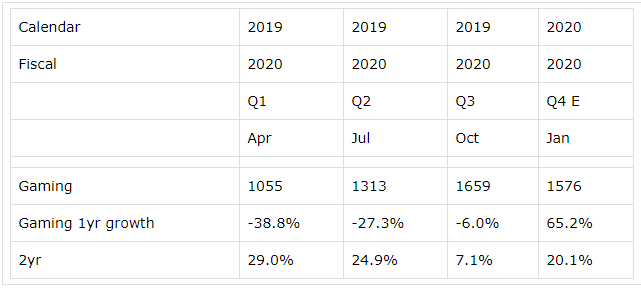
The two most important drivers are gaming (which is its largest segment) and datacenter. Both saw a two-year slowdown. So, of course, when you have your two key businesses seeing a slowdown, overall revenues saw that same two-year slowdown.
Here's gaming.
(Click on image to enlarge)
Source: Elazar Advisors Models pulling data from Nvidia earnings reports.
You can see the two-year numbers slowing from 29% to 25% to 7% in Q3. It needs a big acceleration to hit numbers in Q4.
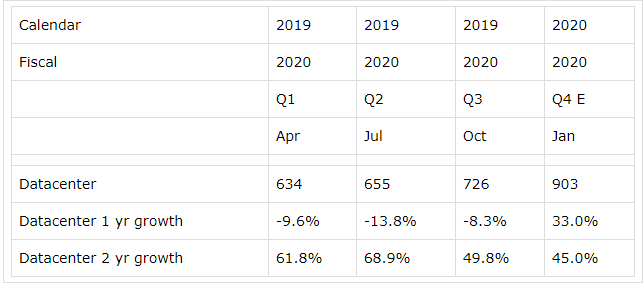
Here's Datacenter.
(Click on image to enlarge)
Source: Elazar Advisors Models pulling data from Nvidia earnings reports.
You see the July quarter showed some life. The two-year number went from 61.8% to 68.9%. That Q2 was actually its first reacceleration after a 200% slowdown in that two-year number over three quarters.
Given the company's commentary at Citi that Q3 was seeing "broad-based" growth from Q2, I was hopeful that would translate to a two-year acceleration in Q3. It didn't.
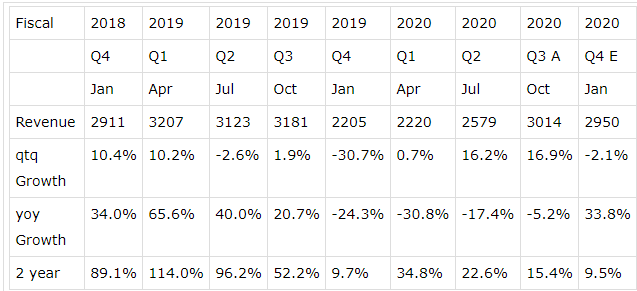
Here's the overall revenue growth number.
(Click on image to enlarge)
Source: Elazar Advisors Models pulling data from Nvidia earnings reports.
You see the slowdown from last year's growth rates. You also see the slowdown over the last two quarters. And this slowdown was occurring during "broad-based" strength.
For me that's not enough.
I Like To Avoid Risk
Frankly I can miss things, and I don't mind chasing if I have the EPS upside. But I don't mind missing things because (as my subscribers have seen), I tend to avoid big misses. When I see a slowdown, I pretty much want to put that company on a back-burner. Those are the ones that tend to have quarters that see guide-downs, and tech investors don't like guide-downs.
Is that going to happen here? Don't know. But in the meantime, with slower revenue growth rates, I don't want to be here to find out. There's enough out there with accelerating growth rates.
Why Is Nvidia Slowing?
AMD is probably one big reason that Nvidia has been seeing some pressure despite cloud spending picking up in Q3.
First, here's cloud spending in Q3 as defined by capex.
(Click on image to enlarge)
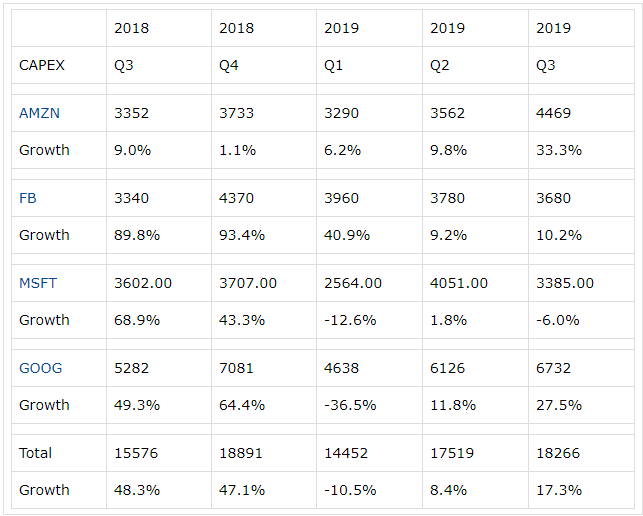
Source: Each company's earnings reports.
Growth rates are down big from last year's 40-50% capex growth rates but have re-accelerated from the past couple of quarters.
That pick up should be a tailwind.
But AMD's many new products are taking share. AMD had many new announcements with cloud providers as well.
So slower growth rates from last year and adding to that AMD taking some share make growth rates tougher to come by.
Nvidia is very bullish about AI and the amount of demand coming. But so far, we are not seeing it in our key two-year numbers.
Until then, we want to wait it out to try to avoid some risk if there is any. Usually, slowing two-year numbers hint to something.
After-Hours Exit
Here's a clip from our chat in the after-hours of the earnings report:
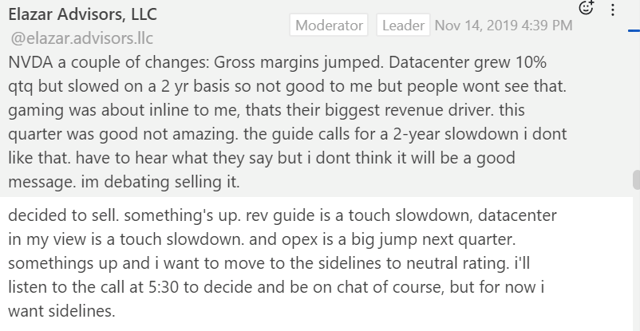
We exited Nvidia on earnings day in the after-hours ahead of the earnings call when the stock was still up a couple of percent in the overnight. The stock ended up dropping as the earnings call went on.
Again, everything looked ok, but the underlying two-year performance wasn't what we were looking for, so we exited.
One of my specialties is quickly analyzing after an earnings print and deciding what to do with a stock either to buy, add or sell. In this case, it wasn't what I was looking for.
Conclusion
I do like the Nvidia story very much. I also "want" to like it because it's still way down from its highs. But I don't buy stories. I base my opinions on the numbers. That keeps my analytical process disciplined. When the numbers look like they are going to set up a blow-out next year, great. But when the numbers point to a slowdown, in tech, I want to be on the safe side. Nvidia's slowing two-year performance concerns me again.


Comments
Log in or sign up to join the conversation.