

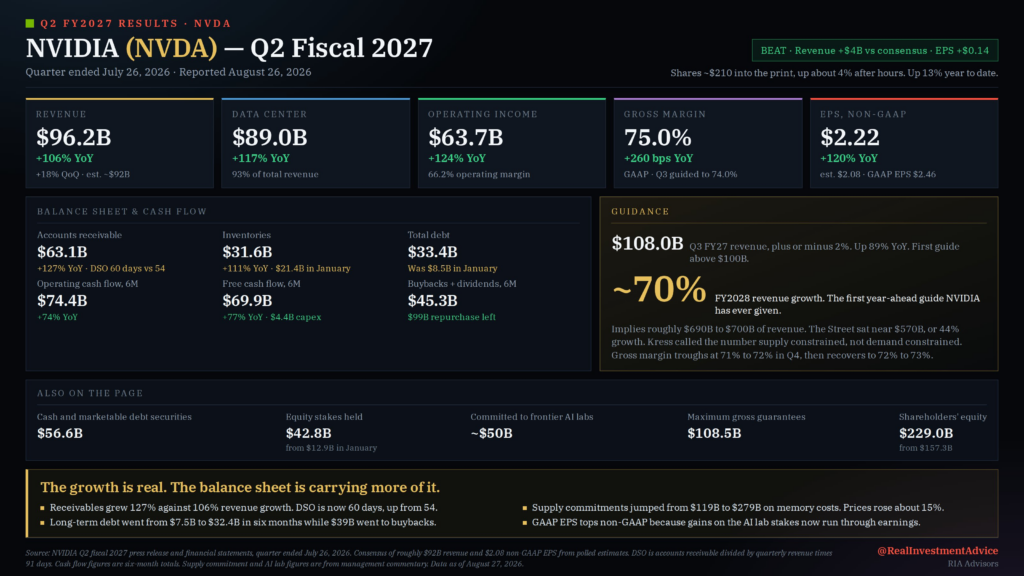
Nvidia reported record fiscal second-quarter results Wednesday with revenue more than doubling year over year to $96 billion. After initially falling on the news, the stock rose over 8% overnight. During the earnings call with analysts, CFO Colette Kress guided Nvidia’s fiscal 2028 revenue to roughly 70% growth. The forecast implies nearly $700 billion in annual revenue, more than 10% higher than most analysts expected. CEO Jensen Huang one-upped her, alluding that demand is much greater than what they can supply.
Even though our demand is much greater than 70%, our supply allows us to confidently deliver 70%… We’ve got a huge year coming up next year, and it’s going to be pretty extraordinary.
The commitments from hyperscalers driving Nvidia’s revenue outlook are impressive. Kress said the top five hyperscalers are expected to increase capital spending from $800 billion this year to $1.3 trillion in 2027, and commitments for Nvidia chips more than doubled sequentially, from $119 billion to $279 billion.
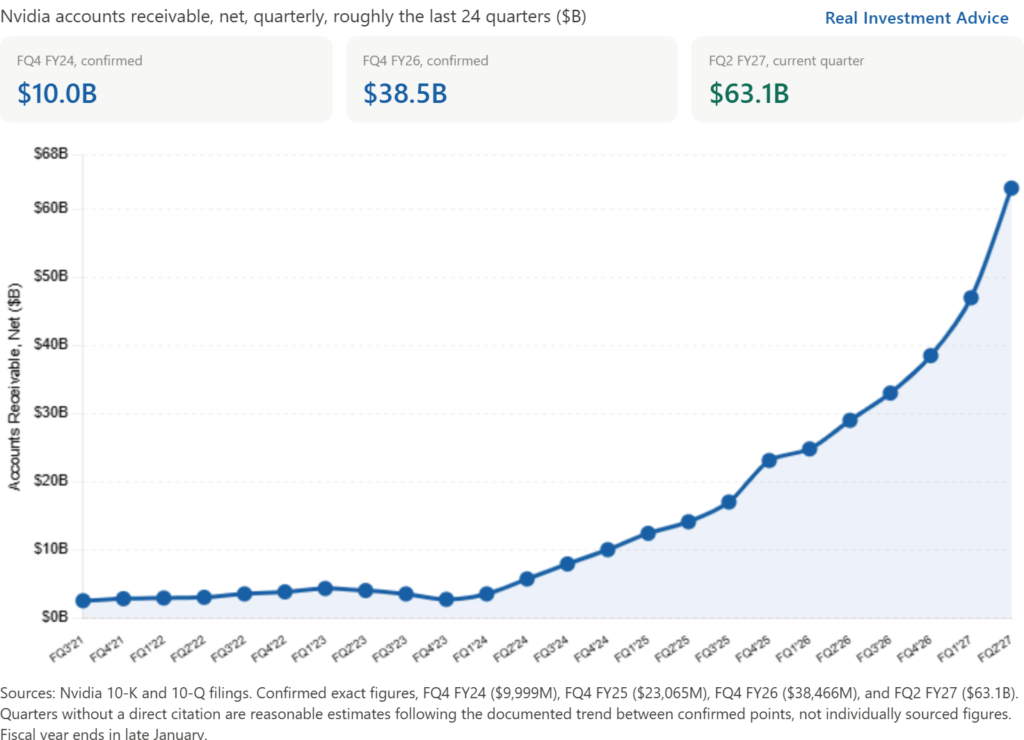
Gross margins held at 75% for a second straight quarter, though Kress warns they will compress to 71-72% by Q4, partly due to memory scarcity driven by the massive AI buildout. Also of note and as we discuss in more detail in a section below, its accounts receivable rose by 127%. Nvidia spent $26 billion on buybacks and dividends this past quarter, showing the company is returning capital even as it commits hundreds of billions in funding agreements with customers to promote future demand.
What To Watch Today
Earnings

Economy

Market Trading Update
In yesterday’s commentary, we laid out the earnings preview for NVDA. Today, we are going to discuss the results and why NVDA not only remains an important barometer of the AI space, but also an important data point for the market in general.
As Michael notes above, the print was spectacular, and the stock traded near $224 in Thursday’s pre-market, up about 7%. So the “beat and raise” coverage wrote itself, and the Nvidia “buy, sell, hold” question looked settled before the market even opened. However, it wasn’t and isn’t, and the number that matters never appeared on the income statement. It was in the cash flow statement.
Give the quarter its due first. Revenue beat consensus by nearly $4 billion, Data Center grew 117%, and gross margin came in at 75.0%, up 2.6 points from the July quarter a year ago. Jensen Huang said, “Compute is revenue” on the release. On these numbers, he’s earned the line.
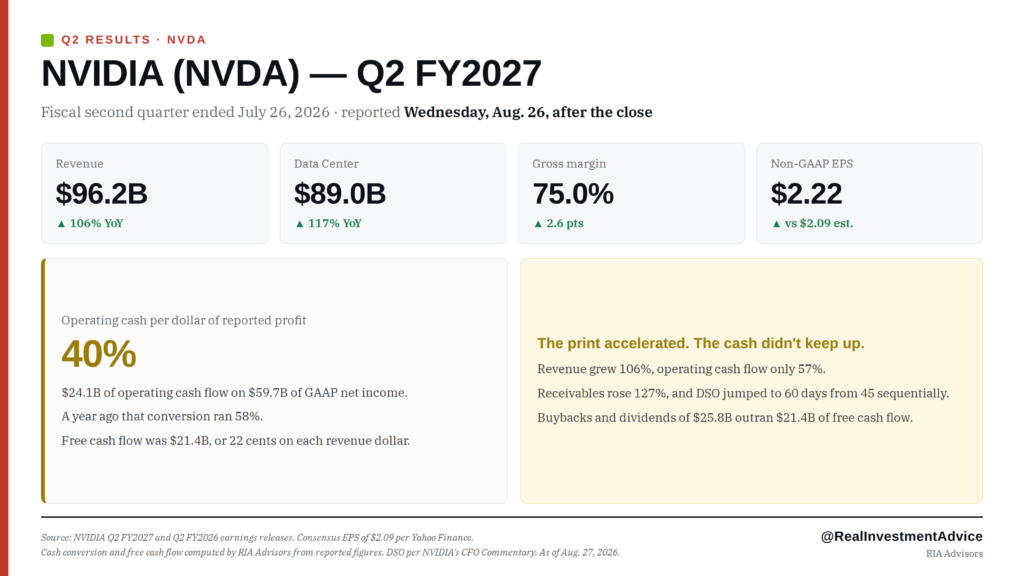
There were two details worth paying attention to. The first was that gross margin was guided DOWN to 74.0% next quarter, which is small but the wrong direction for a company that the market prices on scarcity. Secondly, GAAP earnings of $2.46 also exceeded the adjusted $2.22 because a $7.8 billion mark-to-market gain on equity stakes was recognized in the income statement. Anyone anchoring to the GAAP figure is counting a “one-time” windfall as operating performance, which is why we focus on operating income, which strips out those one-time gains.
As for the reported $12.9 billion for Hugging Face, read the price two ways. When compared against the roughly $150 million in revenue, Nvidia paid 86 times sales. However, against Nvidia’s balance sheet, it was twelve days of revenue. Strategically loud, financially trivial, and the “vertical integration” framing reads as defense. Nvidia’s largest customers are designing their own processors, and owning the place developers download models from is how you keep them on CUDA.
Here’s the chart of the day. Revenue grew 106%. Net income grew 126%. Operating cash flow grew 57%.
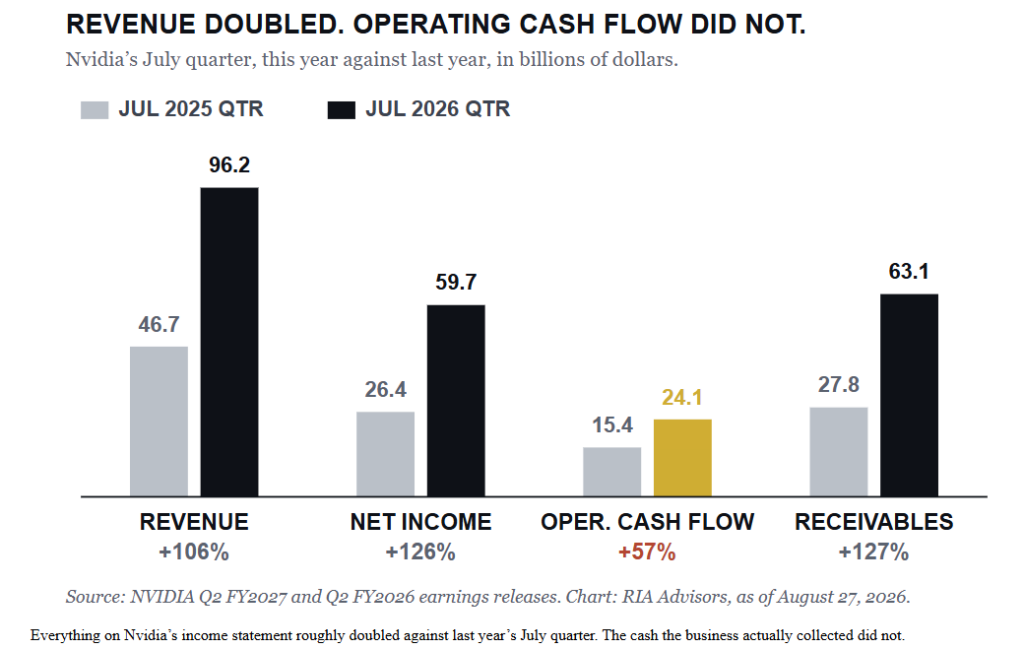
That gap is what the “quality of earnings” question actually means. Nvidia turned $59.7 billion of reported profit into $24.1 billion of operating cash, roughly forty cents on the dollar, against fifty-eight cents a year ago. Free cash flow totaled $21.4 billion, while the company returned $25.8 billion to shareholders through buybacks and dividends. For one quarter, Nvidia returned more cash than the business generated and covered the shortfall from the balance sheet. It’s the same species of choice we looked at on the policy side on Wednesday.
The Nvidia Buy Sell Hold Verdict
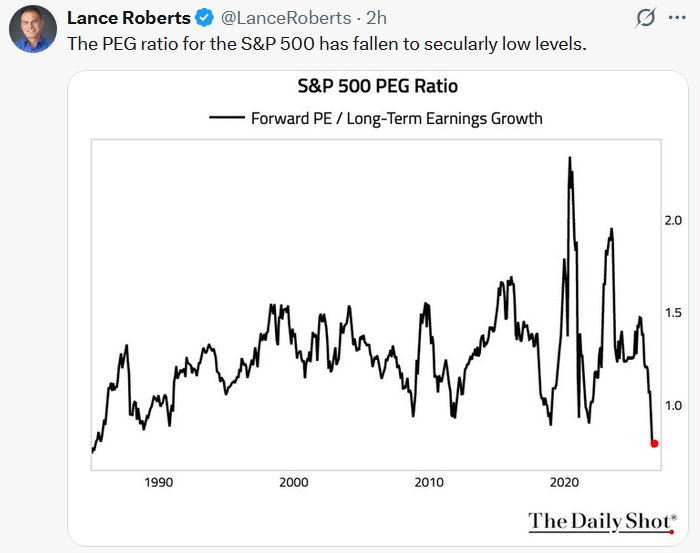
So, mostly good news, and some things to watch, which brings us to the “Buy, Sell, or Hold” question. We say “Hold” for now. The valuation is the weakest part of the bear case, not the strongest. Nvidia trades at 18.4x forward earnings, while the S&P 500 trades at 20.0. The largest weight in the index, the stock every strategist points at when they call this market expensive, is cheaper than the market it dominates.
It earned a 103% return on invested capital over the past year against a cost of capital nobody sensibly models above the low teens. Broadcom, a genuinely excellent business, returns 24%.
So we are not selling 18x earnings on a business compounding at triple digits. I’m not adding either, because you don’t pay up into a margin guide that just ticked lower and a cash conversion rate that halved in four quarters. Both facts arrived in the same press release, and the market spent Thursday morning pricing only the revenue line.
Will “hold” always be the right answer? No. If the fundamentals begin to weaken, we will reevaluate our thesis quickly and take action.
Currently, we hold Nvidia at 4% of our 60/40 portfolio, and most investors read that the wrong way. The arithmetic is dull. Nvidia is 7.50% of the S&P 500, so an index-neutral position inside a 60% equity sleeve works out to 4.50% of total assets, which makes our 4% a half-point underweight rather than the “concentrated” bet it gets called. At that weight, a 30% drawdown costs the portfolio 1.2 points, and a 50% drawdown costs 2.0 points. Neither ends a retirement plan.
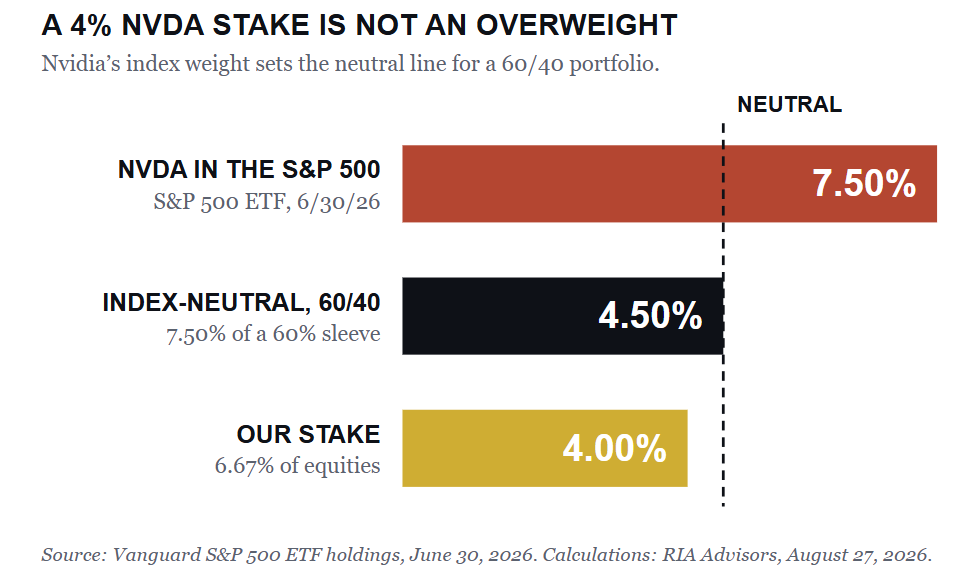
So keep it at the target weight and let it work. Trim back to 4% whatever the next rally pushes past 5%, because that’s rebalan
Nvidia Accounts Receivable Double
As we opened this Commentary, Nvidia reported another quarter of stunning revenue growth. However, buried in the earnings report is a potential risk that gets far less attention than the headline growth numbers. Three customers accounted for roughly 44% of first-half revenue combined, and in the prior quarter, three customers represented 64% of accounts receivable. Nvidia does not name the customers in its filings.
Our best guess is that they are the largest hyperscalers. CFO Colette Kress has said cloud service providers represent roughly half of data center revenue. Thus, with Microsoft Azure, Amazon Web Services, and Google Cloud commanding the largest share of that market, Microsoft, Amazon, and Alphabet, alongside Meta and OpenAI, are the most likely candidates.
Microsoft, Amazon, Alphabet, and Meta are among the most well-capitalized companies, are highly rated by bond rating agencies, have tens of billions in quarterly free cash flow, and balance sheets built to absorb far more spending than they’re currently committing. That concentration of risk is not concerning in our opinion.
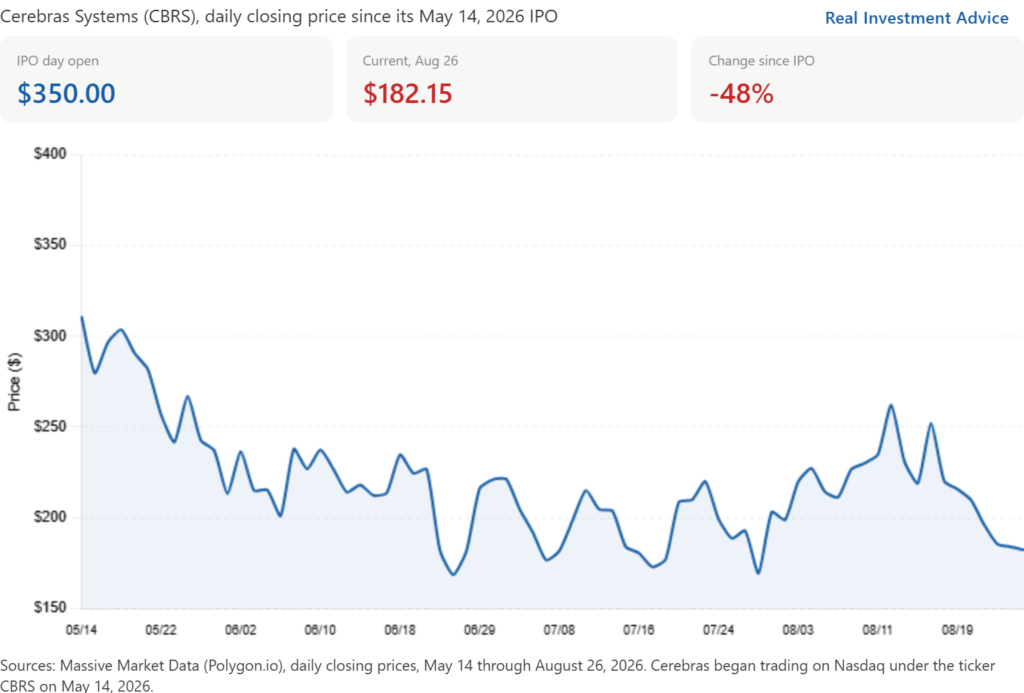
OpenAI is the exception. It’s privately held, unprofitable, and increasingly diversifying its own compute away from Nvidia toward Cerebras and other architectures. They are expected to announce an IPO this year or early next year, which would better finance the company and improve the risk on Nvidia’s books. However, its shift in ordering away from Nvidia may be more concerning. The section below shares more about Cerebras and the differences between their chips and Nvidia’s.
Who Is Cerebras?
Compared to Nvidia, Cerebras Systems takes the opposite approach to AI chips. Rather than manufacturing individual GPUs and networking thousands of them together, Cerebras builds a Wafer-Scale Engine, a single chip that uses an entire silicon wafer, roughly the size of a dinner plate. For context, Nvidia’s largest GPU is closer to the size of a credit card.
Cerebras eliminates a major source of latency. In a normal GPU cluster, data travels between separate chips through cables and networking protocols, adding latency. Cerebras keeps everything on one piece of silicon to avoid the latency.
Building a chip that large was considered impossible to mass produce because one defect can ruin the entire chip. Cerebras solved this problem with hundreds of thousands of small, redundant cores, so a single defect disables only one tiny core rather than the whole chip.
To some degree, Cerebras is becoming a credible alternative for AI inference. If other large hyperscalers and AI labs like OpenAI shift to wafer-scale inference, Nvidia’s revenue growth may fall short of expectations. However, Cerebras is too small to replace Nvidia at scale; its entire revenue base is a fraction of what Nvidia earns in a single quarter, and it can’t manufacture wafer-scale systems at anywhere near the volume hyperscalers demand today. Its wafers also excel at a narrower niche, inference and memory-bandwidth-heavy workloads, rather than serving as a general-purpose substitute for the training work that drives most AI spending.
Tweet of the Day



Comments
Log in or sign up to join the conversation.