


Analysts have been hiking their Nvidia Inc. (NVDA) revenue and earnings forecasts, along with their price targets. Two attractive plays are to sell short out-of-the-money NVDA puts as well as NVDA put credit spreads.
NVDA closed higher on Monday, Sept. 28, at $228.36. That's near its recent peak of $230.36 on Sept. 4. But it could be worth well over that, based on analysts' higher price targets.
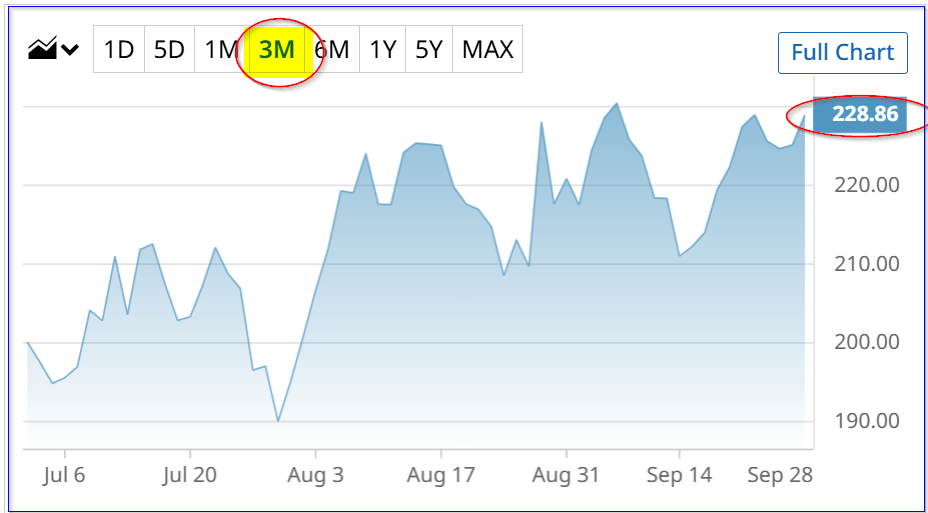
NVDA stock - last 3 months - Barchart - Sept. 28, 2026
Higher Price Targets for NVDA
I discussed Nvidia's valuation in an Aug. 30 Barchart article after its Aug. 26 Q2 earnings results ("Despite Impressive Results, Nvidia Stock May Be Stuck in a Range - What's the Best Play?").
I showed that NVDA could be worth at least $6.848 trillion, using analysts' revenue forecasts for the next 12 months (NTM). I applied a 42% free cash flow (FCF) margin (the same as in the past year), as well as a 3.30% FCF yield.
This resulted in a price target (PT) of $282.82. But it could be higher now, as analysts have raised their NTM revenue forecasts.
Seeking Alpha shows that the Jan. 31, 2027, fiscal year revenue forecast is now $411.56 billion, and for 2027 (ending Jan. 31, 2028), it's $682.73 billion. That means the average for the NTM period is $547.15 billion (vs. $538 billion as seen in my earlier article).
So, applying a 42% FCF margin and using a 3.3% FCF yield, the fair market value (FMV) is:
$547.15b x 0.42 = $220.8 billion NTM FCF
$220.8b FCF / 0.033 FCF yield = $6,963.6 billion FMV
That's $115.6 billion higher than my prior estimate. Moreover, as NVDA now has a market cap of $5,526 billion (according to Yahoo! Finance), it implies the price target should be 26% higher:
$6,926.6b FMV / $5,526b mkt cap -1 = 0.26 = +26% upside
1.26 x $228.36 stock price = $287.73 price target (PT)
That's 1.9% higher than my prior $282.82 price target. Similarly, Yahoo! Finance shows that the average PT of 61 analysts is now $327.70, up from $305.79. Similarly, Barchart's PT is up to $326.75, up from $321.59 earlier in the month.
Nevertheless, these higher PTs might not get hit. As a result, one way I've discussed playing NVDA is to short out-of-the-money (OTM) NVDA puts.
Shorting OTM NVDA Puts
For example, I wrote that shorting the $205.00 put option expiring on Oct. 9 has an expected yield of 2.195% (i.e., $4.50 premium/$205.00 strike price). At the time, NVDA was at $271.55, so the strike price was 5.77% lower (i.e., “out-of-the-money”).
Since then, as NVDA has moved higher to $228.36, the premium for the $205 put expiring Oct. 8 has dropped to just 41 cents at the midpoint. That is a successful play for the short-seller of these puts. So, it makes sense to roll this over to a new one-month period.
For example, in the Nov. 6 expiry period (39 days to expiry), the $215.00 strike price put contract, 6% OTM, now has a $4.05 premium. That gives a short-seller an expected yield of $1.88% (i.e., $405 collected income on $21,500 collateral.
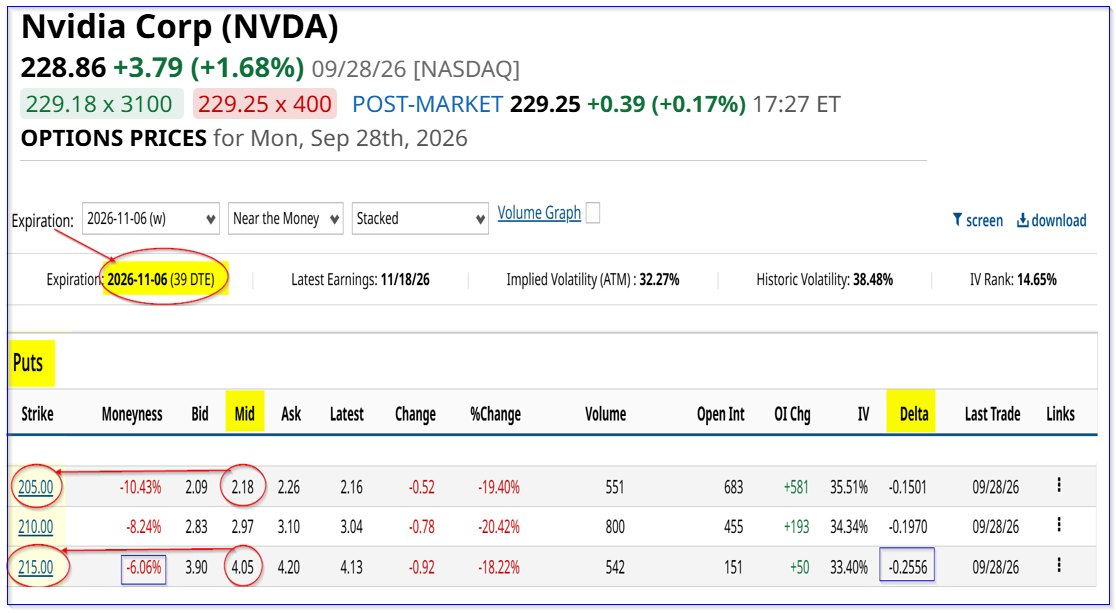
NVDA puts expiring Nov. 6 - Barchart - As of Sept. 28, 2026
This put also has a lower delta of 0.25, compared to the 0.2745 delta in the prior Barchart article. That implies that the investor has a good chance of the collateral not being assigned to buy 100 shares at $215.00.
However, not everyone can afford to post $21,500 in collateral to make $405 over the next month. One way around this, albeit with higher risk, is to do a put credit spread.
NVDA Put Credit Spread Play
In this play, the investor shorts the $215 put but also simultaneously buys the $210 put. This results in a net credit of $187 (i.e., ($4.05 - $2.05) x 100), but the investor only has to post $1,000 in collateral.
That's because the $205 put purchase is $10 lower (i.e., $10 x 100 shares per put contract), and it covers any downside if NVDA were to drop below $205. So, the brokerage firm will only require the $1,000 in collateral. As a result, the expected return (ER) is very high:
$187 / ($1000 - $187) = $187 / $813 = 0.23 = 23% ER
So, for example, by doing 2 put credit spread contracts, the investor can make a net $374 and only post $2,000. That's close to the $405 made by shorting the $215 put and posting $21,500 in collateral.
Moreover, note that if the investor can do this successfully over two months, the ER is better than owning NVDA shares (see the 26% ER shown above).
However, the risk with the put credit spread is much higher. If NVDA trades below $215, down to $205, the investor can lose the whole $1,000 in collateral (actually a net loss of $813, after the premium already collected).
That is different from the short-put investor whose account ends up owning NVDA shares. They may end up with an unrealized loss. The NVDA shares can be held, or covered call plays can be done to lower the loss.
The bottom line is that there are ways to play NVDA that allow an investor to use leverage with acceptable risks.



Comments
Log in or sign up to join the conversation.