

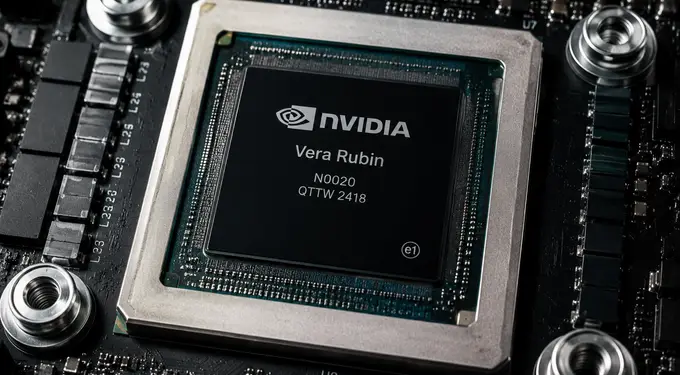
Nvidia (NVDA) shares fell 2% on Wednesday as technology stocks remained under pressure amid a broader market selloff, even as analysts continued to highlight the chipmaker's strong position in the artificial intelligence market.
The broader market moved lower during the session, with the Dow Jones Industrial Average falling 711 points, or 1.4%. The S&P 500 declined 1.2%, while the Nasdaq Composite dropped 1.6%.
Despite the pullback, analysts remain optimistic about Nvidia's long-term prospects, citing strong demand for AI infrastructure, expanding product offerings, and what some view as an attractive valuation relative to expected earnings growth.
AI infrastructure demand continues to drive growth
Nvidia remains one of the largest beneficiaries of the AI spending boom as cloud providers and AI developers continue investing heavily in computing infrastructure.
The company reported revenue of $81.6 billion in the first quarter of fiscal 2027, representing an 85% year-over-year increase. Growth accelerated during the quarter, with Nvidia adding $13.5 billion in sequential revenue.
Much of the momentum came from the company's data center business, which generated $75 billion in revenue, up 92% from a year earlier and 21% sequentially.
Management attributed the strength largely to demand for its Blackwell architecture.
Within the data center segment, computing revenue reached $60 billion, while networking revenue climbed to $15 billion, nearly tripling from the prior-year period.
The rapid growth in networking revenue highlights Nvidia's efforts to expand beyond graphics processing units and capture a larger share of AI infrastructure spending.
By offering integrated systems that combine processors, networking technologies, software, and system architecture, Nvidia has broadened its role within AI deployments and increased its addressable market.
CPU expansion opens new growth opportunities
Another area attracting investor attention is Nvidia's expansion into the central processing unit market.
As AI workloads increasingly shift from model training toward inference and autonomous AI agents, demand for high-performance CPUs is expected to grow.
Nvidia estimates the CPU market opportunity at approximately $200 billion and expects its CPU products to generate roughly $20 billion in revenue this year.
Analysts view the company's CPU strategy as an important long-term growth catalyst.
Seeking Alpha analyst Vinay Utham, CFA, reiterated a Strong Buy rating on Nvidia and raised his base-case price target to $311.
According to Utham, Nvidia's first-quarter fiscal 2027 results demonstrated growing diversification within its data center business, helping reduce customer concentration risk while strengthening the company's long-term growth outlook.
He also highlighted Nvidia's expansion into the estimated $200 billion CPU market through products such as Vera CPU and RTX Spark, describing it as a significant growth opportunity that may not yet be fully reflected in investor expectations.
The expansion could further strengthen Nvidia's ecosystem by increasing customer reliance on integrated CPU and GPU platforms while creating additional revenue streams across AI training, inference, networking, and future agentic AI applications.
Analysts see significant upside despite valuation concerns
Several analysts continue to argue that Nvidia remains attractively valued relative to its earnings growth outlook.
The stock currently trades at roughly 25.4 times forward earnings, while analysts project earnings growth of more than 88% in fiscal 2027, followed by another 34% increase in fiscal 2028.
Wall Street currently maintains a consensus Strong Buy rating on the stock.
The average analyst price target stands at $303.71, implying approximately 46% upside from Nvidia's recent closing price of $208.64. The highest published target is $500 per share.
Utham argued that Nvidia remains attractively valued despite competitive pressures and potential margin risks.
He believes the stock trades at a discount relative to slower-growing companies, with future upside increasingly supported by earnings growth rather than further valuation expansion.



Comments
Log in or sign up to join the conversation.