

The Health Care Select Sector SPDR ETF (XLV) has been under a lot of pressure due to the political and regulatory uncertainty weighting on the healthcare sector recently. In particular, the healthcare reform proposals from Democratic presidential nominees Elizabeth Warren and Bernie Sanders have produced plenty of concerns among investors in healthcare stocks.
More recently, however, it looks like this risk is dissipating and the chances for an aggressive reform of the healthcare sector are coming down when considering the political landscape in general. Regulatory uncertainty will probably remain a major factor affecting XLV for years to come, but it looks like things won't be as bad as previously expected.
In this context, XLV is starting to move in the right direction and showing relative strength versus the broad market. Importantly, the ETF looks well-positioned for attractive returns in the long term when considering the main fundamental drivers for the stocks in the portfolio.
Strong Quality And A Catalyst
The healthcare sector has many attractive characteristics, and it's benefitting from favorable supply and demand dynamics in the years ahead. Life expectancy is getting extended, and the world's older population is expected to significantly increase. America's 65-and-over population is projected to reach 88 million by 2050, and nearly 17% of the world population is expected to be aged 65 and over by that year.
At the same time, new drugs, treatments, and technologies of all kinds are expanding the frontiers of possibilities, creating massive opportunities of all kinds of companies bringing the right healthcare solutions to the market.
The demand and supply dynamics for the healthcare sector are clearly promising, and this is where competitive advantages come into play. You need companies in the sector to have enough competitive strengths so that they can protect their profits from the competition and translate their favorable opportunities into long-term profitability.
Patents are an obvious source of competitive advantage for drug companies, and regulation many times benefits the large and well-established players in different segments by limiting competition. Even more important, the scale of the business is a key source of cost advantage - a key consideration that also benefits the top players in the market.
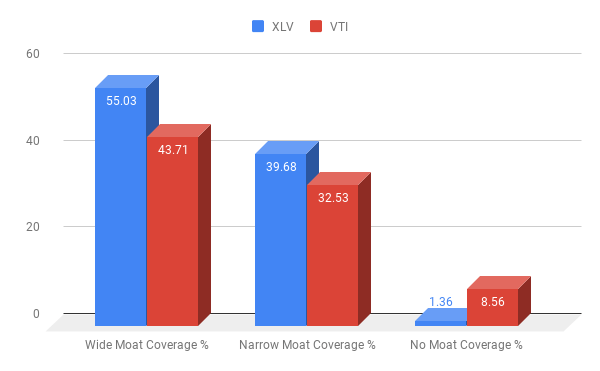
In order to quantify the different degrees of competitive advantages, we can take a look at "moats" or competitive strengths as categorized by Morningstar. The chart below compares Health Care Select Sect SPDR ETF versus the Vanguard Total Stock Market ETF (VTI) in terms of the competitive advantages, or moats, exhibited by the companies in the portfolios.
It's easy to see how XLV has a larger percentage of companies with wide and narrow moats, and also a smaller percentage of companies with no moats. The healthcare sector is fertile ground for solid competitive advantages and attractive profitability for companies that know how to play their cards well.
Data Source: Morningstar
In other words, big healthcare stocks are benefitting from powerful industry tailwinds, and they have what it takes in order to reap big rewards from those tailwinds over the years ahead.
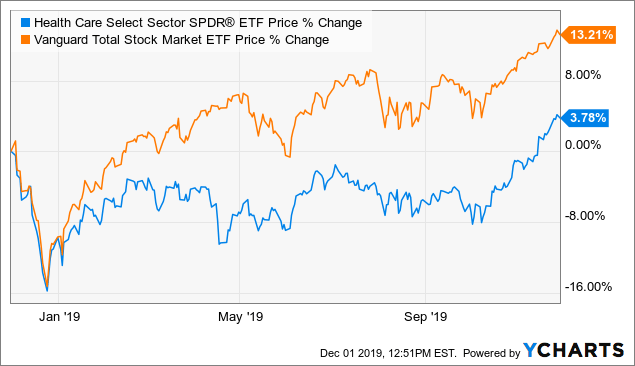
Over the past year, XLV has significantly lagged behind VTI, which is arguably due to the political risk affecting healthcare stocks to a good degree.
Data by YCharts
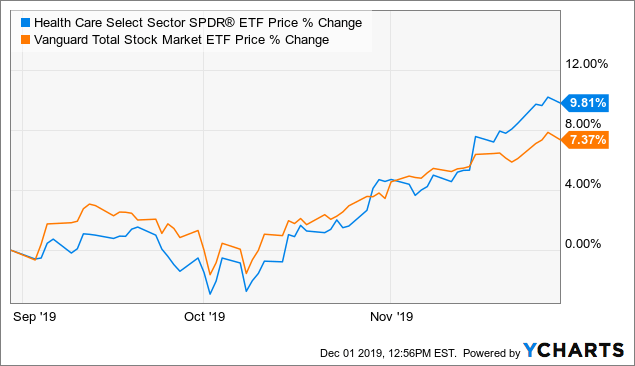
But the tables have turned recently, regulatory risk is coming down and XLV is starting to outperform in the past 3 months.
Data by YCharts
Relative strength has important implications over the middle term. Many big institutional investors pay close attention to the main inter-sector trends in the market. If you are looking to outperform the market while managing massive amounts of money, betting on the right sectors is of utmost importance.
If healthcare stocks continue doing well, this will probably reinforce the positive narrative around healthcare stocks due to the dissipating regulatory risk, creating a self-sustaining virtuous cycle for XLV.
Multi-Factor Perspective
When analyzing an ETF, we can get some valuable insights by looking not only at the ETF itself but also at the main stocks in the portfolio. At the end of the day, the ETF is as good or bad as the stocks that it owns.
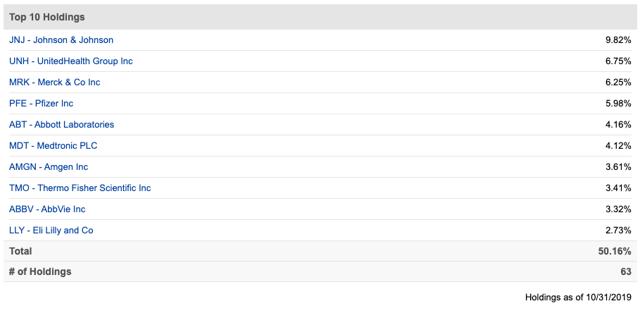
The top 10 positions in XLV account for more than 50% of the portfolio. These are Johnson & Johnson (JNJ), UnitedHealth Group Inc. (UNH), Merck (MRK), Pfizer (PFE), Abbott Laboratories (ABT), Medtronic (MDT), Amgen (AMGN), Thermo Fisher Scientific (TMO), AbbVie (ABBV), and Eli Lilly (LLY).
Source: Seeking Alpha Essential
In order to evaluate these companies from a quantitative multi-factor perspective, we can run them through the PowerFactors algorithm. This is a quantitative system that ranks stocks based on 4 factors: financial quality, value, fundamental momentum, and relative strength.
Here is a quick explanation of the factors considered in the algorithm:
- Financial quality includes profitability metrics such as return on assets, return on investment, return on equity, gross profit margin, operating profit margin, and free cash flow margin. The more profitable the business, the higher its ability to create profits for shareholders over the long term.
- Valuation covers typical valuation ratios such as price-to-earnings, price-to-earnings growth, price-to-free cash flow, and enterprise value-to-EBITDA. The cheaper the better, so stocks with lower valuation levels receive a higher ranking in the algorithm.
- Fundamental Momentum: This factor looks for companies that are performing better than expected and producing rising expectations, so it measures the change in earnings and sales estimates.
- Relative Strength: Winners tend to keep on winning when a stock is outperforming the market, as it tends to continue doing so more often than not over the middle term. Relative strength measures how the stock has performed in comparison to other names in the market.
The backtested performance numbers show that companies with high PowerFactors rankings tend to deliver superior returns in the long term. The higher the PowerFactors ranking, the higher the expected returns, indicating that the system is consistent and robust.
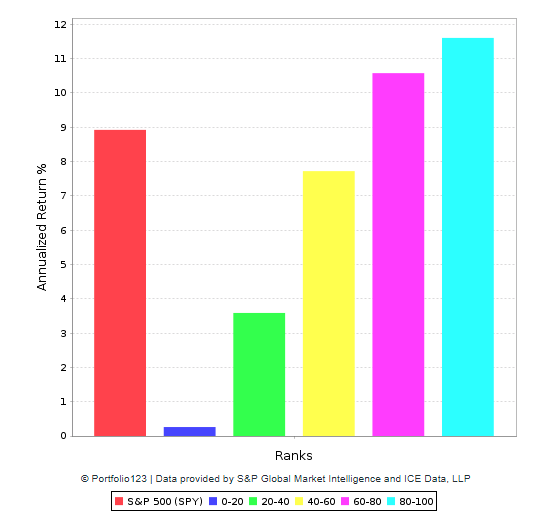
Data from S&P Global via Portfolio123
Looking at the top 10 positions in the XLV portfolio, all of these names have PowerFactors rankings above 90, meaning that the 10 stocks are in the best 10% of the U.S. market according to this ranking. The average ranking is an impressive 94.74 for the top 10 positions in XLV.
The table below shows the top 10 names, their overall PowerFactors ranking and their rankings for each of the specific factors: quality, value fundamental momentum, and relative strength.
| Ticker | Name | PowerFactors | Quality | Value | F.M. | R.S. |
| AMGN | Amgen Inc. | 99.7 | 98.72 | 99.11 | 92.09 | 85.23 |
| ABBV | AbbVie Inc. | 98.69 | 93.03 | 99.3 | 95.6 | 71.92 |
| MRK | Merck & Co. Inc. | 97.85 | 97.32 | 96.81 | 91.23 | 66.29 |
| MDT | Medtronic PLC | 96.8 | 85.49 | 93.83 | 86.77 | 77.74 |
| TMO | Thermo Fisher Scientific Inc. | 94.09 | 84.17 | 85.5 | 77.75 | 82.1 |
| LLY | Eli Lilly and Co. | 93.05 | 97.05 | 96.18 | 80.96 | 51.41 |
| ABT | Abbott Laboratories | 92.13 | 85.79 | 88.59 | 81.27 | 66.17 |
| PFE | Pfizer Inc. | 92.03 | 95.39 | 92.58 | 90.83 | 42.81 |
| JNJ | Johnson & Johnson | 91.55 | 95.72 | 96.13 | 75.48 | 52.27 |
| UNH | UnitedHealth Group Inc. | 91.51 | 87.85 | 86.88 | 73.67 | 70.99 |
| Average | 94.74 | 92.053 | 93.491 | 84.565 | 66.693 |
Risk And Reward Going Forward
The stock market hates uncertainty, and political risk is a very real uncertainty driver around XLV. But the main point to consider is that this factor is already well-known and incorporated into investor expectations. Smart investment decisions are made by looking forward as opposed to backward.
Healthcare reform is necessary and perhaps even unavoidable, but the probabilities for aggressive reform that could do a lot of damage to healthcare companies are clearly declining. After all, investors tend to overreact and exaggerate the risks in these kinds of situations.
Looking at the long-term fundamentals, XLV has a portfolio of companies with solid competitive strengths, favorable market dynamics, and attractive characteristics from a multi-factor perspective, so the big picture looks quite strong in the years ahead.
All things considered, short-term uncertainty seems to be creating a buying opportunity for long-term investors in Health Care Select Sector SPDR ETF.



Comments
Log in or sign up to join the conversation.