


The semiconductor industry supply chain is globalized, and all regions contribute their own strength
Since its development, the global semiconductor industry has become an industry of hundreds of billions of dollars, and the industry chain has achieved globalization. The global semiconductor industry is an industry that truly realizes the globalization of the supply chain at present, Countries or regions such as the United States, South Korea, Japan, China, Europe and other countries and regions play their respective industrial chain advantages to contribute to the global semiconductor industry. At present, no country or region in the world can achieve self-sufficiency in semiconductors.
According to the latest data released by the American Semiconductor Industry Association (SIA), the sales of semiconductor companies in the United States account for 47% of global semiconductor sales. Ranked second is South Korea, where the sales of South Korean semiconductor companies accounted for 19%. Both Japan and the EU semiconductor companies accounted for 10% of their sales, tied for third place. The sales of semiconductor companies in Taiwan and Mainland China accounted for 6% and 5% respectively.
According to the report "Strengthening the Global Semiconductor Industry Chain in the Era of Uncertainty (2021.04)" jointly issued by BCG(Boston Consulting Group) and SIA (Semiconductor Industry Association), If the statistics are based on the location of equipment manufacturing/assembly, the sales of semiconductor companies in mainland China accounted for as high as 35% in 2019; The United States ranked second with 19% of sales.
Specifically, the United States has contributed important forces in the forefront of the semiconductor industry chain, EDA/IP (Electronic design automation/Internet Protocol) chip design and other fields; Japan has provided core technologies in important links such as global semiconductor manufacturing equipment and semiconductor materials; South Korea has contributed to the field of chip design-storage, Semiconductor materials have played a key role; China has played an important role in wafer manufacturing.
In the added value of the industry chain, these six countries/regions contributed 9% or more of the value of the global semiconductor industry's total added value. Among them, the United States contributed 74% of added value in EDA/IP; contributed 67% of added value in chip design-logic; contributed 29% of added value in chip design-storage; contributed 41% of added value in semiconductor manufacturing equipment.
Mainland China accounts for as much as 38% of the added value of global wafer manufacturing, end-packaging and testing. China Taiwan accounts for 22%, 20%, and 27% of global semiconductor materials, wafer manufacturing,front-wafer manufacturing and end-wafer manufacturing, end packaging, and test added value respectively.
South Korea has contributed more than half of the added value in global semiconductor chip design-storage. Japan's global chip design-DAO(Data Access Object), semiconductor manufacturing equipment, and semiconductor materials accounted for 24%, 32% and 19% of the added value, respectively. Europe's global chip design-DAO, semiconductor manufacturing equipment and semiconductor materials accounted for 19%, 18% and 12% of the added value respectively.
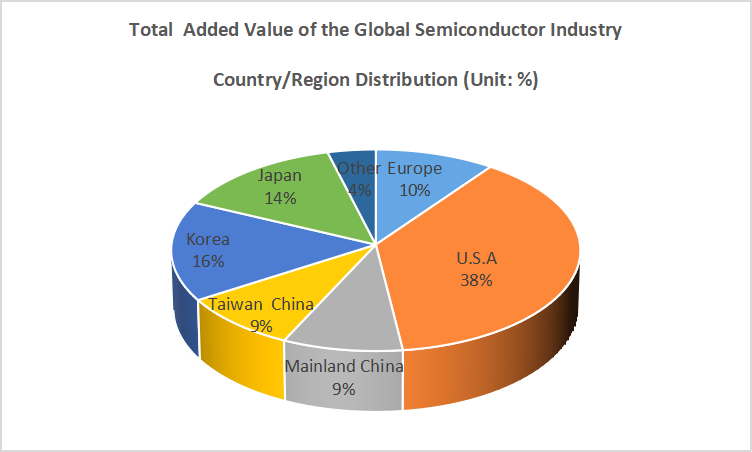
No country/region can be self-sufficient in the entire industry chain
High cost of self-sufficiency
The globalization trend of the semiconductor industry is irreversible. Each country or region is dependent on each other in the semiconductor industry, no country or region in the world can achieve self-sufficiency in semiconductors at present.
According to the latest report "Strengthening the Global Semiconductor Industry Chain in the Era of Uncertainty (2021.04)" jointly released by BCG and SIA, assuming that each region of the world builds a fully self-sufficient local semiconductor industry chain and supply chain, the world needs to spend at least $900 billion to $1.225 trillion in incremental upfront investment, the new costs will be $45 billion-125 billion a year, and will lead to an overall increase of 35% to 65% in global semiconductor prices. According to the price transmission mechanism, the increase in semiconductor cost will be transmitted to the manufacturing cost of electronic equipment, and consumers will eventually pay for it.
Although the United States, as the world’s strongest comprehensive semiconductor industry needs to be self-sufficient, it also needs to spend $350-420Bn in upfront investment, with an additional annual cost of $5-15Bn; and as a major global wafer manufacturing country ,If China wants to achieve self-sufficiency in the semiconductor industry, the mainland China alone needs to spend $175-250Bn in initial investment, and spend $10-30 Bn in capital costs each year.
Long conversion cycle of self-sufficient semiconductor technology
In addition to wasting about US$1 trillion in capital, it takes a very long time for a country or region to rely solely on its own strength from semiconductor product technology research, manufacturing to product completion.
It takes at least 10-15 years for a general new semiconductor technology method to go from publishing a paper to large-scale commercial manufacturing at present, The Extreme Ultraviolet (EUV), which is the basis of the world's most advanced semiconductor manufacturing node, has taken nearly 40 years from the early concept demonstration to the commercialization that is now realized, In addition, EUV produces the required EUV photoresist equipment, of which 100,000 parts are from more than 5,000 suppliers around the world.
At the same time, the birth of these semiconductor technologies and products is also the result of mutual communication and cooperation between countries and regions. For example, 60% of the semiconductor-related scientific papers published by American institutions are written in cooperation with institutions in other countries. Of the semiconductor-related scientific papers published by Chinese institutions, 36% were co-authored with institutions in other countries.
It can be seen that the average time it takes to move from product concept to commercialization in a country or region alone will far exceed the current average time. It is far from impossible for a single country or region to achieve self-sufficiency in the semiconductor industry.


Comments
Log in or sign up to join the conversation.