

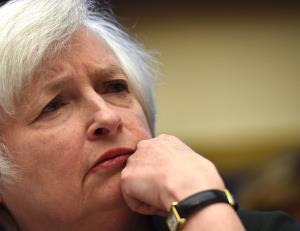
The Federal Reserve decided to keep interest rates unchanged as expected. The Fed also projected two quarter point rate hikes -- fewer than what had previously been envisioned. Fed Chairwoman Janet Yellen has cited the Fed's data dependency -- usually concerning inflation and unemployment figures. On Wednesday she introduced nine words that could prompt the Fed to keep rates steady for some time:
Global economic and financial developments continue to pose risks.
I assumed Yellen would reference the global economy some time during the meeting. However, making it another key data point in deciding whether to hike rates sounds to me like a sea change.
The Global Economy Is Showing Cracks
The global economy is starting to crack. China's February exports fell 25% Y/Y while imports were off nearly 14%; it was the worst monthly collapse in Chinese exports since 2009. The world's second-largest economy, China also represents 10% of global exports and 8% of imports. The IMF is so concerned that it is expected to cut its forecast for 2016 global growth from the 3.4% it currently estimates.
China's pullback was one of the catalysts that caused 2015 world trade to fall by nearly 14% Y/Y -- the first contraction since 2009. The Baltic Dry Index, which measures global trade in bulk commodities, is at historic lows; some swear by the index as predictor of global recession. The IMF believes immediate action must be taken to boost demand. While Japanese and European central bankers have been willing to cut rates further, Yellen's acknowledgement that global growth factors into the Fed's interest rate policy could be viewed as "immediate action."
It Could Get Worse
According to McKinsey the flow of goods, services, and finance as a percentage of GDP fell from 53% in 2009 to 39% in 2014. And it could worsen.
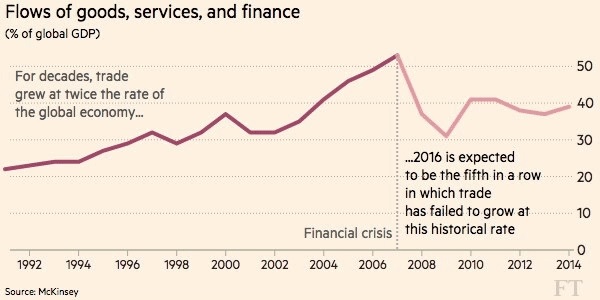
A slowing China has taken a toll on global trade. However, growing automation has also hurt; this implies that the decline in demand for cargo ships, and reduction in trading activity at global shipping ports could be structural:
The flow of digital information around the world more than doubled between 2013 and 2015 alone, to an estimated 290 terabytes per second, McKinsey says. That figure will grow by a third again this year, meaning that by the end of 2016 companies and individuals around the world will send 20 times more data across borders than they did in 2008 ...
It is already in evidence at major companies like General Electric (GE), which is using 3D printers to make fuel nozzles for jet engines and expects its aviation unit to be manufacturing 100,000 parts using the technology by 2020. Such innovations bring closer the day when companies make much greater use of the capacity to receive equipment not by container ship, but by a digital set of orders destined for a 3D printer.
Despite the efficiency gains from automation, the global economy is still in the doldrums. This is in spite of the trillions in "so-called" economic stimulus packages from central bankers.
Where From Here?
If global economic growth is another data point for the Fed then I expect Yellen to keep rates low for a long time. Global trade since Financial Crisis of 2008 may have been fueled by central bankers, but it was also financed with debt. Many producers of steel, iron ore, oil, coal are in hoc to banks. The pull back in China -- the world's biggest buyer of commodities -- and falling commodities prices make it difficult for producers to service their debt. In turn, rising defaults could hurt bank earnings and make it difficult for them to honor counter-party obligations; I expect a subsequent decrease in bank lending to reverberate throughout the global economy.
The circular reference is that the debt-fueled commodities boom created by the Fed, may be a rationale not for not removing the punch bowl. More low rates could create more speculation and delay the inevitable -- a bursting of bubbles in equities, real estate and other asset classes.
The Fed said, "Global economic and financial developments continue to pose risks." What I heard was, "The Fed is boxed in and will remain so for a while."



Comments
Log in or sign up to join the conversation.